Home
Class 12
PHYSICS
A narrow beam of white light goes throug...

A narrow beam of white light goes through a slab having parallel faces.

A

The light never splits in different colours

B

The emergent beam is white

C

The light inside the slab is split into different colours

D

The light inside the slab is white

Text Solution

Verified by Experts

The correct Answer is:
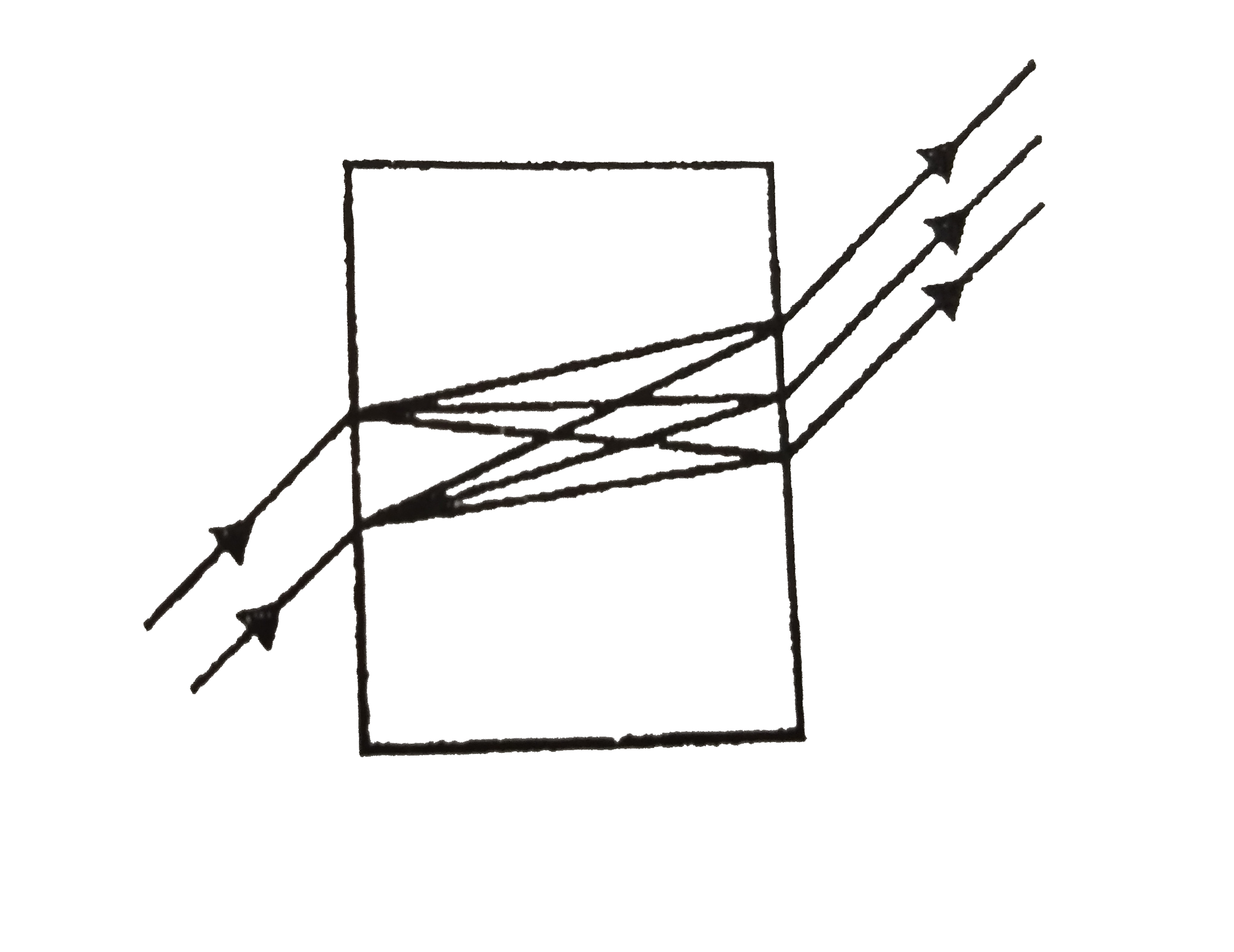
b,c

The light splits in different colours inside the slab due to dispersion.
But the emergent rays will be paeallel and will overlap with others hence giving white emergent beam. Inside the slab rays of different colours are not parallel and they intersect each other.
Promotional Banner

Topper's Solved these Questions

  • GEOMATRICAL OPTICS

    RESONANCE ENGLISH|Exercise Exercise-3|80 Videos
  • GEOMATRICAL OPTICS

    RESONANCE ENGLISH|Exercise Advance level Problems|35 Videos
  • GEOMATRICAL OPTICS

    RESONANCE ENGLISH|Exercise Exercise-1|141 Videos
  • EXPERIMENTAL PHYSICS

    RESONANCE ENGLISH|Exercise PART -II|10 Videos
  • GRAVITATION

    RESONANCE ENGLISH|Exercise HIGH LEVEL PROBLEMS|16 Videos

Similar Questions

Explore conceptually related problems

A narrow beam of light passes through a slab obliquely and is then received by an eye. The index of refraction of the material in the slab fluctuates slowly with time. How will it appear to the eye? The twinkling of stars has a similar explanation.

The diagram shown below in Fig. 6.8 shows the path taken by a narrow beam of yellow monochromatic light passing through an equiangular glass prism. If the yellow light is replaced by a narrow beam of white light incident at the same angle, draw another diagram to show the passage of white light through the prism and label it to show the effect of the prism on the white light.

Draw a ray diagram showing the dispersion through a prism when a narrow beam of white light is incident on one of its refracting surface. Also indicate the order of the colours of the spectrum obtained.

A narrow and parallel beam of white light is incident on a convex lens, parallel to its principal axis. Draw a labelled diagram to show how coloured images are formed by the lens.

A beam of white lighe passing through a hollow prism gives no spectrum.

What is the cause of dispersion of white light through a glass prism Draw a ray diagram to show the path of light when two identical glass prisms are arranged together in inverted position with respect to each other and narrow beam of white light is allowed to fall obliquely on one of the faces of the prisms.

How will you use two indentical prisms so that a narrow beam of white light incident on one prism emerges out of the second prism as white light ? Draw the diagram.

How will you use two identical glass prisms so that a narrow beam of white light incident on one prism emerges out of the second prism as white light? draw and label the ray diagram

A beam of unpolarised light passes through a tourmaline crystal A and then it passes through a second tourmaline crystal B oriented so that its principal plane is parallel to that of A. The intensity of emergent light is I_(0) . Now B is rotated by 45^(@) about the ray. The emergent light will have intensity

When a beam of white light is passed through sodium vapours and then through a spectrometer, spectrum so obtained has two dark lines present in the yellow region. This spectrum is called :

RESONANCE ENGLISH-GEOMATRICAL OPTICS -Exercise-2
  1. An object O is kept infront of a converging lens of focal length 30 cm...

    Text Solution

    |

  2. If a symmetrical bi-concave thin lens is cut into two identical halves...

    Text Solution

    |

  3. A narrow beam of white light goes through a slab having parallel faces...

    Text Solution

    |

  4. By properly combining two prisms made of different materials, it is po...

    Text Solution

    |

  5. A plane mirror M is arranged parallel to a wall W at a distance l from...

    Text Solution

    |

  6. A man washign to get a picture of a Zebra photographed a white donkey ...

    Text Solution

    |

  7. An equiconvex lens of refractive index n(2) is placed such that the re...

    Text Solution

    |

  8. In the figure shown , a point object O is placed in air on the princip...

    Text Solution

    |

  9. An object is kept on the principal axis of a convex mirror of focal le...

    Text Solution

    |

  10. A real object is placed infront of a convex mirror (focal length f). I...

    Text Solution

    |

  11. A small air bubble is trapped inside a transparent cube of size 12 cm....

    Text Solution

    |

  12. A parallel beam of light is incident normally on the flat surface of a...

    Text Solution

    |

  13. The image of a white object in with light formed by a lens is usually ...

    Text Solution

    |

  14. The image of a white object in with light formed by a lens is usually ...

    Text Solution

    |

  15. The image of a white object in with light formed by a lens is usually ...

    Text Solution

    |

  16. The image of a white object in with light formed by a lens is usually ...

    Text Solution

    |

  17. The ciliary muscles of eye control the curvature of the lens in the ey...

    Text Solution

    |

  18. The ciliary muscles of eye control the curvature of the lens in the ey...

    Text Solution

    |

  19. The ciliary muscles of eye control the curvature of the lens in the ey...

    Text Solution

    |

  20. The ciliary muscles of eye control the curvature of the lens in the ey...

    Text Solution

    |

