Home
Class 12
PHYSICS
The image of a white object in with ligh...

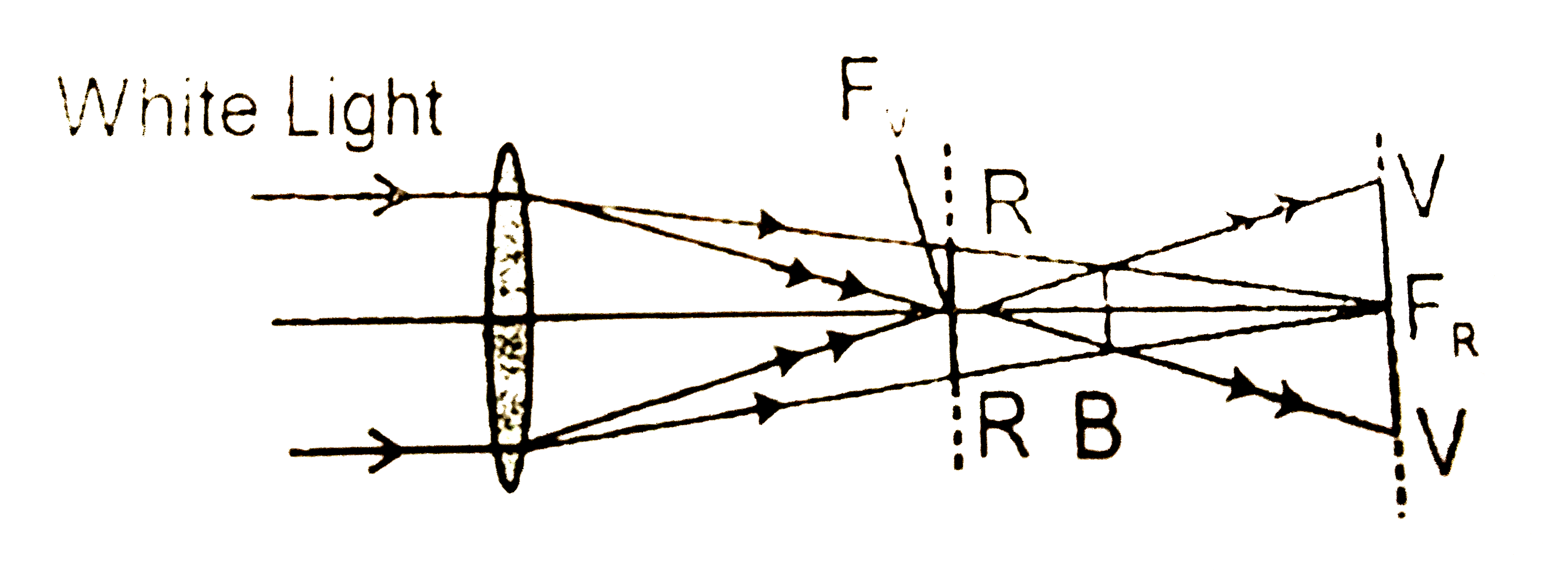
The image of a white object in with light formed by a lens is usually colored and blurred. This defect of image is called chromatic aberration and arises due to the fact that focal length of a lens is different for different colours. As `R` .`I`. `mu` of lens is maximum for violet while minimum for red, violet is focused nearest to the lens while red farthest from it as shown in figure.
As a result of this, in case of convergent lens if a screen is placed at `F_(v)` center of the image will be violet and focused while sides are red and blurred. While at `F_(R)` , reverse is the case, `i.e` ., center will be red and focused while sides violet and blurred. The differece between `f_(v)` and `f_(R)` is a measure of the longitudinal chromatic aberration `(L.C.A),i.e.,`
`L.C.A.=f_(R)-f_(v)=-df` with `df=f_(v)-f_(R)` ...........`(1)`
However, as for a single lens,
`(1)/(f)=(mu-1)[(1)/(R_(1))-(1)/(R_(2))]` .............`(2)`
`rArr -(df)/(f^(2))=dmu[(1)/(R_(1))-(1)/(R_(2))]` ...............`(3)`

Dividing E1n. `(3)` by `(2)` :
`-(df)/(f)=(dmu)/((mu-1))=omega, [omega=(dmu)/((mu-1))] "dispersive power" , .........(4)`
And hence, from Eqns. `(1)` and `(4)` ,
`L.C.A.=-df=omegaf`
Now, as for a single lens neither `f` nor `omega` zero, we cannot have a single lens free from chromatic aberration.
Condition of Achromatism :
In case of two thin lenses in contact
`(1)/(F)=(1)/(F_(1))+(1)/(F_(2)) i.c,. -(dF)/(F^(2))=(df_(1))/(f_(1)^(2))-(df_(2))/(f_(2)^(2))`
The combination will be free from chromatic aberration if `dF=0`
`i.e., (df_(1))/(f_(1)^(2))+(df_(2))/(f_(2)^(2))=0` which with the help of Eqn. `(4)` reduces to
`(omega_(1)f_(1))/(f_(1)^(2))+(omega_(2)f_(2))/(f_(2)^(2))=0 , i.e., (omega_(1))/(f_(1))+(omega_(2))/(f_(2))=0 ........(5)`
This condition is called condition of achromatism (for two thin lenses in contact ) and the lens combination which satisfies this condition is called achromatic lems, from this condition, `i.e.,` form Eqn. `(5)` it is clear the in case of achromatic doublet :
Since, if `omega_(1)=omega_(2), (1)/(f_(1))+(1)/(f_(2))=0 i.e., (1)/(F)=0` or `F=infty`
`i.e.,` combination will not behave as a lens, but as a plane glass plate.
`(2)` As `omega_(1)` and `omega_(2)` are positive quantities, for equation `(5)` to hold, `f_(1)` and `f_(2)` must be of opposite nature, `i.e.,` if one of the lenses is converging the other must be diverging.
`(3)` If the achromatic combination is convergent,
`f_(C)ltf_(D)` and as `(f_(C))/(f_(d))=(omega_(C))/(omega_(D)), omega_(C)ltomega_(d)`
`i.e.,` in a convergent achromatic doublet, convex lens has lesses focal legth and dispersive power than the divergent one.
A combination is made of two lenses of focal lengths `f` and `f'` in contact , the dispersive powers of the materials of the lenses are `omega` and `omega'` . The combination is achromatic when :

A

`omega=omega_(0), omega' =2omega_(0), f'=2f`

B

`omega=omega_(0), omega' =2omega_(0), f'=f//2`

C

`omega=omega_(0), omega' =2omega_(0), f'=-f//2`

D

`omega=omega_(0)`, `omega' =2omega_(0), f'=-2f`

Text Solution

Verified by Experts

The correct Answer is:

D

Form points `(2)` and `(3)` of passage :
`f` and `f'` must be of opposite sing.
Also `omega_(C)ltomega_(D)` and `f_(C)ltf_(D)`.
Promotional Banner

Topper's Solved these Questions

  • GEOMATRICAL OPTICS

    RESONANCE ENGLISH|Exercise Exercise-3|80 Videos
  • GEOMATRICAL OPTICS

    RESONANCE ENGLISH|Exercise Advance level Problems|35 Videos
  • GEOMATRICAL OPTICS

    RESONANCE ENGLISH|Exercise Exercise-1|141 Videos
  • EXPERIMENTAL PHYSICS

    RESONANCE ENGLISH|Exercise PART -II|10 Videos
  • GRAVITATION

    RESONANCE ENGLISH|Exercise HIGH LEVEL PROBLEMS|16 Videos
RESONANCE ENGLISH-GEOMATRICAL OPTICS -Exercise-2
  1. A narrow beam of white light goes through a slab having parallel faces...

    Text Solution

    |

  2. By properly combining two prisms made of different materials, it is po...

    Text Solution

    |

  3. A plane mirror M is arranged parallel to a wall W at a distance l from...

    Text Solution

    |

  4. A man washign to get a picture of a Zebra photographed a white donkey ...

    Text Solution

    |

  5. An equiconvex lens of refractive index n(2) is placed such that the re...

    Text Solution

    |

  6. In the figure shown , a point object O is placed in air on the princip...

    Text Solution

    |

  7. An object is kept on the principal axis of a convex mirror of focal le...

    Text Solution

    |

  8. A real object is placed infront of a convex mirror (focal length f). I...

    Text Solution

    |

  9. A small air bubble is trapped inside a transparent cube of size 12 cm....

    Text Solution

    |

  10. A parallel beam of light is incident normally on the flat surface of a...

    Text Solution

    |

  11. The image of a white object in with light formed by a lens is usually ...

    Text Solution

    |

  12. The image of a white object in with light formed by a lens is usually ...

    Text Solution

    |

  13. The image of a white object in with light formed by a lens is usually ...

    Text Solution

    |

  14. The image of a white object in with light formed by a lens is usually ...

    Text Solution

    |

  15. The ciliary muscles of eye control the curvature of the lens in the ey...

    Text Solution

    |

  16. The ciliary muscles of eye control the curvature of the lens in the ey...

    Text Solution

    |

  17. The ciliary muscles of eye control the curvature of the lens in the ey...

    Text Solution

    |

  18. The ciliary muscles of eye control the curvature of the lens in the ey...

    Text Solution

    |

  19. Figure shows a solid transport semi cylinder of radius 10 cm. A screen...

    Text Solution

    |

  20. Figure shows a solid transport semi cylinder of radius 10 cm. A screen...

    Text Solution

    |
