Home
Class 12
PHYSICS
A right-angle crown glass prism with cri...

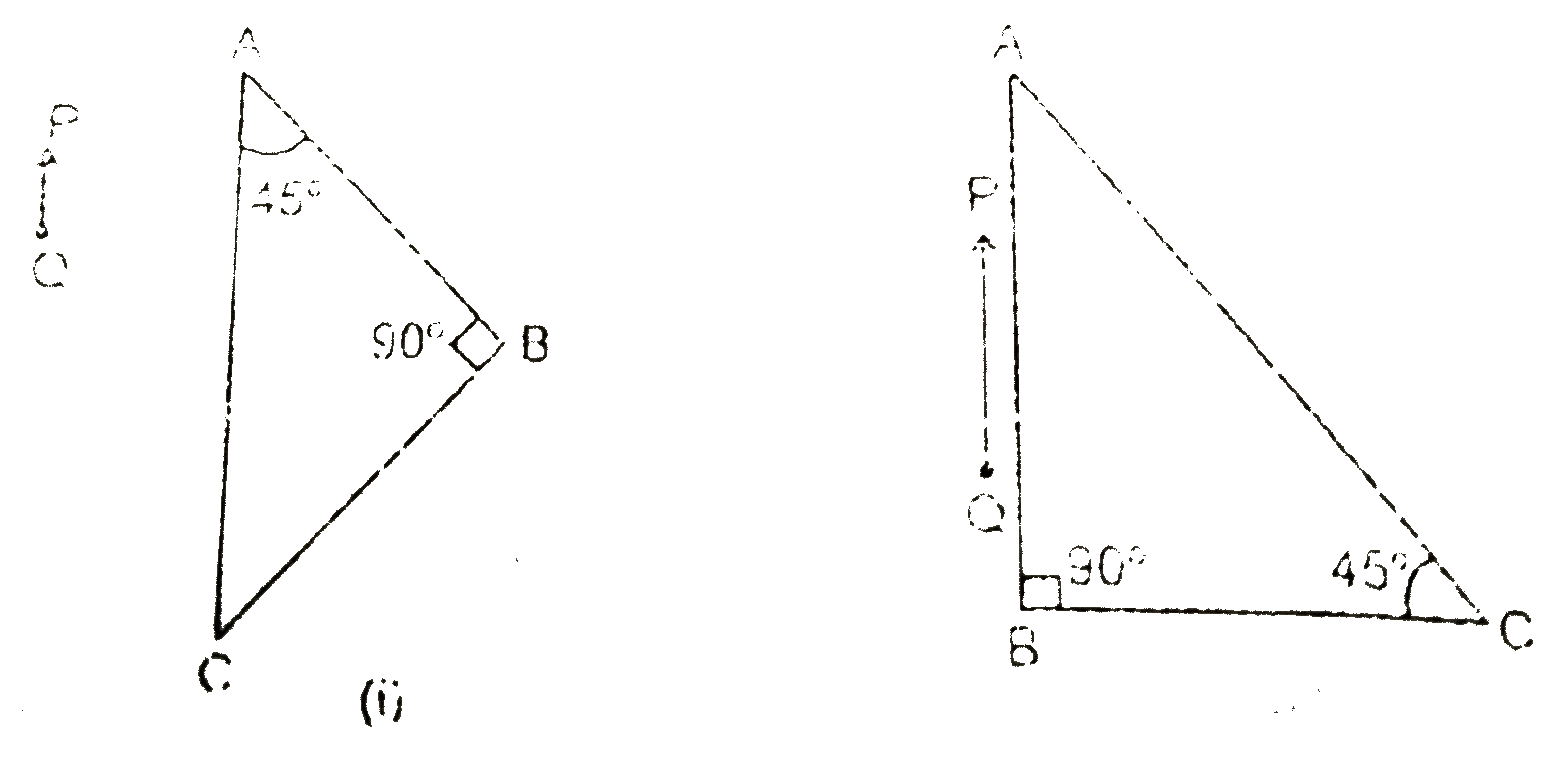
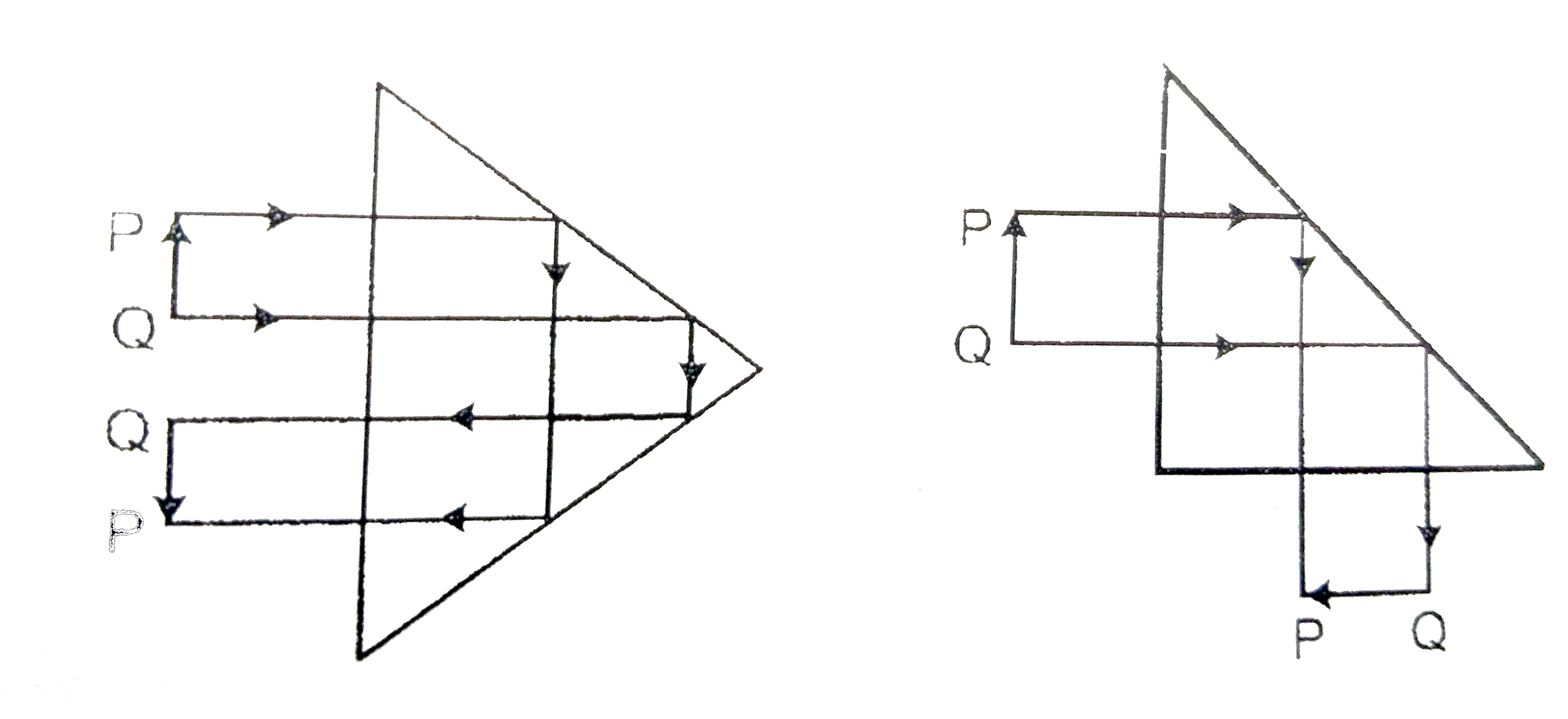
A right-angle crown glass prism with critical angle `41^(@)` is placed berore an object, `PQ`, in two position as shown in the figure `(i)` and `(ii)`. Trace the paths of the rays from `P` and `Q` passing through the prism in the two cases.

Text Solution

Verified by Experts
Promotional Banner

Topper's Solved these Questions

  • GEOMATRICAL OPTICS

    RESONANCE ENGLISH|Exercise Advance level Problems|35 Videos
  • GEOMATRICAL OPTICS

    RESONANCE ENGLISH|Exercise Exercise-2|62 Videos
  • EXPERIMENTAL PHYSICS

    RESONANCE ENGLISH|Exercise PART -II|10 Videos
  • GRAVITATION

    RESONANCE ENGLISH|Exercise HIGH LEVEL PROBLEMS|16 Videos

Similar Questions

Explore conceptually related problems

A ray is incident on interface of two media at critical angle as shown in the figure.

Consider a light beam incident from air to a glass slab at Brewster's angle as shown in figure. A polaroid is placed in the path of the emergent ray at point P and rotated about an axis passing through the centre and pependicular to the plane of the polaroid.

Consider a light beam incident from air to a glass slab at Brewster's angle as shown in figure. A polaroid is placed in the path of the emergent ray at point P and rotated about an axis passing through the centre and pependicular to the plane of the plaroid.

Consider a light beam incident from air to a glass slab at Brewster's angle as shown in figure. A polaroid is placed in the path of the emergent ray at point P and rotated about an axis passing through the centre and pependicular to the plane of the plaroid.

A right-angled prism of apex angle 4^(@) and refractive index 1.5 is located in front of a vertical plane mirror as shown in figure. A horizontal ray of light is falling on the prism. Find the total deviation produced in the light ray as it emerges 2nd time from the prism.

Three glass prisms A , B and C of same refractive index are placed in contact with each other as shown in figure, with no air gap between the prisms. Monochromatic ray of light OP passes through the prism assembly and emerges as QR . The conditions of minimum deviation is satisfied in the prisms

A crown glass prism of angle 5^(@) is to be combined with a flint prism in such a way that the mean ray passes undeviated. Find (a) the angle of the flint glass prism needed and (b) the angular dispersion produced by the combinatino when white light goes through it. Refractive indices for red, yellow, and violet light are 1.541, 1.517 and 1.523, repectively, for crown flass and 1.613, 1.620 and 1.632 for flint glass.

Two monochromatic ray of light are incident normally on the face AB of an isosceles right - angled 'I' and '2' are respectively 1.35 and 1.45. Trace path of these rays after entering through the prism.

We have to combine a crown glass prism of angle 4^(@) with a flint glass prism in such a way that the mean ray passes undeviated, find (i) the angle of the flint glass prism needed and (i) the angular dispersion produced by the combination when white light goes through it. Refractive indices for red, yellow and violet light are 1.514, 1.517 and 1.523 respectively for crown glass and 1.613, 1.620 and 1.632 for flint glass.

A ray of light incident normally on an isosceles right angled prism travels as shown in the figure. The least value of the refractive index of the prism must be

RESONANCE ENGLISH-GEOMATRICAL OPTICS -Exercise-3
  1. A green light is incident from the water to the air – water interface ...

    Text Solution

    |

  2. Monochromatic light is incident on a glass prism of angle A. If the re...

    Text Solution

    |

  3. A right-angle crown glass prism with critical angle 41^(@) is placed b...

    Text Solution

    |

  4. A ray of light falls on a mirror normally. What are the values of angl...

    Text Solution

    |

  5. What is far-sightedness or hypermatropia? What cause hypermetropia How...

    Text Solution

    |

  6. A double convex lens made of glass of refractive index 1.56 has both r...

    Text Solution

    |

  7. A convex mirror always produces a virtual image of real object indepen...

    Text Solution

    |

  8. A converging lens of refractive index 1.5 is kept in a liquid medium h...

    Text Solution

    |

  9. What is the main reason for axial charomatic aberration in the formati...

    Text Solution

    |

  10. An equiconvex lens, with redii of curvature of magnitude 10 cm each, i...

    Text Solution

    |

  11. Why is the ratio of the velocities of light of wavelengths 4000 Å and ...

    Text Solution

    |

  12. (a) For a ray of light travelling from a denser medium of refractive ...

    Text Solution

    |

  13. Derive the lens formula, (1)/(f)=(1)/(v)-(1)/(u) for a concave lens, u...

    Text Solution

    |

  14. A ray of light passing through an equilateral traingular glass prism f...

    Text Solution

    |

  15. (a) Draw a ray diagram showing the passage of light through a glass pr...

    Text Solution

    |

  16. A glass lens of refractive index 1.5 is placed in a trough of liquid....

    Text Solution

    |

  17. (a) Draw the ray diagram for the formation of image of an object by a ...

    Text Solution

    |

  18. Why are convex mirrors used as side view mirrors in cars ?

    Text Solution

    |

  19. Three light rays red (R), green (G) and blue (B) are incident on a rig...

    Text Solution

    |

  20. The far point of a myopic person is 80 cm in front of the eye. What is...

    Text Solution

    |

