Home
Class 12
PHYSICS
(a) (i) Draw a labelled ray diagram to s...

(a) (i) Draw a labelled ray diagram to show the formation of image in an astronomical telescope for a distant object.
(ii) Write three distinct advantages of a reflecting type telescope over a refracting type telescope.
(b) A convex lens of focal length 10 cm is placed coaxially 5 cm away from a concave lens of focal length 10 cm. If an object is placed 30 cm in front of the convex lens, find the position of the image formed by the combined system.

Text Solution

Verified by Experts
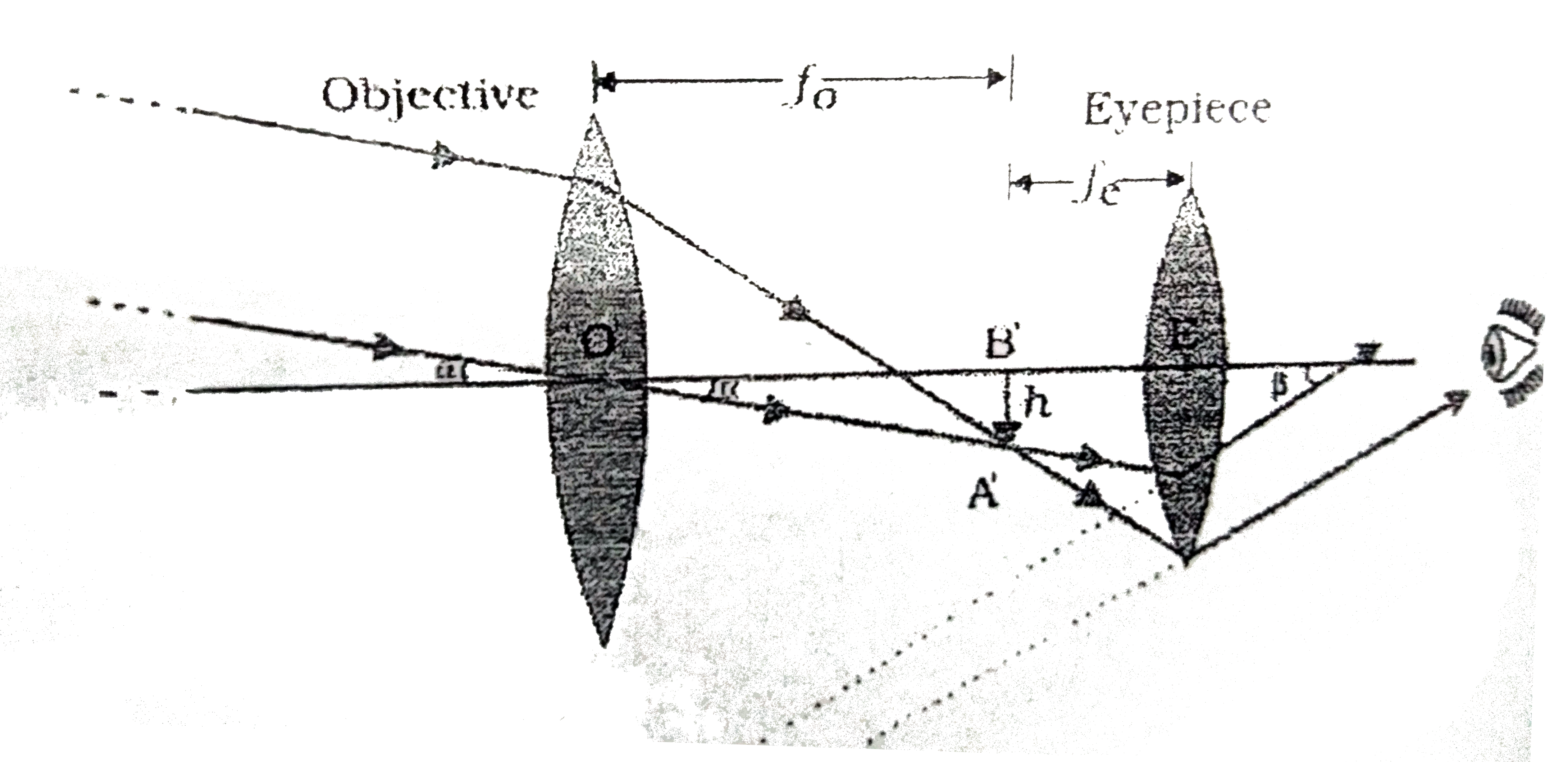
(a)
(ii) First, there is no chromatic aberration in a mirror. Second, if a parabolic reflecting suface is chosen, spherical aberration in also removed. Mechanical support is much less of a problem since a mirror weighs much less than a lens of equivalent optical quality, and can be supported over its entire back surface, not just over its rim.
(b) `f_(1)=10 cm, d=5 cm, f_(2)=-10 cm`
`u=-30 cm, v=?`
Combined focal length `f` is
`(1)/(f)=I(1)/(f_(1))+(1)/(f_(2))-(d)/(f_(1)f_(2)), (1)/(f)=(1)/(10)+(1)/(-10)-(5)/((10)(-10))`
`(1)/(f)=(1)/(10)-(1)/(10)+(5)/(100) rArr f=(100)/(5)=20 cm`
`(1)/(f)=(1)/(v)-(1)/(u), (1)/(20)=(1)/(v)-(1)/(-30)rArr(1)/(20)=(1)/(v)+(1)/(30)`
`(1)/(20)-(1)/(30)=(1)/(v)rArr(3-2)/(60)=(1)/(v)`
`therefore v=60 cm`
`therefore` Image will be formed at a distance of `30 cm` from the combination of lenses.
Promotional Banner

Topper's Solved these Questions

  • GEOMATRICAL OPTICS

    RESONANCE ENGLISH|Exercise Advance level Problems|35 Videos
  • GEOMATRICAL OPTICS

    RESONANCE ENGLISH|Exercise Exercise-2|62 Videos
  • EXPERIMENTAL PHYSICS

    RESONANCE ENGLISH|Exercise PART -II|10 Videos
  • GRAVITATION

    RESONANCE ENGLISH|Exercise HIGH LEVEL PROBLEMS|16 Videos

Similar Questions

Explore conceptually related problems

A convex lens of focal length 20cm is placed 10cm away from a second convex lens of focal length 25 cm. What wil be the location of the image of an object at 30 cm in front of the first lens?

A convex lens of focal length 20cm is placed coaxilly with a convex mirror of radius of curvature 20 cm. The two are kept 15 cm apart. A point object is placed 40 cm in front of the convex lens. Find the position of the image formed by this combination. Draw the ray diagram showing the image formation.

A convex lens of focal length 30 cm is placed coaxially in contact with a concave lens of focal length 40 cm. Determine the power of the combination. Will the system be converging or diverging in nature?

Two thin lenses, both of 10 cm focal length- one convex and other concave, are placed 5 cm apart. An object is placed 20 cm in front of the convex lens. Find the nature and position of the final image.

A convex lens of focal length 20 cm and a concave lens of focal length 10 cm are placed 20 cm apart. In between them an object placed at distance x from the convex lens. What is the value of x (in cm ) so that images from by both the lenses coincides ?

A convex lens of focal length 20cm is placed 10cm in front of a convex mirror or radius of curvature 15cm. Where should a point object be placed in front of the lens so that it images on to itself?

A convex lens of focal length 15 cm is placed on a plane mirror. An object is placed at 30 cm from the lens. The image is

An object is placed at a distance of 12 cm from a convex lens of focal length 8 cm. Find : nature of the image

A convex lens of focal length 30 cm forms an image of height 2 cm for an object situated at infinity. If a concave lens of focal length 20 cm is placed coaxially at a distance of 26 cm from convex lens then size of image would be

An object is placed at a distance 24 cm in front of a convex lens of focal length 8 cm. Calculate the distance of the image from the lens.

RESONANCE ENGLISH-GEOMATRICAL OPTICS -Exercise-3
  1. Three light rays red (R), green (G) and blue (B) are incident on a rig...

    Text Solution

    |

  2. The far point of a myopic person is 80 cm in front of the eye. What is...

    Text Solution

    |

  3. (a) (i) Draw a labelled ray diagram to show the formation of image in ...

    Text Solution

    |

  4. (a) Draw the ray diagram showing the geometry of formation of the imag...

    Text Solution

    |

  5. The image obtained with a convex lens is erect and its length is 4 tim...

    Text Solution

    |

  6. A converging lens is kept coaxially in contact with a diverging lens -...

    Text Solution

    |

  7. Draw a ray diagram to show the working of a compound microscope. Deduc...

    Text Solution

    |

  8. An astronomical telescope has an objective of focal length 20 cm and a...

    Text Solution

    |

  9. A convex lens made up of glass of refractive index 1.5 is dipped, in t...

    Text Solution

    |

  10. Use the mirror equation to deduct that : (a) an object between f and...

    Text Solution

    |

  11. A gaint refracting telescope at an observatory has an objective lens o...

    Text Solution

    |

  12. A beam of light converges at a point P. Now a lens is placed in the pa...

    Text Solution

    |

  13. For the same value of angle of incidence, the angles of refraction in ...

    Text Solution

    |

  14. Define magnifying power of a telescope. Write its expression. A smal...

    Text Solution

    |

  15. An object AB is kept in front of a concave mirror as shown in the figu...

    Text Solution

    |

  16. You are given three lenses L(1),L(2) and L(3) each of focal length 20 ...

    Text Solution

    |

  17. Describe a reflecting type telescope. What are its advantage over the ...

    Text Solution

    |

  18. Which type of lens is used to correct astigmatisum ?

    Text Solution

    |

  19. A biconcave lens made of a transparent material of refractive index 1...

    Text Solution

    |

  20. Two monochromatic ray of light are incident normally on the face AB of...

    Text Solution

    |

