Home
Class 12
PHYSICS
You are given three lenses L(1),L(2) and...

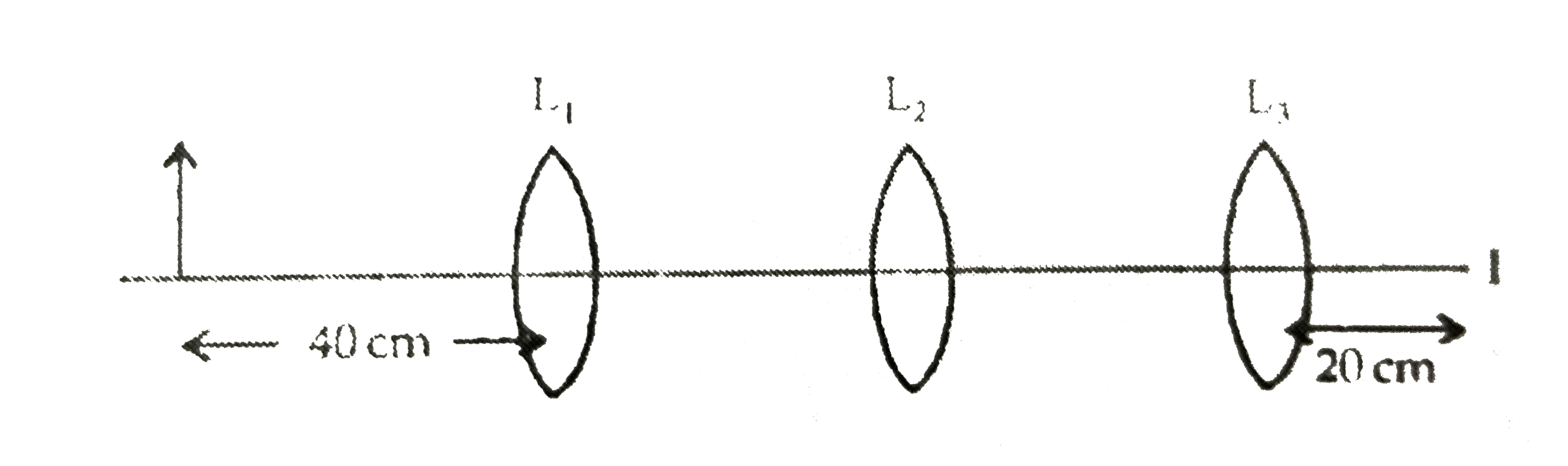
You are given three lenses `L_(1),L_(2) and L_(3)` each of focal length 20 cm. An object is kept at 40 cm in front of `L_(1),` as shown. The final real image is formed at the focus 'I' of `L_(3).` Find the separations between `L_(1),L_(2) and L_(3).`

Text Solution

Verified by Experts

N//a
Promotional Banner

Topper's Solved these Questions

  • GEOMATRICAL OPTICS

    RESONANCE ENGLISH|Exercise Advance level Problems|35 Videos
  • GEOMATRICAL OPTICS

    RESONANCE ENGLISH|Exercise Exercise-2|62 Videos
  • EXPERIMENTAL PHYSICS

    RESONANCE ENGLISH|Exercise PART -II|10 Videos
  • GRAVITATION

    RESONANCE ENGLISH|Exercise HIGH LEVEL PROBLEMS|16 Videos

Similar Questions

Explore conceptually related problems

You are given three lenses L_(1),L_(2) and L_(3) each of focal length 10 cm. An object is kept at 15 cm in front of L_(1), as shown. The final real image is formed at the focus 'T' of L_(3). Find the separations between L_(1),L_(2) and L_(3).

(a) Explain with reason, how the power of a diverging lens changes when (i) it is kept in a medium of refractive index greater than that of the lens, (ii) incident red light is replaced by violet light. (b) Three lenses L_(1), L_(2), L_(3) each of focal length 30 cm are placed co-axially as shown in the figure. An object is held at 60 cm from the optic center of lens L_(1) . The final real image is formal at the focus of L_(3) . Calculate the separation between (i) (L_(1) and L_(2)) and " (ii) " (L_(2) and L_(3)) .

In the network in given find l_(1), l_(2) and l.

Given equation of line L_(1) is y = 4. (iii) Find the equation of L_(2) .

Two rods each of length L_(2) and coefficient of linear expansion alpha_(2) each are connected freely to a third rod of length L_(1) and coefficient of expansion alpha_(1) to form an isoscles triangle. The arrangement is supported on a knife-edge at the midpoint of L_(1) which is horizontal. what relation must exist between L_(1) and L_(2) so that the apex of the isoscles triangle is to remain at a constant height from the knife edge as the temperature changes ?

In the figure shown, there are two convex lenses L_(1) and L_(2) having focal. Lengths f_(1) and f_(2) respectively. The distance between L_(1) and L_(2) will be

Two inductors L_(1) and L_(2) are connected in parallel and a time varying current flows as shown. The ratio of current i_(1)//i_(2) is?

A converging lens L_(1) of focal length 20 cm is separated by 8 cm from a diverging lens L_(2) of focal length 30cm. A parallel beam of light falls on L_(1) after passing through L_(2) is focussed at point P. Calculate V.

Two inductors L_(1) and L_(2) are connected in parallel and a time varying current flows as shown. the ratio of current i_(1)//i_(2)

Consider the lines L_(1) -=3x-4y+2=0 " and " L_(2)-=3y-4x-5=0. Now, choose the correct statement(s). (a)The line x+y=0 bisects the acute angle between L_(1) "and " L_(2) containing the origin. (b)The line x-y+1=0 bisects the obtuse angle between L_(1) " and " L_(2) not containing the origin. (c)The line x+y+3=0 bisects the obtuse angle between L_(1) " and " L_(2) containing the origin. (d)The line x-y+1=0 bisects the acute angle between L_(1) " and " L_(2) not containing the origin.

RESONANCE ENGLISH-GEOMATRICAL OPTICS -Exercise-3
  1. The far point of a myopic person is 80 cm in front of the eye. What is...

    Text Solution

    |

  2. (a) (i) Draw a labelled ray diagram to show the formation of image in ...

    Text Solution

    |

  3. (a) Draw the ray diagram showing the geometry of formation of the imag...

    Text Solution

    |

  4. The image obtained with a convex lens is erect and its length is 4 tim...

    Text Solution

    |

  5. A converging lens is kept coaxially in contact with a diverging lens -...

    Text Solution

    |

  6. Draw a ray diagram to show the working of a compound microscope. Deduc...

    Text Solution

    |

  7. An astronomical telescope has an objective of focal length 20 cm and a...

    Text Solution

    |

  8. A convex lens made up of glass of refractive index 1.5 is dipped, in t...

    Text Solution

    |

  9. Use the mirror equation to deduct that : (a) an object between f and...

    Text Solution

    |

  10. A gaint refracting telescope at an observatory has an objective lens o...

    Text Solution

    |

  11. A beam of light converges at a point P. Now a lens is placed in the pa...

    Text Solution

    |

  12. For the same value of angle of incidence, the angles of refraction in ...

    Text Solution

    |

  13. Define magnifying power of a telescope. Write its expression. A smal...

    Text Solution

    |

  14. An object AB is kept in front of a concave mirror as shown in the figu...

    Text Solution

    |

  15. You are given three lenses L(1),L(2) and L(3) each of focal length 20 ...

    Text Solution

    |

  16. Describe a reflecting type telescope. What are its advantage over the ...

    Text Solution

    |

  17. Which type of lens is used to correct astigmatisum ?

    Text Solution

    |

  18. A biconcave lens made of a transparent material of refractive index 1...

    Text Solution

    |

  19. Two monochromatic ray of light are incident normally on the face AB of...

    Text Solution

    |

  20. A convex lens of focal length 20cm is placed coaxilly with a convex mi...

    Text Solution

    |
