Home
Class 12
PHYSICS
The figure shows the square face (of sid...

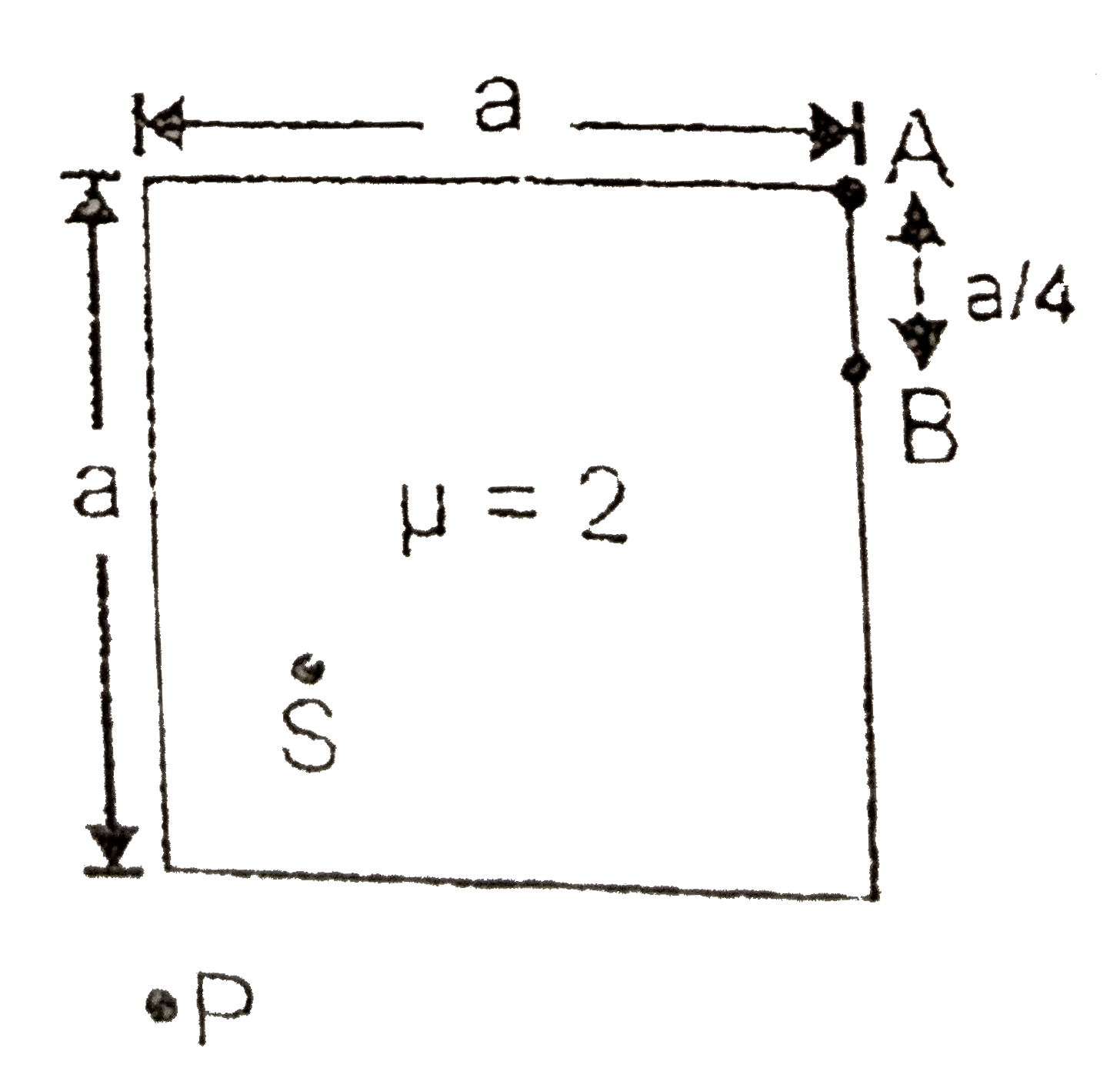
The figure shows the square face (of side 'a') of a transparent cuboidal block. The thickness or the third dimension of the block is negligible in comparison to 'a'. The block has uniform refrative index `mu` equal to `2`. A point source `S` which can emit light in all directions can move inside the block. It is desired that no light of `'S'` should pass through `AB`. Sketch the region in which `S` should be present to satisfy this condition.

Text Solution

Verified by Experts

The correct Answer is:
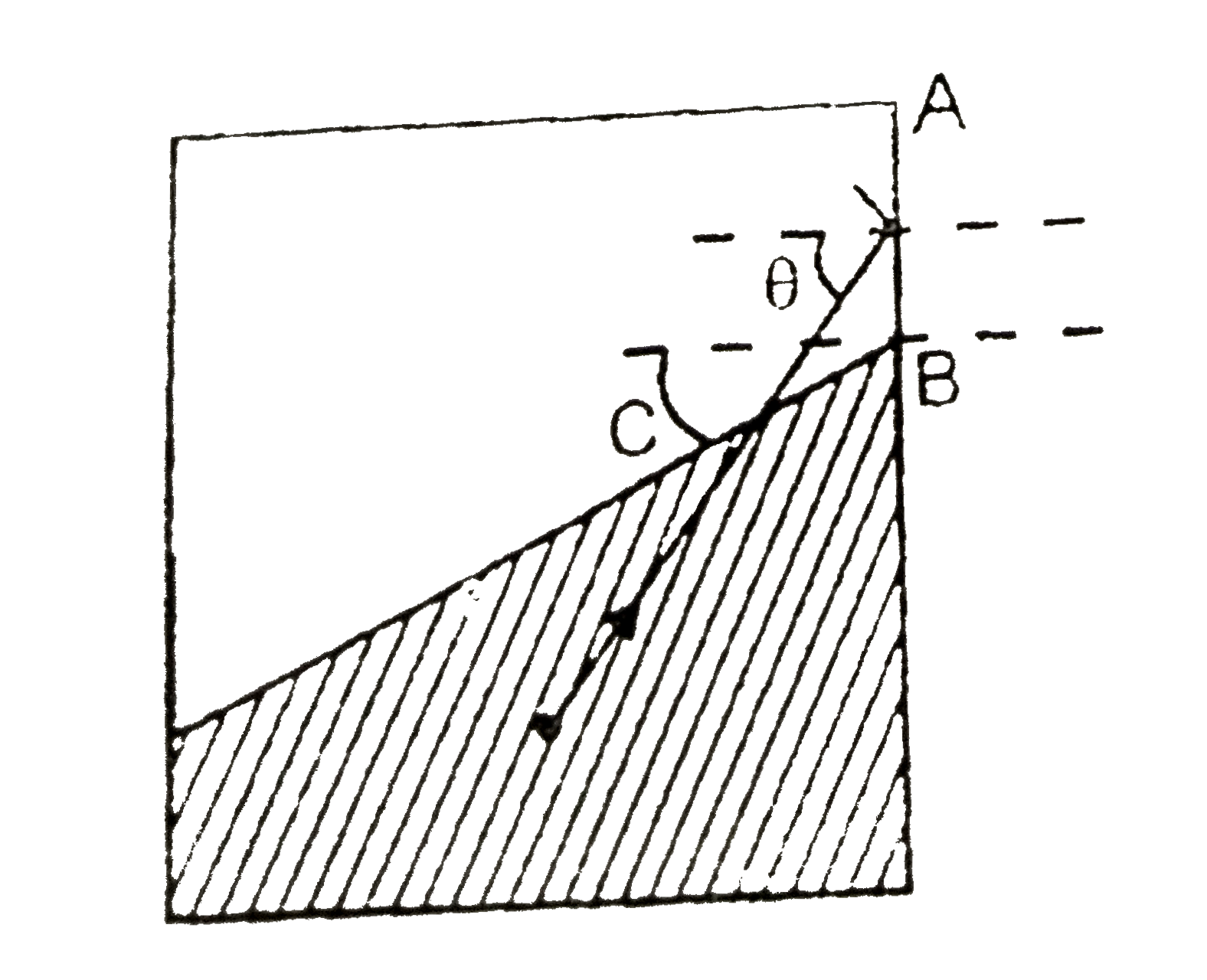
`(##RES_OPT_PHY_XII_C01_E01_238_A01##)`

`sin C=(1)/(2),C=30^(@)`
If `S` is anywhere in the shaded region, the light rays from `S` will strike `AB` making an angle more than critical angle.
Promotional Banner

Topper's Solved these Questions

  • GEOMATRICAL OPTICS

    RESONANCE ENGLISH|Exercise Exercise-3|80 Videos
  • EXPERIMENTAL PHYSICS

    RESONANCE ENGLISH|Exercise PART -II|10 Videos
  • GRAVITATION

    RESONANCE ENGLISH|Exercise HIGH LEVEL PROBLEMS|16 Videos

Similar Questions

Explore conceptually related problems

An uncharge aluminium block has a cavity within it. The block is placed in a region where a uniform electric field is directed upward. Which of the following is a correct statement descrining conditions in the interior of the block's cavity?

Light of wavelength 4500Å in vacuum enters into a glass block of refractive index 1.5. What is the wavelength of light in the glass block?

A block is resting on a horizontal plate in the xy plane and the coefficient of friction between block and plate is mu . The plate begins to move with velocity v=bt^(2) in x direction At what time will the block start sliding on the plate?

Two block of masses m_(1) and m_(2) connected by a light spring rest on a horixontal plane. The cofficient of friction between the block and the surface is equal to mu . What minimum constant force has to be applied in the horizontal direction to the block of mass m_(1) in order to shift the other block?

Two block of masses m_(1) and m_(2) connected by a light spring rest on a horizontal plane. The coefficient of friction between the block and the surface is equal to mu . What minimum constant force has to be applied in the horizontal direction to the block of mass m_(1) in order to shift the other block?

A block of mass M is kept on as rough horizontal surface. The coefficient of static frictionbetween the block and the surface is mu . The block is to be pulled by applying a force to it. What minimum force is needed to slide the block? In which direction should this force act?

A smooth block loosely fits in a circular tube placed on a horizontal surface. The block moves in as uniform circular motion along the tube figure. Which wall (inner or outer) will exert a nonzero normal contact force on the block? .

The coefficient of static friction between the two blocks shown in figure is mu and the table is smooth. What maximum horizontal forced F can be applied to he block of mass M so that the block move together?

The coefficient of static friction between the two blocks shown in figure is mu and the table is smooth. What maximum horizontal forced F can be applied to he block of mass M so that the block move together?

A block of mass m=1 kg has a speed v = 4 m//s at theta = 60^(@) on a circular track of radius R = 2 m as shown in figure. Size of the block is negligible. Coefficient of friction between block and the track is mu = 0.5 . The force of friction between the two is

RESONANCE ENGLISH-GEOMATRICAL OPTICS -Advance level Problems
  1. Two concave mirrors each of focal length 'f' are placed infront of eac...

    Text Solution

    |

  2. An observer observer a fish moving upwards in a cylindrical container ...

    Text Solution

    |

  3. The figure shows the square face (of side 'a') of a transparent cuboid...

    Text Solution

    |

  4. An insect at point 'P' sees its two images in the water mirror system ...

    Text Solution

    |

  5. A ray of light is incident on a surface in a direction given by vector...

    Text Solution

    |

  6. If an observer sees the bottom of the vessel shown in Figure., at 8cm,...

    Text Solution

    |

  7. A man starting from point P cross a 4km wide lagoon and reaches point ...

    Text Solution

    |

  8. In the given figure, the faces of prism ABCD made of glass with a refr...

    Text Solution

    |

  9. A point source of light is placed at a distance h below the surface of...

    Text Solution

    |

  10. A glass prism with a refracting angle of 60^(@) has a refractive index...

    Text Solution

    |

  11. O is a point object kept on the principal axis of a concave mirror M o...

    Text Solution

    |

  12. Light travelling in air falls at an incidence angle of 2^(@) on one ra...

    Text Solution

    |

  13. In Figure ., L is a converging lens of focal length 10cm and M Iis a c...

    Text Solution

    |

  14. An object is kept at rest on the principal axis of a lens. Initially t...

    Text Solution

    |

  15. A convex lens produces an image of a condle flame upon a screen whose ...

    Text Solution

    |

  16. A thin equiconvex lens made of glass of refractive index 3//2 and of ...

    Text Solution

    |

  17. A prism of refractive index n(1) & another prism of reactive index n(2...

    Text Solution

    |

  18. A pole of length 2.00 m stands half dipped in a swimming pool with lev...

    Text Solution

    |

  19. A fly F is sitting an a glass S 45 cm thick & of refractive index 3//...

    Text Solution

    |

  20. A glass prothole is made at the botton of a ahip for observing sea lif...

    Text Solution

    |

