Home
Class 12
PHYSICS
An insect at point 'P' sees its two imag...

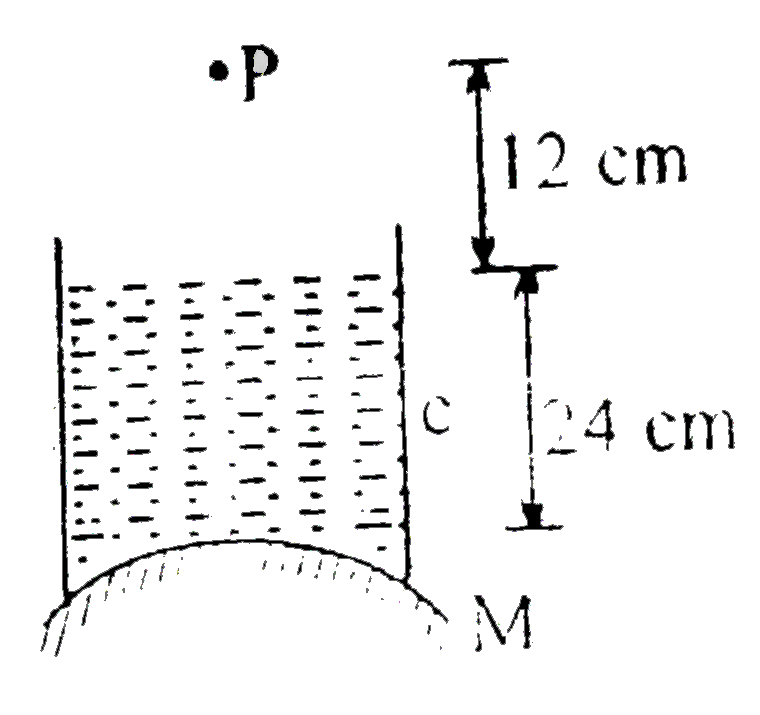
An insect at point 'P' sees its two images in the water mirror system as shown in the figure. One image is formed due to direct partical reflection from water surface and the other image is formed due to refraction, reflection & again refraction by water mirror system in order. Find the separation (in cm) between the two images. Mirror M has focal length 60 cm `[Take mu_(w)=4//3]`

Text Solution

Verified by Experts

The correct Answer is:
`24 cm`

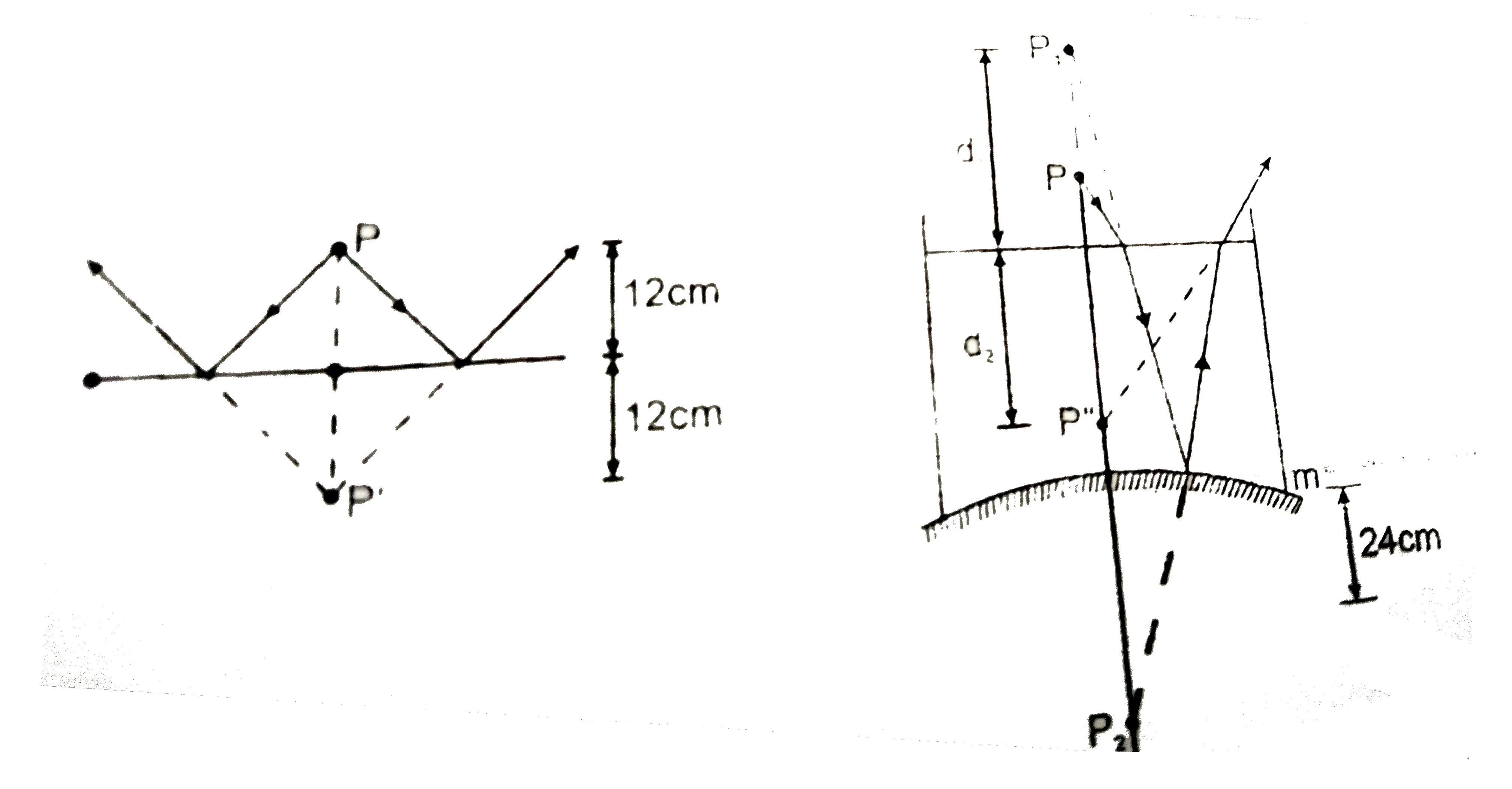
Due to reflection at plane water surface
and other image formation is shown in the figure.
Due to refraction at water
`d_(1)=(12)/(1/(4//3))=16 cm`. For `M_(1),P_(1)` is an object.
for this `(1)/(v)+(1)/(-40)=(1)/(+60)rArrv=24 cm` this is at
It will act as object for water surface which makes image at `P".d_(2)=(24+24)/(4//3)=36 cm`
final images are `P'` and `P"`
distance `P'P"=36-12=24 cm.`
Promotional Banner

Topper's Solved these Questions

  • GEOMATRICAL OPTICS

    RESONANCE ENGLISH|Exercise Exercise-3|80 Videos
  • EXPERIMENTAL PHYSICS

    RESONANCE ENGLISH|Exercise PART -II|10 Videos
  • GRAVITATION

    RESONANCE ENGLISH|Exercise HIGH LEVEL PROBLEMS|16 Videos

Similar Questions

Explore conceptually related problems

A concave mirror of focal length 2 cm is placed on a glass slab as shown in the figure. The image of point object O formed due to reflection at mirror and then refraction by the slab

Mirror in the arrangement shown in figure is moving up with speed 8 cm//sec . There is an object O outside water. Speed of final image formed after two refraction and one refraction and the reflection is : .

Focal length of the mirror shown in figure is 20cm. Find the image position and its velocity.

A point object lies 30 cm above water on the axis of a convex mirror of focal length 40 cm lying 20 cm below water surface. Consider two images. (i) Image formed by the partial reflection from water surface. (ii) Image formed by refraction from water surface followed by reflection from mirror and again refraction out of the water surface. find the distance between these two images.

Image of sun formed due to reflection at air water interface is found to be very highly polarised. Refractive index of water being mu=4//3 , find the angle of sun above the horizon

A bird is flying with a velocity v between two long vertical mirrors making an angle theta with mirror M_(1) as shown. Then what will be the relative velocity of approach between the images formed by the mirrors due to the 1st reflection in each of them

A spherical mirror is placed 10 cm below the level of water. A point oject is placed in air 30 cm above the water surface on the axis of the mirror such that two images seen by an observer above the water surface coincide. The images are formed by partial reflection at the water surface and due to emerging light after feflection from the mirror. Find the focal length of the mirror. (mu_("water")=(4)/(3))

A plane mirror and a concave mirror are arranged as shown in figure and O is a point object, Find the position of image formed by two reflection, first one talking place at concave mirror.

An object, a convex lens of focal length 20 cm and a plane mirror are arranged as shown in the figure. How far behind the mirror is the second image formed?

If final image after two refractions through the lens and one reflection from the mirror forms at the same point O. Refrative index of the material of the lens mu=3//2 . Then find d.

RESONANCE ENGLISH-GEOMATRICAL OPTICS -Advance level Problems
  1. An observer observer a fish moving upwards in a cylindrical container ...

    Text Solution

    |

  2. The figure shows the square face (of side 'a') of a transparent cuboid...

    Text Solution

    |

  3. An insect at point 'P' sees its two images in the water mirror system ...

    Text Solution

    |

  4. A ray of light is incident on a surface in a direction given by vector...

    Text Solution

    |

  5. If an observer sees the bottom of the vessel shown in Figure., at 8cm,...

    Text Solution

    |

  6. A man starting from point P cross a 4km wide lagoon and reaches point ...

    Text Solution

    |

  7. In the given figure, the faces of prism ABCD made of glass with a refr...

    Text Solution

    |

  8. A point source of light is placed at a distance h below the surface of...

    Text Solution

    |

  9. A glass prism with a refracting angle of 60^(@) has a refractive index...

    Text Solution

    |

  10. O is a point object kept on the principal axis of a concave mirror M o...

    Text Solution

    |

  11. Light travelling in air falls at an incidence angle of 2^(@) on one ra...

    Text Solution

    |

  12. In Figure ., L is a converging lens of focal length 10cm and M Iis a c...

    Text Solution

    |

  13. An object is kept at rest on the principal axis of a lens. Initially t...

    Text Solution

    |

  14. A convex lens produces an image of a condle flame upon a screen whose ...

    Text Solution

    |

  15. A thin equiconvex lens made of glass of refractive index 3//2 and of ...

    Text Solution

    |

  16. A prism of refractive index n(1) & another prism of reactive index n(2...

    Text Solution

    |

  17. A pole of length 2.00 m stands half dipped in a swimming pool with lev...

    Text Solution

    |

  18. A fly F is sitting an a glass S 45 cm thick & of refractive index 3//...

    Text Solution

    |

  19. A glass prothole is made at the botton of a ahip for observing sea lif...

    Text Solution

    |

  20. The figure below depicts a concave mirror with center mirror with cent...

    Text Solution

    |

