Home
Class 12
PHYSICS
If an observer sees the bottom of the ve...

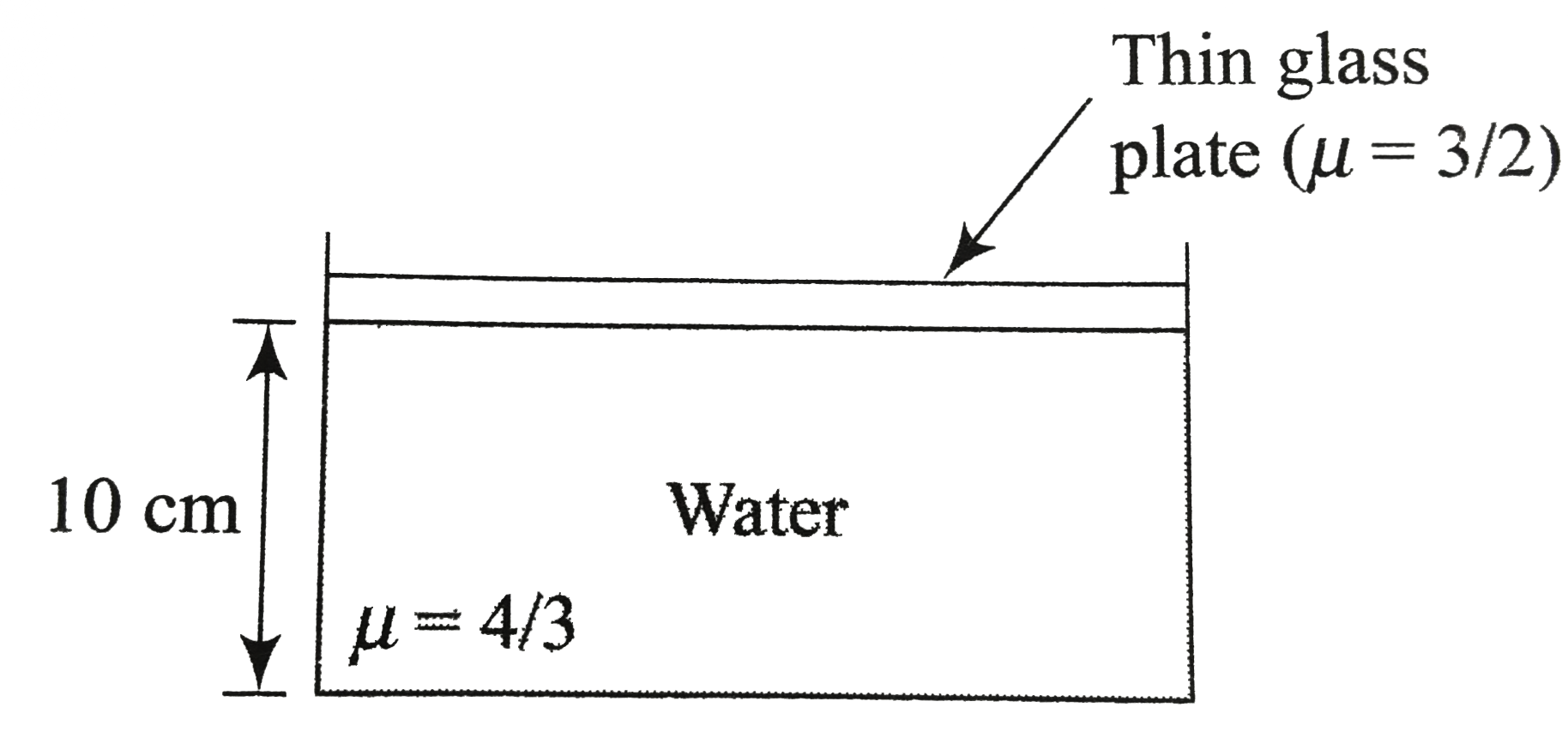
If an observer sees the bottom of the vessel shown in Figure., at 8cm, find the refractive index of the medium in which the observer is present.

Text Solution

Verified by Experts

The correct Answer is:
`(16)/(15)`

Since width of glass sheet is negligible so neglecting effect of glaas sheet.
`d_(app)=(d_(act))/(mu_(rel))rArr8=(10)/((4/(3mu)))`
`rArr8(4)/(3mu)=10rArrmu=(32)/(30)=(16)/(15)`
Promotional Banner

Topper's Solved these Questions

  • GEOMATRICAL OPTICS

    RESONANCE ENGLISH|Exercise Exercise-3|80 Videos
  • EXPERIMENTAL PHYSICS

    RESONANCE ENGLISH|Exercise PART -II|10 Videos
  • GRAVITATION

    RESONANCE ENGLISH|Exercise HIGH LEVEL PROBLEMS|16 Videos

Similar Questions

Explore conceptually related problems

What is the refractive index in a medium where the speed of light is 1.5xx10^8 m/s ?

In the arrangement shown in figure., the image of the extended object as seen by the observer is

An observer can see through a small hole on the side of a jar (radius 15 cm) at a point at height of 15 cm from the bottom (see figure). The hole is at a height of 45 cm. When the jar is filled with a liquid up to a height of 30 cm the same observer can see the edge at the bottom of the jar. If the refractive index of the liquid is N//100 , where N is an integer, the value of N is ___________.

A light ray enters from medium A to medium B as shown in Figure. The refractive index of medium A relative to B will be

The apparent depth of a liquid in a vessel is 15 cm, when its real depth is 20 cm. find the refractive index of the liquid.

A glass beaker has diameter 4cm wide at the bottom. An observer observes the edge of bottom when beaker is empty as shown in figure. When the beaker is completely filled with liquid of refractive index n=sqrt(5//2) , he can just see the centre of bottom, then the height of glass beaker is :

For the arrangement shown in the figure, the force at the bottom of the vessel is

This interference film is used to measure the thickness of slides, paper, etc. The arrangement is as shown in fig. For the sake of clarity, the two strips are shown thick. Consider the wedge formed in between strips 1 and 2. If the interference pattern because of the two waves reflected from wedge surface is observed, then from the observed data we can compute thickness of paper, refractive index of the medium filled in wedge, number of bonds formed, etc. Considre the strips to be thick as compared to wavelength of ligth and light is incident normally. Neglect the effect due to reflection from top surface of strip 1 and bottom surface of strip 2. Take L = 5 cm and lambda_(air) = 40 nm . For strip 1 refractive index is 1.34 abd for strip 2 refractive index is 1.6 The wedge. is filled with a medium having refractive index 1.5. Then

A coin placed at the bottom of a beaker appears to be raised by 4.0 cm. If the refractive index of water is 4/3, find the depth of the water in the beaker.

This interference film is used to measure the thickness of slides, paper, etc. The arrangement is as shown in fig. For the sake of clarity, the two strips are shown thick. Consider the wedge formed in between strips 1 and 2. If the interference pattern because of the two waves reflected from wedge surface is observed, then from the observed data we can compute thickness of paper, refractive index of the medium filled in wedge, number of bonds formed, etc. Considre the strips to be thick as compared to wavelength of ligth and light is incident normally. Neglect the effect due to reflection from top surface of strip 1 and bottom surface of strip 2. Take L = 5 cm and lambda_("air") = 400 nm ,h=20mm. In question 53, if air wedge has been filled with a medium having refractive index 1.3 then find the number of bright bands.

RESONANCE ENGLISH-GEOMATRICAL OPTICS -Advance level Problems
  1. An observer observer a fish moving upwards in a cylindrical container ...

    Text Solution

    |

  2. The figure shows the square face (of side 'a') of a transparent cuboid...

    Text Solution

    |

  3. An insect at point 'P' sees its two images in the water mirror system ...

    Text Solution

    |

  4. A ray of light is incident on a surface in a direction given by vector...

    Text Solution

    |

  5. If an observer sees the bottom of the vessel shown in Figure., at 8cm,...

    Text Solution

    |

  6. A man starting from point P cross a 4km wide lagoon and reaches point ...

    Text Solution

    |

  7. In the given figure, the faces of prism ABCD made of glass with a refr...

    Text Solution

    |

  8. A point source of light is placed at a distance h below the surface of...

    Text Solution

    |

  9. A glass prism with a refracting angle of 60^(@) has a refractive index...

    Text Solution

    |

  10. O is a point object kept on the principal axis of a concave mirror M o...

    Text Solution

    |

  11. Light travelling in air falls at an incidence angle of 2^(@) on one ra...

    Text Solution

    |

  12. In Figure ., L is a converging lens of focal length 10cm and M Iis a c...

    Text Solution

    |

  13. An object is kept at rest on the principal axis of a lens. Initially t...

    Text Solution

    |

  14. A convex lens produces an image of a condle flame upon a screen whose ...

    Text Solution

    |

  15. A thin equiconvex lens made of glass of refractive index 3//2 and of ...

    Text Solution

    |

  16. A prism of refractive index n(1) & another prism of reactive index n(2...

    Text Solution

    |

  17. A pole of length 2.00 m stands half dipped in a swimming pool with lev...

    Text Solution

    |

  18. A fly F is sitting an a glass S 45 cm thick & of refractive index 3//...

    Text Solution

    |

  19. A glass prothole is made at the botton of a ahip for observing sea lif...

    Text Solution

    |

  20. The figure below depicts a concave mirror with center mirror with cent...

    Text Solution

    |

