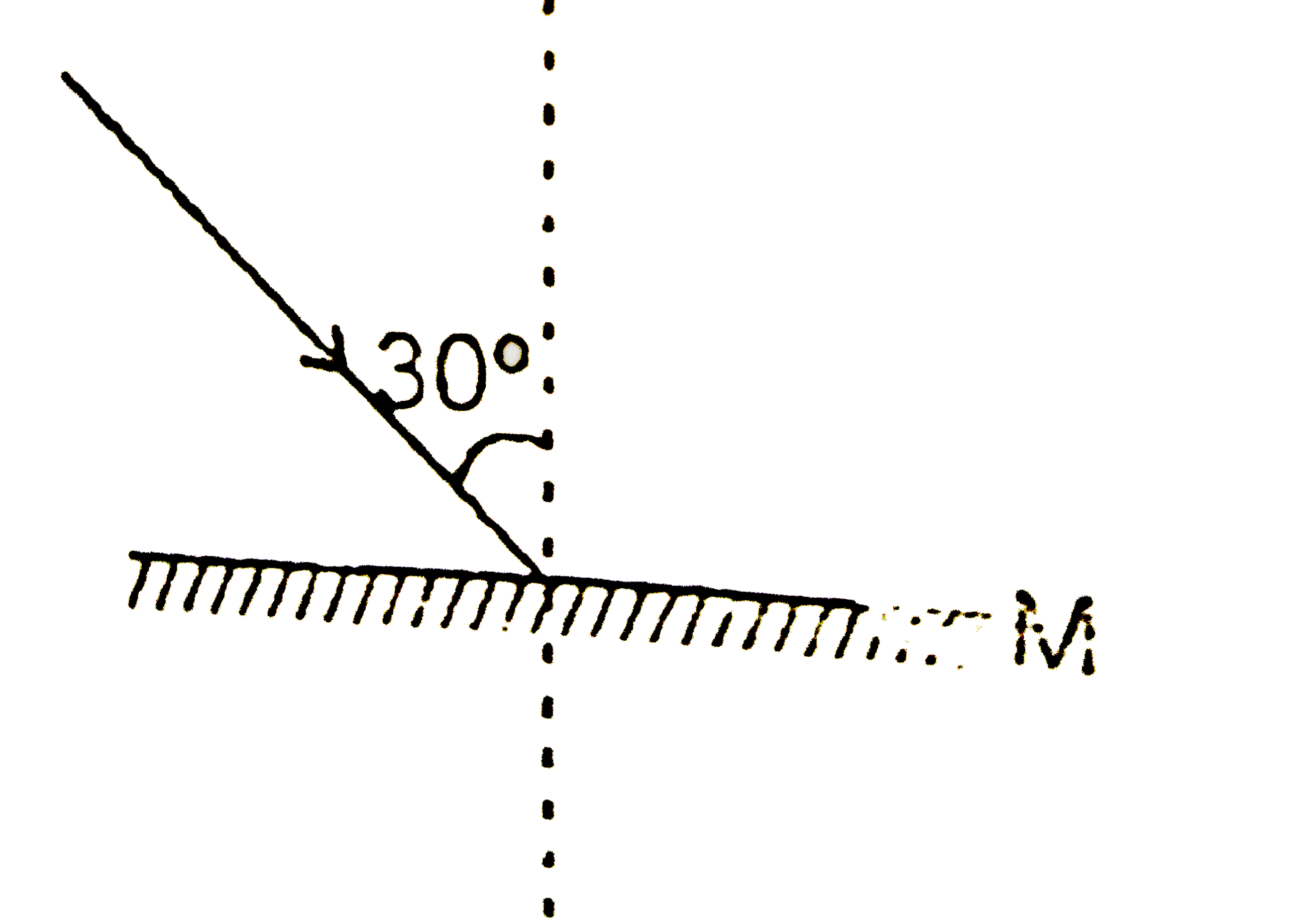
Text Solution
Verified by Experts
The correct Answer is:



Topper's Solved these Questions
GEOMATRICAL OPTICS
RESONANCE ENGLISH|Exercise Exercise-2|62 VideosGEOMATRICAL OPTICS
RESONANCE ENGLISH|Exercise Exercise-3|80 VideosGEOMATRICAL OPTICS
RESONANCE ENGLISH|Exercise Problem|33 VideosEXPERIMENTAL PHYSICS
RESONANCE ENGLISH|Exercise PART -II|10 VideosGRAVITATION
RESONANCE ENGLISH|Exercise HIGH LEVEL PROBLEMS|16 Videos
Similar Questions
Explore conceptually related problems
RESONANCE ENGLISH-GEOMATRICAL OPTICS -Exercise-1
- The focal lengths of the objective and eye lens of a microscope are 1 ...
Text Solution
|
- If the focal length of the objective and eye lens are 1.2 cm and 3 cm...
Text Solution
|
- Find the angle fo deviation (both clockwise and anti-clock wise)suf...
Text Solution
|
- Figures shows a plane mirror on which a light ray is incident, if t...
Text Solution
|
- A light ray is incident on a plane mirror, which after getting refl...
Text Solution
|
- Sun rays are incident at an angle of 24^(@) with the horizon. How ca...
Text Solution
|
- Two plane mirrros are placed as shown in the figure and a point objec...
Text Solution
|
- A point object is placed (0,0) and a plane mirror 'M' is placed, incl...
Text Solution
|
- A rod of length 10 cm lies along the principal axis of a concave mirr...
Text Solution
|
- A point source is at a distance 35cm on the optical axos from a sph...
Text Solution
|
- Find the diameter of the image of the moon formed by a spherical conc...
Text Solution
|
- The radius of curvature of a convex spherical mirror is 1.2m. How fa...
Text Solution
|
- A converging beam of light rays in incident on a concave spherical ...
Text Solution
|
- A point object is placed on the principle axis at 60cm in fornt ...
Text Solution
|
- A man uses a concave mirror for shaving. He keeps his face at a dist...
Text Solution
|
- Two spherical mirros (convex and concave) having the same focal leng...
Text Solution
|
- A light ray falling at an angle of 45^@ with the surface of a clean sl...
Text Solution
|
- A light ray is incident at 45^(@) on a glass slab. The slab is 3cm thi...
Text Solution
|
- In the given figure an abserve in air (n=1) sees the botoom of a bre...
Text Solution
|
- In the given figure rasy incident on an interface would converge 10c...
Text Solution
|