Home
Class 12
PHYSICS
Find the focal length of lens shown in ...

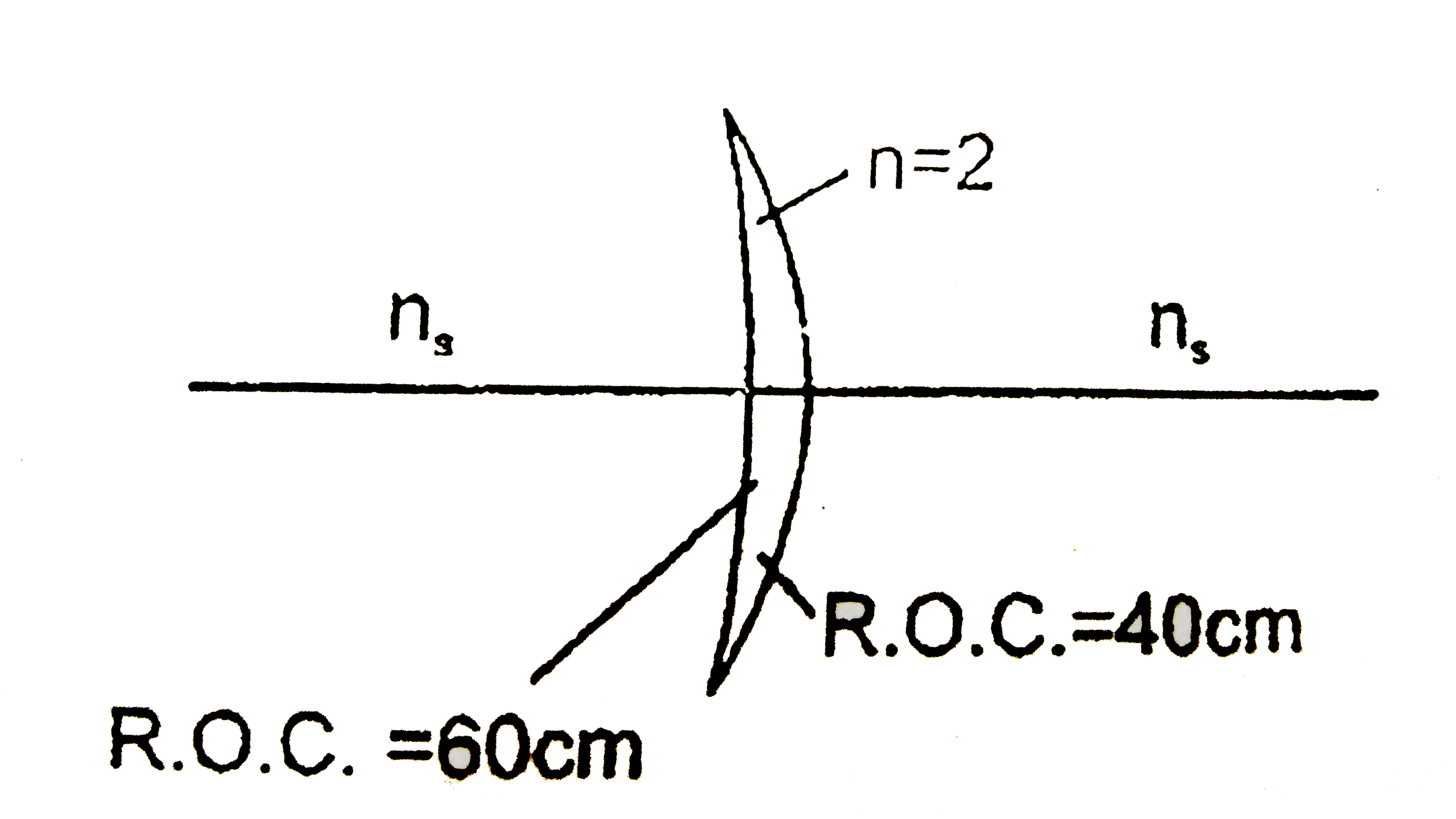
Find the focal length of lens shown in the figure. Solve for three cases `n_(S) = 1.5, n_(S) = 2.0, n_(S) = 2.5`.

Text Solution

Verified by Experts

The correct Answer is:

`360 cm, oo; -600 cm`

`(1)/(f_(1)) = ((2)/(1.5) - 1) ((1)/(-60) - (1)/(-40)) rArr f_(1) = 360cm`
`(1)/(f_(2)) = ((2)/(2) - 1) ((1)/(-60) - (1)/(-40)) = 0 rArr f_(2) = oo`
`(1)/(f_(3)) = ((2)/(2.5) - 1) ((1)/(-60) - (1)/(-40)) rArr f_(3) = -600 cm`
Promotional Banner

Topper's Solved these Questions

  • GEOMATRICAL OPTICS

    RESONANCE ENGLISH|Exercise Exercise-2|62 Videos
  • GEOMATRICAL OPTICS

    RESONANCE ENGLISH|Exercise Exercise-3|80 Videos
  • GEOMATRICAL OPTICS

    RESONANCE ENGLISH|Exercise Problem|33 Videos
  • EXPERIMENTAL PHYSICS

    RESONANCE ENGLISH|Exercise PART -II|10 Videos
  • GRAVITATION

    RESONANCE ENGLISH|Exercise HIGH LEVEL PROBLEMS|16 Videos

Similar Questions

Explore conceptually related problems

Which of the following sets of quantum numbers represents the highest energy of an electron? (A) n = 5, l = 0, m = 0, s = +1/2 (B) n = 6, l = 2, m = 1, s = +1/2 (C) n = 5, l = 1, m = 1, s = -1/2 (D) n = 4, l = 1, m = 0 s = -1/2

Find the product of 7/2s^2t\ a n d\ s+tdot Verify the result for s=1/2a n d\ t=5.

If sum of n terms of a sequence is S_n then its nth term t_n=S_n-S_(n-1) . This relation is valid for all ngt-1 provided S_0= 0. But if S_1=0 , then the relation is valid ony for nge2 and in that case t_1 can be obtained by the relation t_1=S_1. Also if nth term of a sequence t_n=S_n-S_(n-1) then sum of n term of the sequence can be obtained by putting n=1,2,3,.n and adding them. Thus sum_(n=1)^n t_n=S_n-S_0. if S_0=0, then sum_(n=1)^n t_n=S_n. On the basis of above information answer thefollowing questions: If nth term of a sequence is 1/((n+2)n!) then sum of to infinity of this sequence is (A) 1 (B) 1/2 (C) 1/3 (D) none of these

Let S_(1),S_(2),S_(3) , …. Are squares such that for each nge1, The length of the side of S_(n) is equal to length of diagonal of S_(n+1) . If the length of the side S_(1) is 10 cm then for what value of n, the area of S_(n) is less than 1 sq.cm.

In an arithmetic series, if S_(n)=3n^(2)+2n , find the first three terms.

From the following sets quantum number state which are possible. Explain why the other are not permitted ? a. n = 0, l = 0, m= 0, s = + 1//2 b. n = 1, l = 0, m= 0, s = - 1//2 c. n = 1, l = 1, m= 0, s = + 1//2 d. n = 1, l = 0, m= +1, s = + 1//2 e. n = 0, l = 1, m= -1, s = - 1//2 f. n = 2, l = 2, m= 0, s = - 1//2 g. n = 2, l = 1, m= 0, s = - 1//2

Two coherent monochromatic point sources S_1 and S_2 are placed in front of an infinite screen as shown in figure. Wavelength of the light emitted by both the sources is zero. Initial phase difference between the sources is zero. Initially S_(1)S_(2)=2.5 lambda and the number of bright circular rings on the screen in n_(1) . if the distance S_(1)S_(2) is increased and made 5.7 lambda , the number of bright circular rings becomes n_(2) . the difference n_(2)-n_(1) is

If C_(0), C_(1), C_(2), …, C_(n) denote the binomial coefficients in the expansion of (1 + x)^(n) , then sum_(0 ler )^(n)sum_(lt s len)^(n)C_(r)C_(s) =.

If S_n , be the sum of n terms of an A.P ; the value of S_n-2S_(n-1)+ S_(n-2) , is

Designate the electrons with the following sets of quantum numbers : (a) n=3, l=0, m=0, s=-1/2 (b) n=2, l=1, m=+1, s=+1/2 (c ) n=5, l=0, m=0, s=+1/2

RESONANCE ENGLISH-GEOMATRICAL OPTICS -Exercise-1
  1. A quarter cylinder of radius R and refractive index 1.5 is placed on a...

    Text Solution

    |

  2. Lenses are constructed by a material of refractive indices 1'50. The m...

    Text Solution

    |

  3. Find the focal length of lens shown in the figure. Solve for three c...

    Text Solution

    |

  4. Given an optical axis MN and the positons of a real object AB and it...

    Text Solution

    |

  5. A thin lens made of a material of refractive indexmu2 has a medium of ...

    Text Solution

    |

  6. Two glasses with refractive indices of 1.5 and 1.7 are used to make tw...

    Text Solution

    |

  7. An object of height 1cm is set at angles to the optical axis of a dou...

    Text Solution

    |

  8. A lens placed between a candle and a fixed screen forms a real tr...

    Text Solution

    |

  9. A pin of length 1cm lies along the principle axis of a converging len...

    Text Solution

    |

  10. The radius of the sun is 0.75xx10^(8)m and its distance from the eart...

    Text Solution

    |

  11. A 5.0 diopter lens forms a virtual image which is 4 times the object p...

    Text Solution

    |

  12. A diverging lens of focal length 20 cm and a converging mirror of foca...

    Text Solution

    |

  13. A converging lens and a diverging mirror are placed at a separation of...

    Text Solution

    |

  14. A point object is placed on the principal axis of a convex lens (f = 1...

    Text Solution

    |

  15. A convex lens of focal length 20 cm and a concave lens of focal length...

    Text Solution

    |

  16. Two identical thin converging lenses brought in contact so that thei...

    Text Solution

    |

  17. A point object is placed at a distance of 15 cm from a convex lens. Th...

    Text Solution

    |

  18. The convex surface of a thin concave-convex lens of glass of refractiv...

    Text Solution

    |

  19. A certain material has refractive indices 1.56, 1.60 and 1.68 for red,...

    Text Solution

    |

  20. A flint glass prism and a crown glass prism are to be combined in such...

    Text Solution

    |
