Home
Class 12
PHYSICS
A convex lens of focal length 20 cm and ...

A convex lens of focal length 20 cm and a concave lens of focal length 10 cm are placed 10 cm apart with their principal axes coinciding. A beam of light travelling parallel to the principal axis and having a beam diameter 5.0 mm, is incident on the combination. Show that the emergent beam is parallel to the incident one. Find the beam diameter of the emergent beam.

Text Solution

Verified by Experts

The correct Answer is:
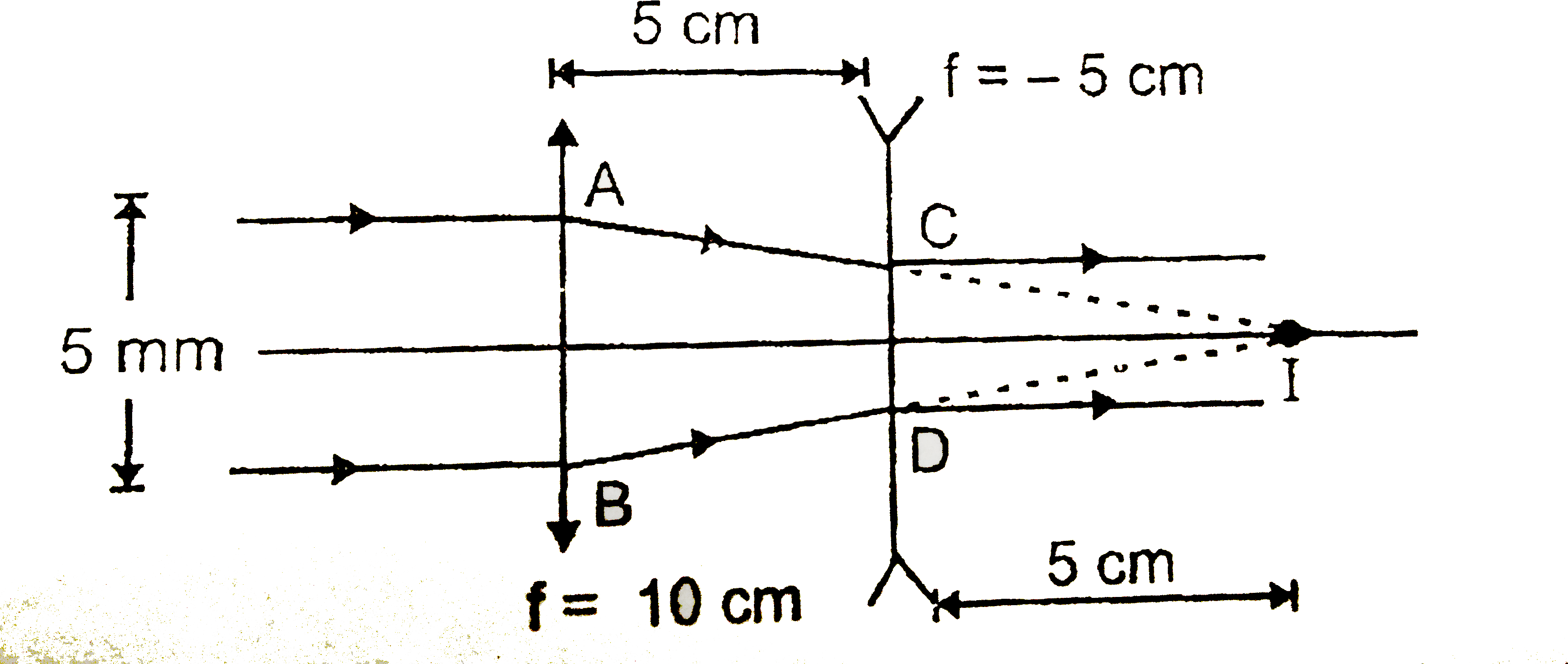
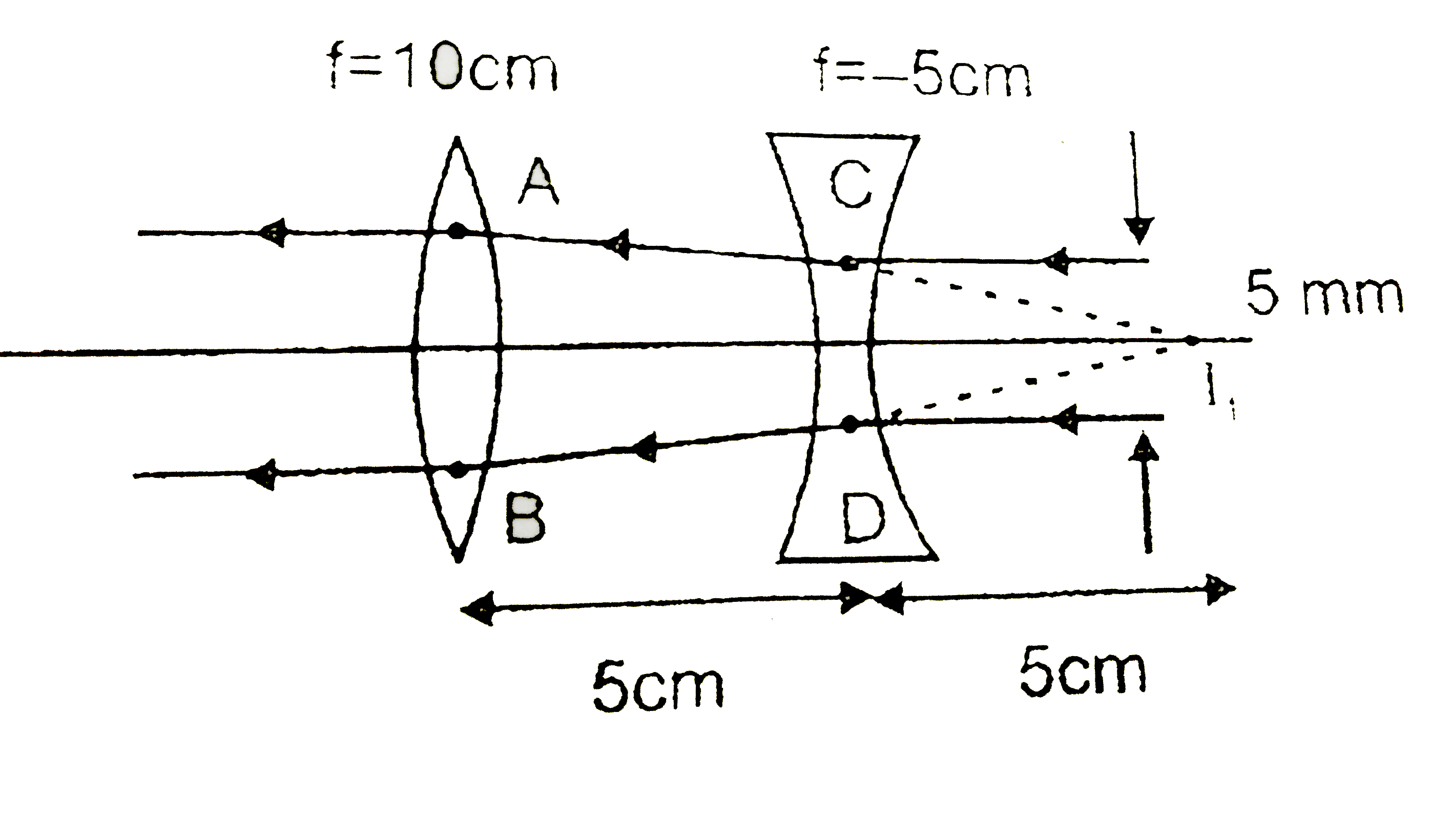
`1.0cm` if the light is incident form the side of concave lens and `2.5mm` if it is incident form the side of the convex lens and the corresponding ratio of intensities are `1//4` and `4`

If light is incident form side of convex lens

For fianl light ray to be parallel to the axis of the lens, the image formed by the mirror should be at the focus of the lens.
therefore, the final beam wil be `||` to incident ray.
`(AB)/(CD) = (10)/(5)`
`rArr CD = (AB)/(2) = (AB)/(2) = (5)/(2) mm = 2.5mm`
Power, `P` = constant
`:. I_(1) A_(1) = I_(2) A_(2)`
`rArr (I_(2))/(I_(1)) = (A_(1))/(A_(2)) = (D_(1)^(2))/(D_(2)^(2)) = [(5)/(5//2)]^(2) = 4`
If light is incident form side of concave lens, first image is formed at the focus of concave lens means at the focus fo convex lens. Therefore, final ray will be `||` to incident one.
`(AB)/(CD) = (10)/(5)`
`rArr AB = 2 xx CD = 2xx5 mm`
`(I_(2))/(I_(1)) = (A_(1))/(A_(2)) = (D_(1)^(2))/(D_(2)^(2)) = ((5)/(10))^(2) = (1)/(4)`
Promotional Banner

Topper's Solved these Questions

  • GEOMATRICAL OPTICS

    RESONANCE ENGLISH|Exercise Exercise-2|62 Videos
  • GEOMATRICAL OPTICS

    RESONANCE ENGLISH|Exercise Exercise-3|80 Videos
  • GEOMATRICAL OPTICS

    RESONANCE ENGLISH|Exercise Problem|33 Videos
  • EXPERIMENTAL PHYSICS

    RESONANCE ENGLISH|Exercise PART -II|10 Videos
  • GRAVITATION

    RESONANCE ENGLISH|Exercise HIGH LEVEL PROBLEMS|16 Videos

Similar Questions

Explore conceptually related problems

A diverging lens of focal length 20 cm and a converging lens of focal length 30 cm are placed 15 cm apart with their principal axes coinciding. Where should an object be placed on the principal axis so that its image formed at infinity ?

A convex lens of focal length 80 cm and a concave lens of focal length 50 cm are combined toghether. What will be their resulting power ?

A converging lens of focal length 12 cm and a diverging mirror of focal length 7.5 cm are placed 5.0 cm apart with their principal axes coinciding. Where should an object be placed so that its image falls on itself ?

A light beam, passes from medium 1 to medium 2. Show that the emerging beam is parallel to the incident beam.

A convex lens A of focal length 20cm and a concave lens B of focal length 10 cm are kept along the same axis with a distance d between them. If a parallel beam, then d is

A convex lens A of focal length 20cm and a concave lens B of focal length 10 cm are kept along the same axis with a distance d between them. If a parallel beam, then d is

A light beam passes from medium 1 to medium 2. Show that the emerging beam is parallel to the incident beam.

A converging lens of focal length 15 cm and a converging mirror of focal length 20 cm are placed with their principal axes coinciding. A point source S is placed on the principal axis at a distance of 12 cm from the lens as shown in figure. It is found that the final beam comes out parallel to the principal axis. Find the separation between the mirror and the lens.

A convex lens of focal length 20 cm and a convex mirror of focal length 10 cm are placed co-axially 50 cm apart from each other. An incident beam parallel to its principal axis is incideent on the convex lens. Locate the position of final image formed due to the combination.

A converging lens of focal length 20 cm and a converging mirror of focal length 10 cm are placed 60 cm apart with common principal axis. A point source is placed in between the lens and the mirror at a distance of 50 cm from the lens. Find the locations of the images formed.

RESONANCE ENGLISH-GEOMATRICAL OPTICS -Exercise-1
  1. An object of height 1cm is set at angles to the optical axis of a dou...

    Text Solution

    |

  2. A lens placed between a candle and a fixed screen forms a real tr...

    Text Solution

    |

  3. A pin of length 1cm lies along the principle axis of a converging len...

    Text Solution

    |

  4. The radius of the sun is 0.75xx10^(8)m and its distance from the eart...

    Text Solution

    |

  5. A 5.0 diopter lens forms a virtual image which is 4 times the object p...

    Text Solution

    |

  6. A diverging lens of focal length 20 cm and a converging mirror of foca...

    Text Solution

    |

  7. A converging lens and a diverging mirror are placed at a separation of...

    Text Solution

    |

  8. A point object is placed on the principal axis of a convex lens (f = 1...

    Text Solution

    |

  9. A convex lens of focal length 20 cm and a concave lens of focal length...

    Text Solution

    |

  10. Two identical thin converging lenses brought in contact so that thei...

    Text Solution

    |

  11. A point object is placed at a distance of 15 cm from a convex lens. Th...

    Text Solution

    |

  12. The convex surface of a thin concave-convex lens of glass of refractiv...

    Text Solution

    |

  13. A certain material has refractive indices 1.56, 1.60 and 1.68 for red,...

    Text Solution

    |

  14. A flint glass prism and a crown glass prism are to be combined in such...

    Text Solution

    |

  15. Three thin prisms are combined as shown in figure. The refractive indi...

    Text Solution

    |

  16. The focal lengths of a convex lens for red, yellow and violet rays are...

    Text Solution

    |

  17. A thin prism of angle 6.0^@, omega'=0.07 and muy'=1.50 is combined wit...

    Text Solution

    |

  18. A small telescope has an objective lens of focal length 144 cm and an ...

    Text Solution

    |

  19. An angular magnification (magnifying power) of 30 X is desired using a...

    Text Solution

    |

  20. A compound microscope has an objective of focal length 2.0 cm and an e...

    Text Solution

    |