Home
Class 12
PHYSICS
In Fig. what should be the speed of the ...

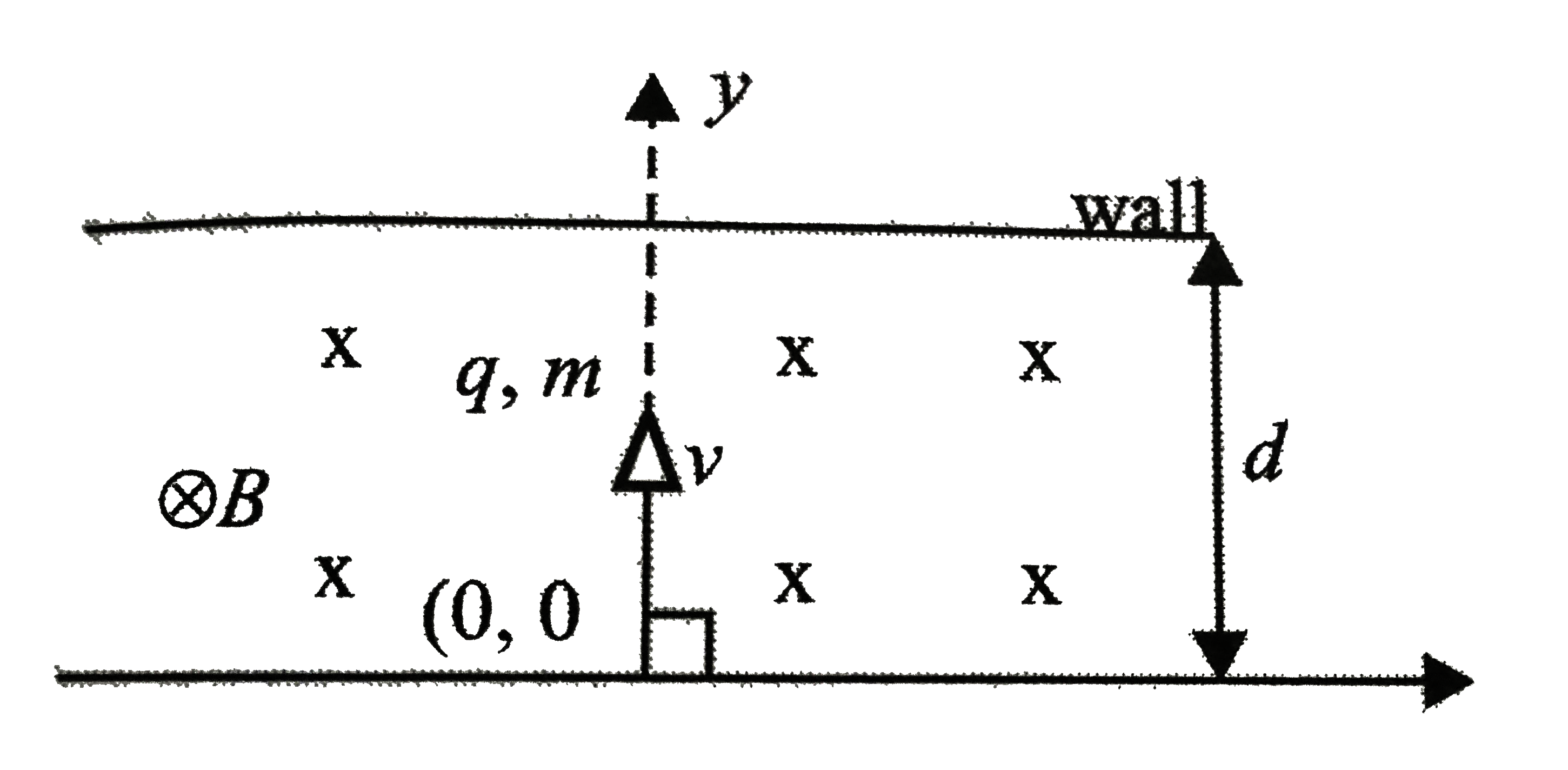
In Fig. what should be the speed of the charged particle so that it cannot collide with the upper wall? Also, find the coordinates of the point where the particle strikes the lower plate in the limiting case of velocity.

Text Solution

Verified by Experts

(i)The path of the particle will be circular larger the velocity, larger will be the radius.For particle not to `s`
strike `R lt d`
`(mv)/(qB)lt d rArr v lt (qBd)/m`
(ii) for limiting case `v=(qBd)/m`
`R=d`
coordinate `=(-2d,0,0)`
Promotional Banner

Topper's Solved these Questions

  • ELECTRODYNAMICS

    RESONANCE ENGLISH|Exercise PROBLEM|12 Videos
  • ELECTRODYNAMICS

    RESONANCE ENGLISH|Exercise Exercise-1 PART-1|83 Videos
  • ELECTRO MAGNETIC WAVES

    RESONANCE ENGLISH|Exercise Exercise 3|27 Videos
  • ELECTROMAGNETIC INDUCTION

    RESONANCE ENGLISH|Exercise A.l.P|19 Videos

Similar Questions

Explore conceptually related problems

A particle of mass m and charge q is accelerated by a potential difference V volt and made to enter a magnetic field region at an angle theta with the field. At the same moment, another particle of same mass and charge is projected in the direction of the field from the same point. Magnetic field induction is B. What would be the speed of second particle so that both particles meet again and again after regular interval of time. Also, find the time interval after which they meet and the distance travelled by the second particle during that interval.

A particle of mass m and charge q is accelerated by a potential difference V volt and made to enter a magnetic field region at an angle theta with the field. At the same moment, another particle of same mass and charge is projected in the direction of the field from the same point. Magnetic field induction is B. What would be the speed of second particle so that both particles meet again and again after regular interval of time. Also, find the time interval after which they meet and the distance travelled by the second particle during that interval.

A particle is projected with a speed u at an angle theta to the horizontal. Find the radius of curvature. At the point where the particle is at a highest half of the maximum height H attained by it.

A particles is projected horizontally with a speed v from the top of a plane inclined at an angle tehta to the horizontal as shown in the figure. (a) Hwo far from the point of projection will the particle strike the plane ? (b) Find the time taken by the particel to hit the plane. (c) What is the velocity of particle just before it hits the plane ?

A projectile is thrown into space so as to have maximum horizontal range R . Taking the point of projection as origin, find out the co-ordinates of the point where the speed of the particle is minimum.

An electron is projected as shown with speed u . If electron just fails to strike the upper plate, find range. (distance from starting point at which electron strike the lower plate again). Consider only electric force.

A particle is dropped from point P at time t = 0. At the same time another particle is thrown from point O as shown in the figure and it collides with the particle P. Acceleration due to gravity is along the negative y-axis. If the two particles collide 2 s after they start, find the initial velocity v_0 of the particle which was projected from O. Point O is not necessarily on ground.

Two particles A and B are moving along x-axis. Their x-coordinate versus time graphs are as shown below (a) Find the time when the particles start their journey and the x-coordinate at that time. (b) Find velocities of the two particles. (c) When and where the particles strike with each other.

A particle with mass m and charge q moving with a velocity v , enters a region of uniform magnetic field B , shown, in the figure above. The particle strikes the wall at a distance d from the entance slit. If the paticle's velocity stays the same but its charge to mass ratio is doubled, distance frm the entrance slit where the particle strike the wall is d/n , then find n

A particle with mass m and charge q moving with a velocity v , enters a region of uniform magnetic field B , shown, in the figure above. The particle strikes the wall at a distance d from the entance slit. If the paticle's velocity stays the same but its charge to mass ratio is doubled, distance frm the entrance slit where the particle strike the wall is d/n , then find n

RESONANCE ENGLISH-ELECTRODYNAMICS-Advanced level problems
  1. In Fig. what should be the speed of the charged particle so that it ca...

    Text Solution

    |

  2. Calculate the magnetic moment (in Am^(2) ) of a thin wire with a curre...

    Text Solution

    |

  3. A small charged ball having mass m and charge q is suspended from a ri...

    Text Solution

    |

  4. The figure shows a conductor of weight 1.0 N& length L=0.5 m placed on...

    Text Solution

    |

  5. Four long wires each carrying current I as shown in the are placed at ...

    Text Solution

    |

  6. A solenoid of length 0.4m and having 500 turns of wire carries a curre...

    Text Solution

    |

  7. A uniformly charged ring of radius 0.1 m rotates at a frequency of 10^...

    Text Solution

    |

  8. The current density vecj inside a long, solid, cylindrica wire of radi...

    Text Solution

    |

  9. A neutral particle is at rest in a uniform magnetic field B. At time t...

    Text Solution

    |

  10. A non-uniform magnetic field vecB=B(0)(1+y/d)(-hatk) is present in reg...

    Text Solution

    |

  11. A neutral atom of atomic mass number 100 which is stationary at the or...

    Text Solution

    |

  12. In the figure shown a positively charged particle of charge q and mass...

    Text Solution

    |

  13. A thin beam of charged particles in incident normally on the boundry o...

    Text Solution

    |

  14. An electron moving with a velocity vecV(1)=2hatim/s at a point in a ma...

    Text Solution

    |

  15. An electron is shot into one end of a solenoid.As it enters the unifor...

    Text Solution

    |

  16. At time t(1), an electron is sent along the positive direction of x-ax...

    Text Solution

    |

  17. In the figure shown an infinitely long wire carries a current I(1) and...

    Text Solution

    |

  18. A loop PQR formed by three identical uniform conducting rods each of l...

    Text Solution

    |

  19. In order to impatt an angular velocity to an earth satellite the geoma...

    Text Solution

    |

  20. Given figure shows a coil bent with all edges of length 1 m and carryi...

    Text Solution

    |

  21. Two particles, each having a mass m are placed at a separation d in a ...

    Text Solution

    |

