Home
Class 12
PHYSICS
(a)Using Ampere's circuital law, obtain ...

(a)Using Ampere's circuital law, obtain the expression for the magnetic field due to a long solenoid at a point inside the solenoid on its axis.
(b )How is the magnetic field inside a given solenoid made strong?

Text Solution

Verified by Experts

(a)Magnetic field due to solenoid:Consider a rectangular amperian loop `abcd` near the middle of solenoid as shown in fig.where `PQ=I`
Let the magnetic field along the path ab be `B` and in zero along `cd`.As the paths `bc` and `da` are perpendicular to the axis of solenoid, the magnetic field component along these path is zero.Therefore, the path `bc` and `da` will not contribute to the line integral of magnetic field `B`.
Total number of turns in length `l=Nl`
The line integral of magnetic field induction `B` over the closed path `abcd` is:
`underset(abcd)(ointvecB).vec(dl)=underset(a)overset(b)intvecB.vec(dl)+underset(b)overset(c)intvecB.vec(dl)+underset(c)overset(d)intvecB.vec(dl)+underset(d)overset(a)intvecB.vec(dl)`
`because underset(a)overset(b)intvecB.vec(dl)=underset(a)overset(b)intBdl cos 0^(@)=Bl`
and `underset(b)overset(c)intvecB.vec(dl)=underset(b)overset(c) int B dl cos 90^(@)=0=underset(d)overset(a)intvecB.vec(dl)`
Also `underset(c)overset(d)vecB.vec(dl)=0`
`(because ` Outside the solenoid `B=0`)
`therefore underset(abcd)(ointvecB).vec(dl)=vec(dl)=Bl+0+0=Bl` ..(i)
Using Ampere's circuital law
`underset(abcd)(ointvecB).vec(dl)=mu_(0)xx"total current in rectangle abcd"`
`mu_(0)xx"no . of turns in rectangle" xx "current" `
`=mu_(0)xxNIxxI=mu_(0) Nl`...(2)
From (1) and (2), we have
`Bl=mu_(0)N//l`
`therefore B=mu_(0)NI`
(b)The magnetic lines of force from a finite solenoid are shown:
The magnetic field due to the neighbouring turns add up along the axis of the solenoid and tend to cancel out of the perpendicular direction.
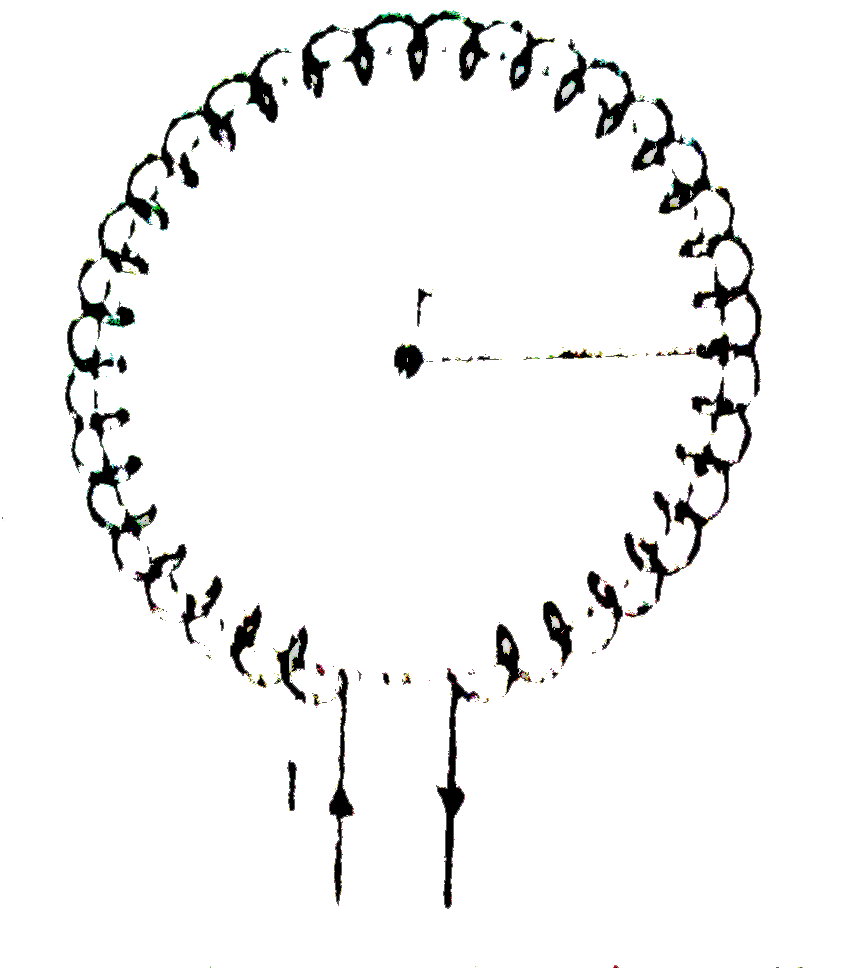
Thus the field at the exterior midpoint is weak and at the interior, it is uniform and strong.When current is passed in toroid, `M.F.` is produced inside the core.
Line integral of magnetic field around the circular path of radius `r`.
`ointvecB.vec(dl)=mu_(0)NI`
`ointB.dlcos 0^(@)=mu_(0)NI`
`B2pir=mu_(0)NI`
`B=(mu_(0)NI)/(2pir)`
`B=mu_(0)nl`
( c) The magnetic field inside a given solenoid made stronger because it becomes everywhere parallel to the axis.


Promotional Banner

Topper's Solved these Questions

  • ELECTRODYNAMICS

    RESONANCE ENGLISH|Exercise Advanced level problems|31 Videos
  • ELECTRODYNAMICS

    RESONANCE ENGLISH|Exercise Exercise-3 PART-2|27 Videos
  • ELECTRO MAGNETIC WAVES

    RESONANCE ENGLISH|Exercise Exercise 3|27 Videos
  • ELECTROMAGNETIC INDUCTION

    RESONANCE ENGLISH|Exercise A.l.P|19 Videos

Similar Questions

Explore conceptually related problems

The magnetic field inside a solenoid is-

Using Ampere.s Circuital Law, derive an expression for the magnetic field along the axis of a toroidal solenoid.

Using Ampere's circuital law, obtain an expression for the magnetic field along the axis of a current carrying solenoid of length l and having N number of turns.

In using Ampere's law,to find the magnetic field inside a straight long soleniod the loop that is taken is

A long solenoid having n = 200 turns per metre has a circular cross-section of radius a_(1) = 1 cm . A circular conducting loop of radius a_(2) = 4 cm and resistance R = 5 (Omega) encircles the solenoid such that the centre of circular loop coincides with the midpoint of the axial line of the solenoid and they have the same axis as shown in Fig. A current 't' in the solenoid results in magnetic field along its axis with magnitude B = (mu)ni at points well inside the solenoid on its axis. We can neglect the insignificant field outside the solenoid. This results in a magnetic flux (phi)_(B) through the circular loop. If the current in the winding of solenoid is changed, it will also change the magnetic field B = (mu)_(0)ni and hence also the magnetic flux through the circular loop. Obvisouly, it will result in an induced emf or induced electric field in the circular loop and an induced current will appear in the loop. Let current in the winding of solenoid be reduced at a rate of 75 A //sec . When the current in the solenoid becomes zero so that external magnetic field for the loop stops changing, current in the loop will follow a differenctial equation given by [You may use an approximation that field at all points in the area of loop is the same as at the centre

A long solenoid having n = 200 turns per metre has a circular cross-section of radius a_(1) = 1 cm . A circular conducting loop of radius a_(2) = 4 cm and resistance R = 5 (Omega) encircles the solenoid such that the centre of circular loop coincides with the midpoint of the axial line of the solenoid and they have the same axis as shown in Fig. A current 't' in the solenoid results in magnetic field along its axis with magnitude B = (mu)ni at points well inside the solenoid on its axis. We can neglect the insignificant field outside the solenoid. This results in a magnetic flux (phi)_(B) through the circular loop. If the current in the winding of solenoid is changed, it will also change the magnetic field B = (mu)_(0)ni and hence also the magnetic flux through the circular loop. Obvisouly, it will result in an induced emf or induced electric field in the circular loop and an induced current will appear in the loop. Let current in the winding of solenoid be reduced at a rate of 75 A //sec . Magentic flux through the loop due to external magnetic field will be I is the current in the loop a_(1) is the radius of solendoid and a_(1)=1cm (given) a_(2) is the radius of circular loop and a_(2)=4cm (given) i is hte current in the solenoid

A long solenoid having n = 200 turns per metre has a circular cross-section of radius a_(1) = 1 cm . A circular conducting loop of radius a_(2) = 4 cm and resistance R = 5 (Omega) encircles the solenoid such that the centre of circular loop coincides with the midpoint of the axial line of the solenoid and they have the same axis as shown in Fig. A current 't' in the solenoid results in magnetic field along its axis with magnitude B = (mu)ni at points well inside the solenoid on its axis. We can neglect the insignificant field outside the solenoid. This results in a magnetic flux (phi)_(B) through the circular loop. If the current in the winding of solenoid is changed, it will also change the magnetic field B = (mu)_(0)ni and hence also the magnetic flux through the circular loop. Obvisouly, it will result in an induced emf or induced electric field in the circular loop and an induced current will appear in the loop. Let current in the winding of solenoid be reduced at a rate of 75 A //sec . Magnitude of induced current that appears in the circular loop is

The strength of magnetic field inside a long current-carrying straight solenoid is:

(A) : A solenoid tend to contract when a current passes through it. (R) : The magnetic field inside the solenoid is uniform.

Using Ampere.s circuital law, obtain an expression for the magnetic flux density .B. at a point .X. at a perpendicular distance .r. from a long current carrying conductor. (Statement of the law is not required).

RESONANCE ENGLISH-ELECTRODYNAMICS-Exercise-3 PART-3
  1. Define magnetic susceptibility of a material. Name two elements, one...

    Text Solution

    |

  2. Magnetic field liness can be entirely confined within the core of a to...

    Text Solution

    |

  3. An electron does not suffer any deflection while passing through a reg...

    Text Solution

    |

  4. Write the expression for the magnetic moment (m) due to a planar squar...

    Text Solution

    |

  5. A long straight wire, of circular cross section (radius =a) carries a ...

    Text Solution

    |

  6. A beam of alpha particles projected along +x- axis , experiences a fo...

    Text Solution

    |

  7. Deduce an expression for the magnetic dipole moment of an electron orb...

    Text Solution

    |

  8. The permeability of magnetic material is 0.9983. Name the type of magn...

    Text Solution

    |

  9. A magnetic needle free to rotate in a vertical plane parallel to the m...

    Text Solution

    |

  10. (a)Using Ampere's circuital law, obtain the expression for the magneti...

    Text Solution

    |

  11. (a) Write the expression for the force, vecF, acting on a charged part...

    Text Solution

    |

  12. What are permanent magnets? Give one example.

    Text Solution

    |

  13. A proton and a deuteron having equal momenta enter in a a region of a ...

    Text Solution

    |

  14. In given diagrams write the direction of magnetic field produced at po...

    Text Solution

    |

  15. Write Biot-Savart law. Write the path of motion of an electron when i...

    Text Solution

    |

  16. A long straight wire of a circular cross section (radius a) carrying s...

    Text Solution

    |

  17. Using the concept of force between two infinitely long parallel curren...

    Text Solution

    |

  18. Show diagrammatically the behaviour of magnetic field lines in the pre...

    Text Solution

    |

  19. If magnetic monpole existed, how would Gauss law of magnetism be modif...

    Text Solution

    |

  20. Derive the expression for force per unit length between two long strai...

    Text Solution

    |