Home
Class 12
PHYSICS
Write Biot-Savart law. Write the path o...

Write Biot-Savart law.
Write the path of motion of an electron when it enters in magnetic field at
`(a)` perpendicular
`(b)`an angle `theta`.

Text Solution

Verified by Experts

Biot-savart's law (`vecB` due to a wire) ,
It is a experimental law. A current `i` flows in a wire (may be stright or curved).Due to `dl` length of the wire the magnetic field at `P` is
`dB prop idl`
`prop 1/r^(2)`
`rArr dB prop (idl sin theta)/r^(2)`
`dB=(mu_(0)/(4pi))("idl" sintheta)/r^(2) rArrvec(dB)=(mu_(0)/(4pi))(vec"(idl)"xxvecr)/r^(3)`
here `vecr`= position vector of the test point w.r.t `vec(dl) theta` = angle between `vec(dl)` and `vecr`.
The resultant `vecB=intvec(dB)`
`vecv||vecB` here `theta=0` or `theta=180^(@)`
therefore `F_(m)=0` , therefore `veca=0` , therefore `vecV=const.`
`therefore` particle will move in a straight line with constant velocity Initial velocity `vecu_|_vecB` and `vecB="uniform"`.In this case `therefore B` is in `z` direction so the magnetic force in `z`-direction will be zero `(because vecF_(m)_|_vecB)`.
Now there is no initial velocity in `z`-direction.
`therefore` particle will always move in `xy` plane.
`therefore` velocity vector is always `_|_vecB`
`therefore F_(m)=qupsilonB=`constant
now `quB=("mu"^(2))/(qB)=` constant
The particle moves in a curved path whose radius of curvature is same every where, such curve in a plane is only a circle.
`therefore` path of the particle is circular.
or
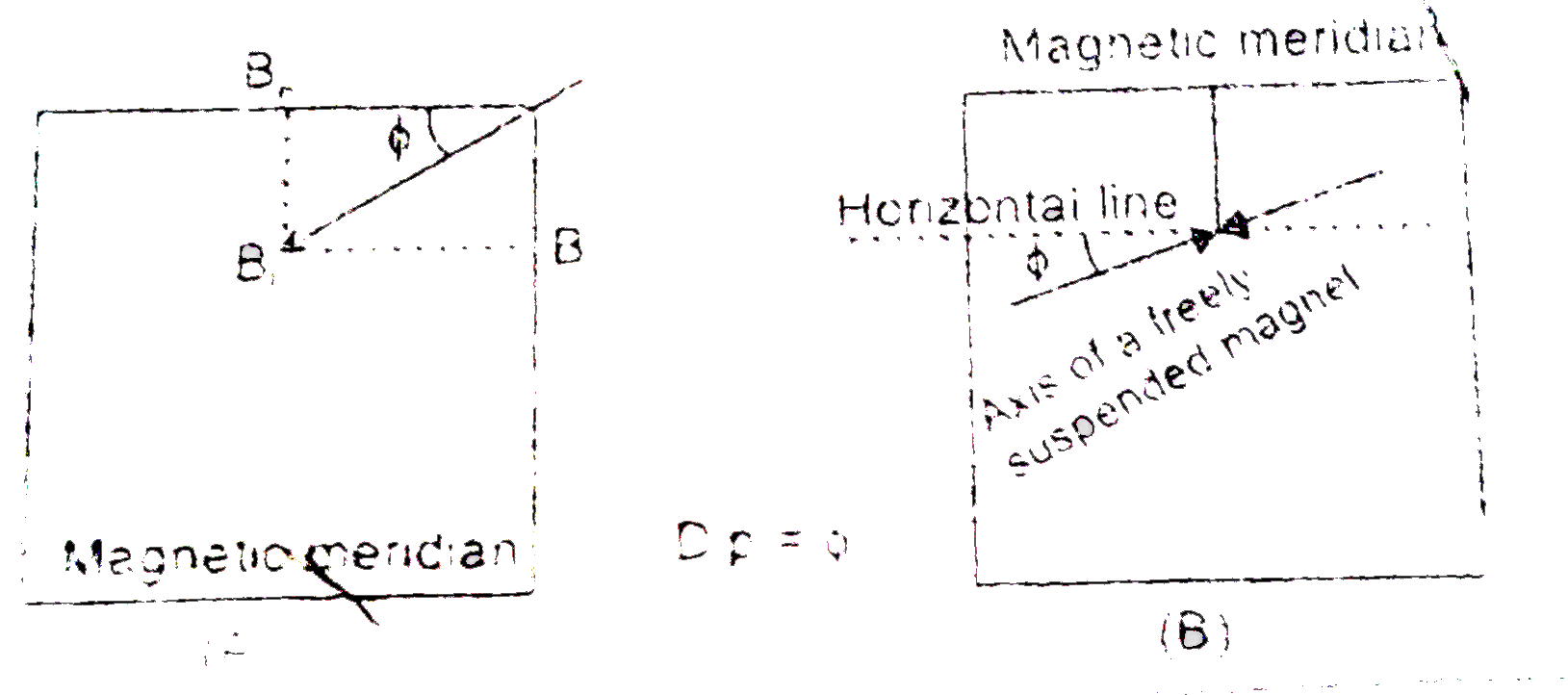
Inclination or Angle of Dip `phi` :It is the angle which the direction of resultant intensity of earth's magnetic field subtends with horizontal line in magnetic meridian at the given place.Actually it is the angle which the axis of a freely suspended magnet (up or down) subtends with the horizontal in magnetic meridian at a given place.Angle of dip at a place is measured by the instrument called Dip-Circle in which a magnetic neddle is free to rotate in a vertical plane which can be set in any vertical direction.
`B_(H)=B_(1)cos phi`
and `B_(y)=B_(1) sin phi`
For `B_(H)=B_(V) rArr phi=45^(@)`


Promotional Banner

Topper's Solved these Questions

  • ELECTRODYNAMICS

    RESONANCE ENGLISH|Exercise Advanced level problems|31 Videos
  • ELECTRODYNAMICS

    RESONANCE ENGLISH|Exercise Exercise-3 PART-2|27 Videos
  • ELECTRO MAGNETIC WAVES

    RESONANCE ENGLISH|Exercise Exercise 3|27 Videos
  • ELECTROMAGNETIC INDUCTION

    RESONANCE ENGLISH|Exercise A.l.P|19 Videos

Similar Questions

Explore conceptually related problems

Biot-Savart law indicates that the moving electrons (velocity vecv ) produce a magnetic field vecB such that

Biot-Savart law indicates that the moving electrons (velocity vecv ) produce a magnetic field vecB such that

Biot-Savart law indicates that the moving electrons (velocity vecv ) produce a magnetic field vecB such that

An electron and a proton have equal kinetic energies. They enter in a magnetic field perpendicularly, Then

A charged particle enters a uniform magnetic field perpendicular to it. The magnetic field

If an electron and a proton having same momenta enter perpendicular to a magnetic field, then

The path of a charged particle in a uniform magnetic field, when the velocity and the magnetic field are perpendicular to each other is a

An electron enters a magnetic field along perpendicular direction. Following quantity will remain constant -

Four particles alpha -particle, deuteron and electron and a CI^(-) ion enter in a transverse magnetic field perpendicular to it with same kinetic energy. Their paths are as shown in figure. Now match the following two columns.

A uniform magnetic field exist in a region which forms an equilateral triangle of side a. The magnetic field is perpendicular to the plane of the triangle . A charged q enters into this magnetic field perpendicular to a side with speed v. The charge enters from midpoint and leaves the field from midpoint of other side. Magnetic induction in the triangles is

RESONANCE ENGLISH-ELECTRODYNAMICS-Exercise-3 PART-3
  1. Define magnetic susceptibility of a material. Name two elements, one...

    Text Solution

    |

  2. Magnetic field liness can be entirely confined within the core of a to...

    Text Solution

    |

  3. An electron does not suffer any deflection while passing through a reg...

    Text Solution

    |

  4. Write the expression for the magnetic moment (m) due to a planar squar...

    Text Solution

    |

  5. A long straight wire, of circular cross section (radius =a) carries a ...

    Text Solution

    |

  6. A beam of alpha particles projected along +x- axis , experiences a fo...

    Text Solution

    |

  7. Deduce an expression for the magnetic dipole moment of an electron orb...

    Text Solution

    |

  8. The permeability of magnetic material is 0.9983. Name the type of magn...

    Text Solution

    |

  9. A magnetic needle free to rotate in a vertical plane parallel to the m...

    Text Solution

    |

  10. (a)Using Ampere's circuital law, obtain the expression for the magneti...

    Text Solution

    |

  11. (a) Write the expression for the force, vecF, acting on a charged part...

    Text Solution

    |

  12. What are permanent magnets? Give one example.

    Text Solution

    |

  13. A proton and a deuteron having equal momenta enter in a a region of a ...

    Text Solution

    |

  14. In given diagrams write the direction of magnetic field produced at po...

    Text Solution

    |

  15. Write Biot-Savart law. Write the path of motion of an electron when i...

    Text Solution

    |

  16. A long straight wire of a circular cross section (radius a) carrying s...

    Text Solution

    |

  17. Using the concept of force between two infinitely long parallel curren...

    Text Solution

    |

  18. Show diagrammatically the behaviour of magnetic field lines in the pre...

    Text Solution

    |

  19. If magnetic monpole existed, how would Gauss law of magnetism be modif...

    Text Solution

    |

  20. Derive the expression for force per unit length between two long strai...

    Text Solution

    |