Home
Class 12
CHEMISTRY
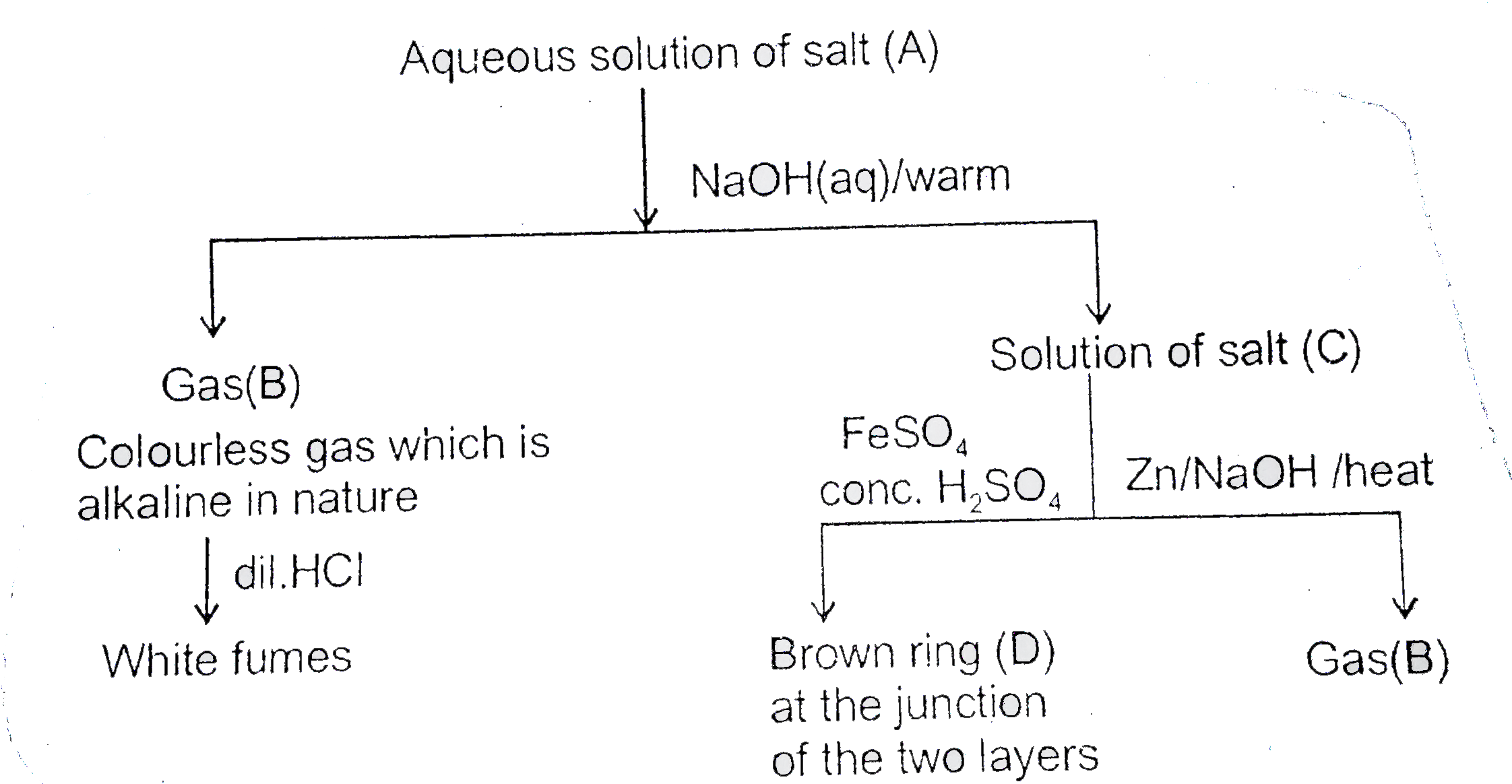
Salt(A) on heating gives a colourless ne...


Salt`(A)` on heating gives a colourless neutral gas which supports combustion.
From the aforesaid, flow diagram, answer the following questions.
The basic radical of salt `(A)` and gas `B` both gives brown precipitate with Nessler's reagent.The composition of the brown precipitate is:

A

`(NH_(4))_(2)[HgI_(4)]`

B

`Hg(NH_(2))NO_(3)`

C

`HgO.HG(NH_(2))I`

D

`(NH_(4))_(3)[Co(NO_(2))_(6)]`

Text Solution

Verified by Experts

The correct Answer is:

C

`NH_(4)^(+)+2[HgI_(4)]^(2-)+4OH^(-)toHgO.Hg(NH_(2))Idarr+7I^(-)+3H_(2)O`
Hence the cation is `NH_(4)^(+)`
Promotional Banner

Topper's Solved these Questions

  • QUALITATIVE ANALYSIS PART 1

    RESONANCE ENGLISH|Exercise Board level exercis|24 Videos
  • QUALITATIVE ANALYSIS PART 1

    RESONANCE ENGLISH|Exercise EXERCISE 1 PART 1 QUALITATIVE ANALYSIS|13 Videos
  • QUALITATIVE ANALYSIS (ANION)

    RESONANCE ENGLISH|Exercise Matching List Type|1 Videos
  • RANK BOOSTER

    RESONANCE ENGLISH|Exercise All Questions|1896 Videos

Similar Questions

Explore conceptually related problems

Salt (A) on heating gives a colourless neutral gas which supports combustion. From the aforesaid, flow diagram, answer the following questions. Which of the following statement is correct ?

Salt (A) on heating gives a colourless neutral gas which supports combustion. From the aforesaid, flow diagram, answer the following questions. The compound (A) contains the following acid radical.

Basic radical which gives Nessler's reagent test in which brown precipitate or brown colouration obtained

A compound containing acetate radical is made to react with neutral ferric chloride. The solution is then diluted with water and boiled for 1-2 minutes. A reddish brown precipitate is obtained.Give the chemical composition of reddish brown precipitate.

When a crystalline compound X is heated with K_(2)Cr_(2)O_(7) and concentrated H_(2)SO_(4) , a reddish brown gas A is evolved. On passing A into caustic soda, a yellow solution of B is formed. A yellow precipitate of C is obtained when a solution B is neutralised with acetic acid and then treated with a lead acetate solution. when X is heated with NaOH , a colourless gas is evolved which, when passed into a solution of K_(2)[HgI_(4)] , gives a reddish brown precipitate of D. ltBrgt Q. Which of the following is the composition of the brown precipitate (D) ?

Identify (A) to (D) in following steps and give chemical equations: (a) A white amorphous powder (A) on strongly heating gives a colourless noncombustible gas (B) and solid (C). (b) The gas (B) turns lime water milky and disappears with the passage of excess of gas. (c) The solution of (C) in dilute HCI gives a white precipitate with an aqueous solution of KdFeCN). (d). The solution of (A) gives white ppt. (D) on passing H_(2)S in presence of NH_(4) OH.

Which of the following salts release reddish brown gas when heated in a dry test tube ?

A white amorphous powder (A) when heated gives a colourless gas (B), which turns lime water milky and the residue (C) which is yellow when hot but white when cold. The residue (C) dissolves in dilute HCl and the resulting solution gives a white precipitate on addition of potassium ferrocyanide solution. (A) dissolves in dilute HCl with the evolution of a gas which is identical in all respects with (B). The solution of (A) as obtained above gives a white precipitate (D) on addition of excess of NH_(4)OH and on passing H_(2)S . Another portion of this solution gives initially a white precipitate (E) on addition of NaOH which dissolves in excess of it. Compounds (A) to (E) are identified as:

The reagents like AgNO_(3),K_(4)[fe(CN)_(6)],KCNS,KI,K_(2)CrO_(4) Nessler's ect, find extenstive and very important applicasion in quentitative analysis because these resgents form different type of produce with different cation for axample KI form yellow precipitate with Pb^(2+) but at form red iprecipitate with Hg^(2+) , Hence these reagents are widely used in the quantitative amalysis of morgenic salts Which of the following cation (i.e. basic radicals) forms coloured (not white) percipitates with aqueous solution of potassium iodide the precipitete does not dissolve is exiess og reagent?

Salts K, L, M, N and O undergo reaction (i) to (v) respectively with different reagents given below. Identify the cation present in these salts on the basis of these reaction. Tabulate your answer in the format given below: (i) Addition of potassium chromate solution to a solution of salt K gives a golden yellow precipitate. (ii) Addition of potassium ferrocyanide solution to a solution of slat L gives a chocolate brown precipitate. (iii) Addition of potassium ferricyanide solution to a solution of salt M gives an intese deep blue solution. (iv) Addition of potassium ferrocyanide solution to a solution of O gives a bluish white precipitate.

RESONANCE ENGLISH-QUALITATIVE ANALYSIS PART 1-A.L.P
  1. Salt(A) on heating gives a colourless neutral gas which supports combu...

    Text Solution

    |

  2. A red solide is insoluble in water. However it becomes soluble if some...

    Text Solution

    |

  3. When a salt is heated with dil H(2)SO(4) and KMnO(4) solution the pi...

    Text Solution

    |

  4. Solution of a salt in dil H(2)SO(4) produces deep blue colour with st...

    Text Solution

    |

  5. Two test tubes containing a nitrate and a bromide are treated separat...

    Text Solution

    |

  6. An inorganic salt when heated with concentrated H(2)SO(4) evolves a co...

    Text Solution

    |

  7. Chromyl chloride vapours are dissolved in water and acetic acid and ba...

    Text Solution

    |

  8. When CS(2) layer containing both Br(2) and I(2) is shaken with exces...

    Text Solution

    |

  9. A metal salt solution gives a yellow precipitate with silver nitrate.T...

    Text Solution

    |

  10. Which of the following will not give positive chromyl chloride test ?

    Text Solution

    |

  11. A white sodium salt dissolves in water to give a solution which is neu...

    Text Solution

    |

  12. A one litre flask is full of brown bromine vapour. The intensity of ...

    Text Solution

    |

  13. Identify the compound which turns black with ammonia solution.

    Text Solution

    |

  14. A white crystalline substance dissolves in water.On passing H(2)S in t...

    Text Solution

    |

  15. The composition of golden spangles is:

    Text Solution

    |

  16. Select the incorrect statement(s).

    Text Solution

    |

  17. What is passivity of Aluminium in presence of HNO3 ?

    Text Solution

    |

  18. White precipitate of PbSO(4) gets dissolved in:

    Text Solution

    |

  19. What final product(s) is/are formed in the following series of reacton...

    Text Solution

    |

  20. Which of the following sulphides do not dissolve in 50% HNO(3) but dis...

    Text Solution

    |

  21. Which of the following statement(s) is/are correct ?

    Text Solution

    |
