Home
Class 12
CHEMISTRY
A student was given a sample of colourle...

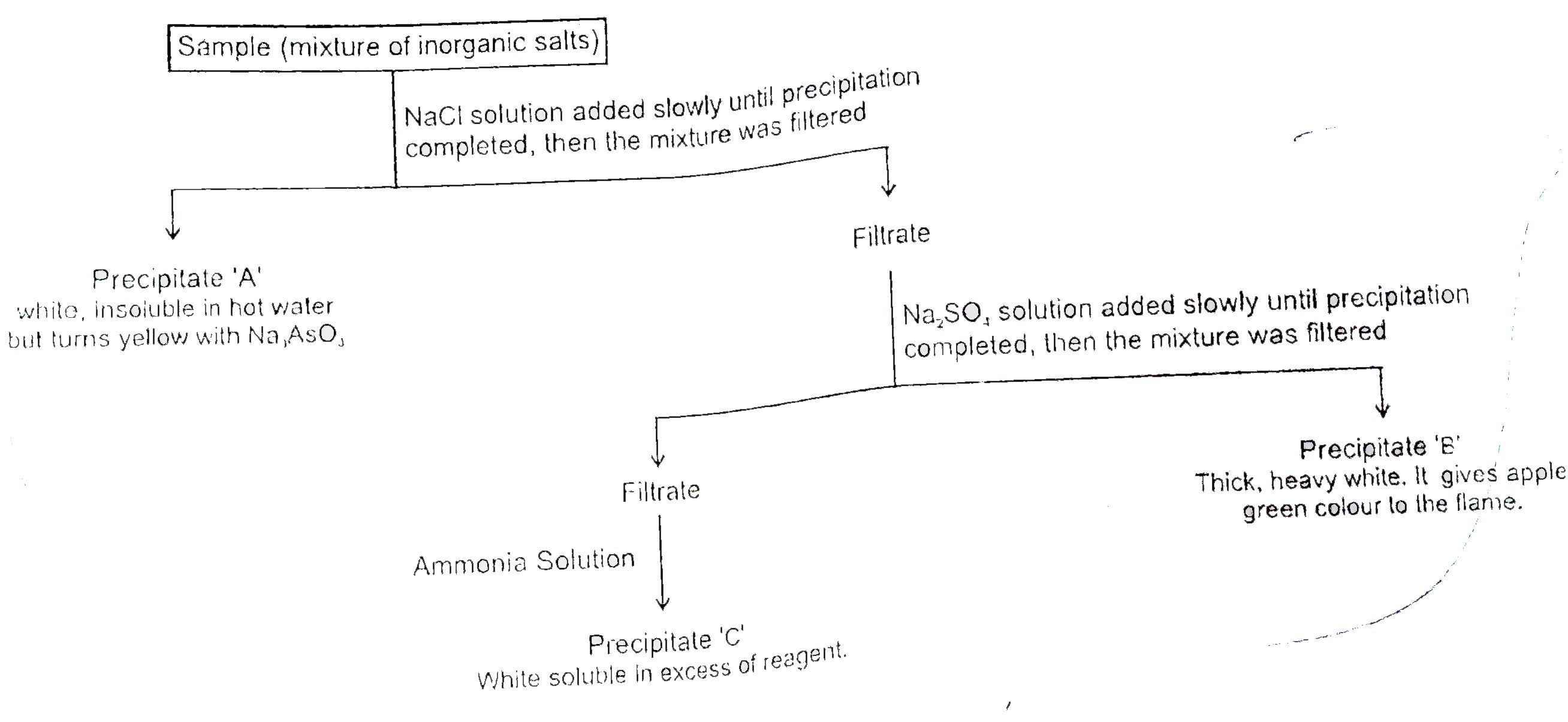
A student was given a sample of colourless solution containing three cations and was asked to identify the cations. Student carried out a series of reactions as given below.
White precipitate `'A'` is not soluble in:

A

`NH_(3)`

B

`2M HCl`

C

`KCN`

D

`Na_(2)S_(2)O_(3)`

Text Solution

Verified by Experts

The correct Answer is:

B
Promotional Banner

Similar Questions

Explore conceptually related problems

A student was given a sample of colourless solution containing three cations and was asked to identify the cations. Student carried out a series of reactions as given below. Precipitates 'A','B' and 'C' are respectively:

Study the given reaction and identify the process which is carried out.

Identify the cation in each of the following case Sodium hydroxide solution when added to solution C gives bluish white precipitate which is insoluble in excess.

Identify the cation in each of the following case Ammonium hydroxide solution when added to the solution B gives white precipitate which dissolves in excess

In a class of 40 students, the marks obtained (out of 50) are as given below: Draw a histogram to represent the given data.

A white substance (A) reacts with dilute H_(2)SO_(4) to produce a colourless suffocating gas (B) and a colourless solution (C )/ The reaction of gas (B) with potassium iodate and starch solution produce a blue colour solution. Aqueous Solution of (A) gives a white precipitate with BaCl_(2) solution which is soluble in dilute HCl . Addition of aqueous NH_(3) or NaOH to (C ) produced first a precipitate which dissolves in excess of the respective reagent to poduced a clear solution. Similarly addition of excess of potassium ferrocyanide to (C ) produced a precipitate (D) which also dissolves in aqeous NaOH giving a clear solution. Identify (A),(B),(C ) and (D ). Write the equation of the reactions involved.

An aqueous solution of metal ion MI reacts separately with reagents Q and R in excess to give tetrahedral and square planar complexes, respectively An aqueous solution of another metal ion M2 always forms tetrahedral complexs with theses reagents. Aqueous solution of M2 on reaction with reagent S gives white precipitate which dissolves in excess of S The reactions are summarised in the scheme given below: SCHEME : What is M2

An aqueous solution of metal ion MI reacts separately with reagents Q and R in excess to give tetrahedral and square planar complexes, respectively An aqueous solution of another metal ion M2 always forms tetrahedral complexs with theses reagents. Aqueous solution of M2 on reaction with reagent S gives white precipitate which dissolves in excess of S The reactions are summarised in the scheme given below: SCHEME : What is S?

A student was given a sample of two tissues. He observes the tissues under the microscope and draws their figures (1 and 2) as shown below . Identify the tissues (1 and 2)

When a white crystalline compound X is heated with K_(2)Cr_(2)O_(7) and concentrated H_(2)SO_(4) a reddish brown gas A is evolved. On passing A into caustic soda solution, a yellow coloured solution of B is obtained. Neutralizing the solution B with acetic acid and on subsequent addition of lead acetate, a yellow precipitate C is obtained. When X is heated with NaOH solution, a colourless gas is evolved and on passing this gas into K_2HgI_4 solution, a reddish brown precipitate D is formed. Identify A, B, C, D and X. Write the equations of reactions involved.
