
Home
Class 12
CHEMISTRY
Identify the hydrocarbon having molecula...

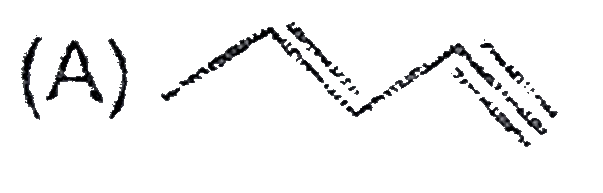
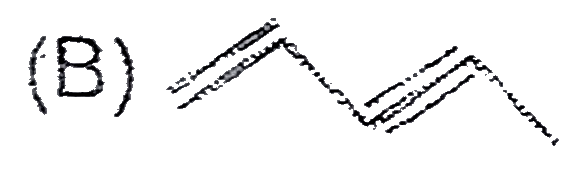
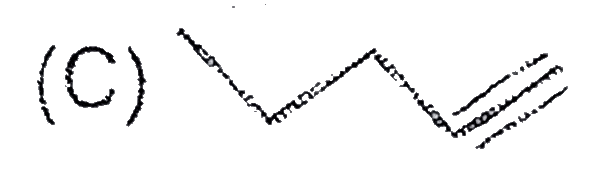
Identify the hydrocarbon having molecular formula `C_(5)H_(6)` which gives white ppt with ammonical `AgNO_(3)` ?

A

B

C

D

Text Solution

AI Generated Solution

The correct Answer is:

To identify the hydrocarbon with the molecular formula \( C_5H_6 \) that gives a white precipitate with ammonical \( AgNO_3 \), we can follow these steps: ### Step 1: Understand the molecular formula The molecular formula \( C_5H_6 \) suggests that the compound is an unsaturated hydrocarbon. The degree of unsaturation can be calculated using the formula: \[ \text{Degree of Unsaturation} = \frac{(2C + 2 - H)}{2} \] For \( C_5H_6 \): \[ \text{Degree of Unsaturation} = \frac{(2 \times 5 + 2 - 6)}{2} = \frac{(10 + 2 - 6)}{2} = \frac{6}{2} = 3 \] This indicates that the compound has three degrees of unsaturation, which could be due to multiple bonds (double or triple bonds) or rings. ### Step 2: Identify possible structures Given that the compound has three degrees of unsaturation, it could be an alkyne (which has a triple bond) or a combination of double bonds and rings. However, since the question specifies that it gives a white precipitate with ammonical \( AgNO_3 \), we focus on terminal alkynes, as they react with ammonical silver nitrate to form a white precipitate of silver acetylide. ### Step 3: List possible terminal alkynes The terminal alkynes that fit the formula \( C_5H_6 \) are: 1. 1-Pentyne (CH≡C-CH2-CH2-CH3) 2. 2-Pentyne (not terminal, so it won't give a precipitate) ### Step 4: Analyze the options Among the possible structures: - **1-Pentyne** has a terminal triple bond and fits the formula \( C_5H_6 \). - **2-Pentyne** does not have a terminal triple bond and will not react with ammonical \( AgNO_3 \). ### Step 5: Conclusion Since 1-Pentyne is the only hydrocarbon that meets the criteria of having a terminal triple bond and the molecular formula \( C_5H_6 \), it is the compound that gives a white precipitate with ammonical \( AgNO_3 \). Thus, the answer is **1-Pentyne**. ---
Promotional Banner

Topper's Solved these Questions

  • STRUCTURAL IDENTIFICATION

    RESONANCE ENGLISH|Exercise Exercise - 2 (Part-I)|10 Videos
  • STRUCTURAL IDENTIFICATION

    RESONANCE ENGLISH|Exercise Exercise - 2 (Part-II)|8 Videos
  • STRUCTURAL IDENTIFICATION

    RESONANCE ENGLISH|Exercise Exercise-1 (Part-I)|23 Videos
  • STEREOISOMERISM

    RESONANCE ENGLISH|Exercise EXERCISE (PART III : PRACTICE TEST-2 (IIT-JEE (ADVANCED PATTERN))|23 Videos
  • SURFACE CHEMISTRY

    RESONANCE ENGLISH|Exercise Section - 5|1 Videos

Similar Questions

Explore conceptually related problems

Which will not give a white ppt with "AgNO"_(3) ?

Pure chloroform gives white ppt. with AgNO_3 .

Which will undergo reaction with ammonical AgNO_(3) :

How many hydrocarbons having molecular mass 68 can give white precipitate with Tollen's reagent ?

AgNO_3 gives red ppt. with.

At identical temperature and pressure the rate of diffusion of hydrogen gas is 3sqrt3 times that of a hydrocarbon having molecular formula C_(n)H_(2n-n) What is the value of n ? .

At identical temperature and pressure the rate of diffusion of hydrogen gas is 3sqrt3 times that of a hydrocarbon having molecular formula C_(n)H_(2n-n) What is the value of n ? .

Which of the following reaction with ammonical AgNO_(3) solution.

An optically active hydrocarbon X has molecular formula C_(6)H_(12) . X on catalytic hydrogenation gives optically inactive C_(6)H_(14).X could be

A saturated hydrocarbon having molecular formula C_(n)H_(2n+2) diffuses through a porous membrane twice as fast as Sulphur dioxide. Determine the molecular mass of hydrocarbon and name it.

RESONANCE ENGLISH-STRUCTURAL IDENTIFICATION-Exercise-1 (Part-II)
  1. Which will undergo reaction with ammonical AgNO(3) :

    Text Solution

    |

  2. Which of the following compounds gives red ppt with Cu(2)Cl(2)//NH(4)O...

    Text Solution

    |

  3. Identify the hydrocarbon having molecular formula C(5)H(6) which gives...

    Text Solution

    |

  4. The group reagent for the test of alcohols is :

    Text Solution

    |

  5. The following two compounds I and II can be distinguished by using rea...

    Text Solution

    |

  6. Which of the following compound will not react with l(2)//OH^(-).

    Text Solution

    |

  7. A compound A gives following reactions. Its structure can be

    Text Solution

    |

  8. An organic compound X (C(4)H(8)O(2)) gives positive test with NaOH an...

    Text Solution

    |

  9. Which of the following compound will give smell of NH(3) with conc. Na...

    Text Solution

    |

  10. Which of the following will not give positive test with CHCl(3)//KOH.

    Text Solution

    |

  11. A positive carbylamine test is shown by :

    Text Solution

    |

  12. The Hinsberg's method is used for :

    Text Solution

    |

  13. The IUPAC name for the following compound is

    Text Solution

    |

  14. , Instant turbidity Identyfy X :

    Text Solution

    |

  15. Which of the following would produce effervescence with sodium bicarbo...

    Text Solution

    |

  16. A compound is heated with zinc dust and ammonium chloride followed by ...

    Text Solution

    |

  17. In the Lassaigne's test , one of the organic compound gave red colour ...

    Text Solution

    |

  18. Lassaigne's test is used in the qualitative analysis to detect

    Text Solution

    |

  19. The compound that does not give a blue colour in Lassaigne’s test is:

    Text Solution

    |

  20. Nitrogen containing organic compound when fused with sodium metal form...

    Text Solution

    |
