Home
Class 12
CHEMISTRY
The following two compounds I and II can...

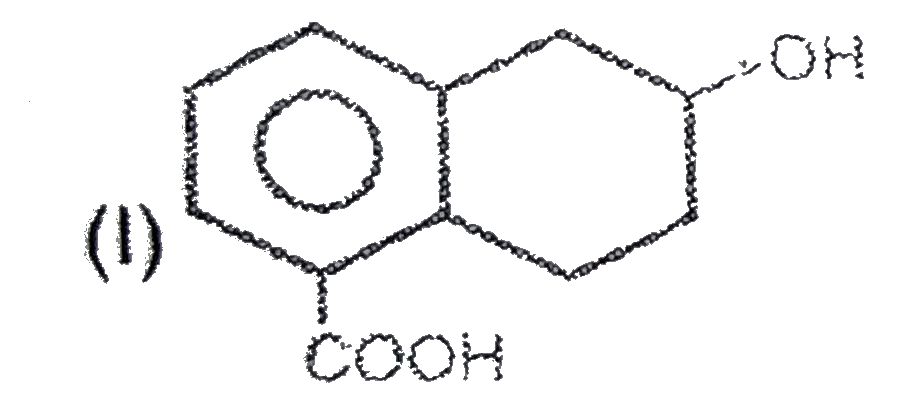
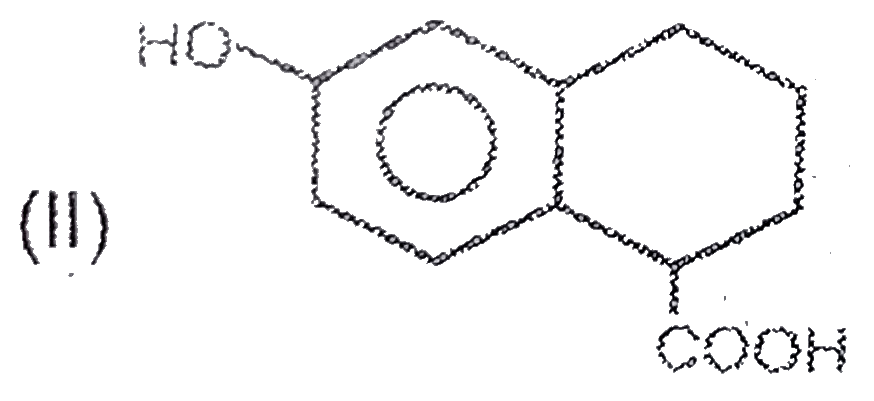
The following two compounds `I` and `II` can be distinguished by using reagent
" "
(a) aq. `NaHCO_(3)` " " (b) Neutral `FeCl_(3)`
(c ) Blue litmus solution " " `Na` metal " " (e) `HCl//ZnCl_(2)` anhydrous

A

`a` or `c`

B

`b` or `e`

C

`d` or `e`

D

`c` or `d`

Text Solution

Verified by Experts

The correct Answer is:

B

(a) Both give the test with `aq`. `NaHCO_(3)` because both have `-COOH` group and acidic hydrogen.
(b) `II` give `+ ve` test with neutral `FeCl_(3)` due to presence of phenolic `-OH` group, but `(I)` does not.
( c) In`(I)` and `(II)` acidic hydrogen atom is present so both give `+ve` test with blue litmus solution.
(d) In `(I)` and `(II)` acidic hydrogen atom is present so both give +`ve` test with `Na` metal.
(e) `(I)` give `+ve` test with `HCl//ZnCl_(2)` due to presence of aliphatic alcoholic group, but `(II)` does not.
Promotional Banner

Topper's Solved these Questions

  • STRUCTURAL IDENTIFICATION

    RESONANCE ENGLISH|Exercise Exercise - 2 (Part-I)|10 Videos
  • STRUCTURAL IDENTIFICATION

    RESONANCE ENGLISH|Exercise Exercise - 2 (Part-II)|8 Videos
  • STRUCTURAL IDENTIFICATION

    RESONANCE ENGLISH|Exercise Exercise-1 (Part-I)|23 Videos
  • STEREOISOMERISM

    RESONANCE ENGLISH|Exercise EXERCISE (PART III : PRACTICE TEST-2 (IIT-JEE (ADVANCED PATTERN))|23 Videos
  • SURFACE CHEMISTRY

    RESONANCE ENGLISH|Exercise Section - 5|1 Videos

Similar Questions

Explore conceptually related problems

The following two compounds I and II can be distinguished by using reagent (a) aq. NaHCO_(3) , Neutral FeCl_(3) (b) Blue litmus solution , Na metal (c) HCl/ ZnCl_(2) anhydrous

The following two compounds I and II can be distinguished by using reagent (1) Aq.NaHCO_3 , (2)Neutral FeCl_3(aq.)(FeCl_3+NH_4OH+H_2O) (3)Blue litmus solution , (4)Na metal (5) HCl+ZnCl_2 (anhydrous)

Acetaldehyde and Propyne can be distinguish by : (i) Tollen's reagent " " (ii) l_(2)//NaOH " " (iii) Lucas reagent " " (iv) neutral FeCl_(3)

Compounds I and II can be distinguished by using reagent. {:(" "I ," "II),("4-Amino-2methylbut-3-en-2ol","4-Amino-2,2-dimethylbut-3-yn-1-ol"):}

Compounds I and II can be distinguished by using reagent. {:("(I)",,"(II)"),("4-Hydroxy-4-methypent-2-enoic acid",,"5-Hydroxypent-2-ynoic acid "):}

The pair of compounds which cannot exist together in aqueous solution is: (I) NaH_(2)PO_(4) and NaHCO_(3)" "(II) Na_(2)CO_(3) and NaHCO_(3) (III) NaOH and NaH_(2)PO_(2)" "(IV) NaHCO_(3) and NaOH

The pairs of compounds which cannot exist together in aquous solution are: (I) NaH_(2)PO_(4) and Na_(2)HCO_(3) (II) Na_(2)CO_(3) and NaOH (III) NaOH and NaH_(2)PO_(4) (IV) NaHCO_(3) and NaOH

Which of the following compounds after mixing can produce blue colouration? (I) K_(4)[Fe(CN)_(6)] and FeCl_(3) solution (II) NH_(4)OH and CuSO_(4) solution (III) Adding anhydrous CuSO_(4) to water (IV) NH_(4)OH+NiSO_(4) solution Choose the correct code:

Five isomeric p-subsituted aromatic compounds (A) to (E ) with molecular formula C_(8)H_(8)O_(2) are given for identifyication. Based on the following observation, give the structures of the compounds. i. Both (A) and (B) form a silver mirror with Tollens reagent, (B) also gives a positive test with neutral FeCl_(3) solution. ii. (C ) gives positive iodoform test. iii. (D) is readily extracted in aqueous NaHCO_(3) solution. iv. (E ) on acid hydrolysis gives 1,4-dihydroxy benzene. Compound (A) is:

Five isomeric p-subsituted aromatic compounds (A) to (E ) with molecular formula C_(8)H_(8)O_(2) are given for identifyication. Based on the following observition, give the strucctures of the compounds. i. Both (A) and (B) form a silver mirror with Tollens reagent, (B) also gives a positive test with neutral FeCl_(3) solution. ii. (C ) gives positive iodoform test. iii. (D) is readily extracted in aqueous NaHCO_(3) solution. iv. (E ) on acid hydrolysis gives 1,4-dihydroxy benzene. Compound (E ) is:

RESONANCE ENGLISH-STRUCTURAL IDENTIFICATION-Exercise-1 (Part-II)
  1. Which of the following compounds gives red ppt with Cu(2)Cl(2)//NH(4)O...

    Text Solution

    |

  2. Identify the hydrocarbon having molecular formula C(5)H(6) which gives...

    Text Solution

    |

  3. The group reagent for the test of alcohols is :

    Text Solution

    |

  4. The following two compounds I and II can be distinguished by using rea...

    Text Solution

    |

  5. Which of the following compound will not react with l(2)//OH^(-).

    Text Solution

    |

  6. A compound A gives following reactions. Its structure can be

    Text Solution

    |

  7. An organic compound X (C(4)H(8)O(2)) gives positive test with NaOH an...

    Text Solution

    |

  8. Which of the following compound will give smell of NH(3) with conc. Na...

    Text Solution

    |

  9. Which of the following will not give positive test with CHCl(3)//KOH.

    Text Solution

    |

  10. A positive carbylamine test is shown by :

    Text Solution

    |

  11. The Hinsberg's method is used for :

    Text Solution

    |

  12. The IUPAC name for the following compound is

    Text Solution

    |

  13. , Instant turbidity Identyfy X :

    Text Solution

    |

  14. Which of the following would produce effervescence with sodium bicarbo...

    Text Solution

    |

  15. A compound is heated with zinc dust and ammonium chloride followed by ...

    Text Solution

    |

  16. In the Lassaigne's test , one of the organic compound gave red colour ...

    Text Solution

    |

  17. Lassaigne's test is used in the qualitative analysis to detect

    Text Solution

    |

  18. The compound that does not give a blue colour in Lassaigne’s test is:

    Text Solution

    |

  19. Nitrogen containing organic compound when fused with sodium metal form...

    Text Solution

    |

  20. The sodium extract of an organic compound on acidified with acetic aci...

    Text Solution

    |
