


Home
Class 12
CHEMISTRY
A hydrogen on oxidative ozonlysis produc...

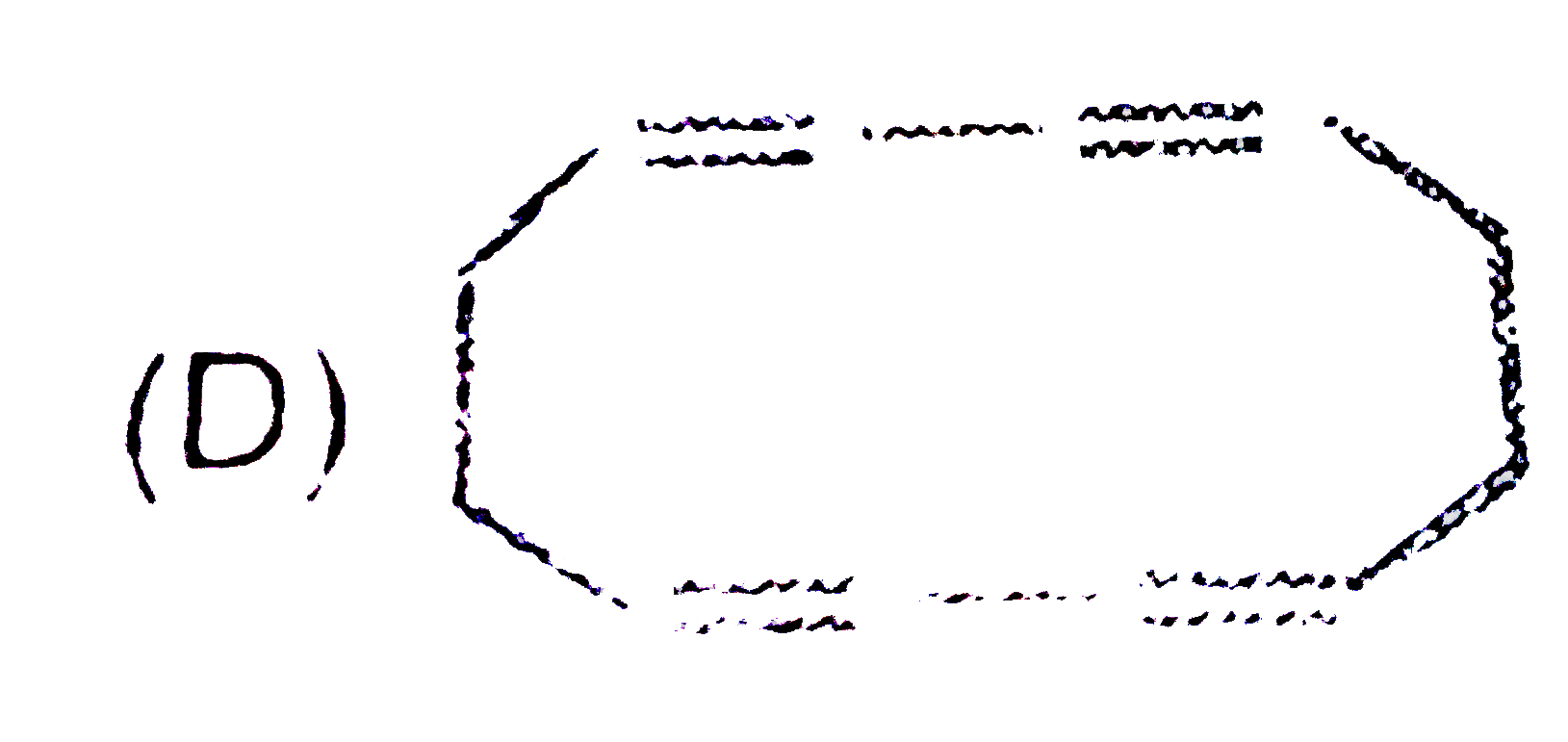
A hydrogen on oxidative ozonlysis produces Oxalic acid and Butanedioic acid. Its structrure is

A

B

C

D

Text Solution

AI Generated Solution

The correct Answer is:

To determine the structure of the hydrogen compound that, upon oxidative ozonolysis, yields oxalic acid and butanedioic acid, we can follow these steps: ### Step 1: Understand the Products The products of the oxidative ozonolysis are oxalic acid (C2H2O4) and butanedioic acid (C4H6O4). - Oxalic acid has the structure: HOOC-COOH - Butanedioic acid has the structure: HOOC-CH2-CH2-COOH ### Step 2: Analyze the Carbon Count - Oxalic acid has 2 carbon atoms. - Butanedioic acid has 4 carbon atoms. - Therefore, the starting compound must have a total of 6 carbon atoms (2 from oxalic acid + 4 from butanedioic acid). ### Step 3: Determine the Structure of the Starting Compound To produce these acids through ozonolysis, the starting compound must have a structure that allows for cleavage into these products. A likely candidate is a symmetrical compound with a double bond that can be cleaved. ### Step 4: Propose a Possible Structure A suitable structure for the starting compound could be 2,4-hexadiene (CH2=CH-CH=CH2). This compound has 6 carbon atoms and two double bonds. ### Step 5: Predict the Ozonolysis Reaction When 2,4-hexadiene undergoes oxidative ozonolysis: 1. The double bonds will break, leading to the formation of carbonyl groups (C=O). 2. Each carbon that was part of a double bond will be converted to a carbonyl (C=O) and will also have a hydroxyl (OH) group added. ### Step 6: Identify the Final Products The ozonolysis of 2,4-hexadiene would yield: - Two molecules of oxalic acid (from the cleavage of the double bonds at the ends). - One molecule of butanedioic acid (from the central part of the molecule). ### Conclusion Thus, the structure of the hydrogen compound that produces oxalic acid and butanedioic acid upon oxidative ozonolysis is 2,4-hexadiene.

To determine the structure of the hydrogen compound that, upon oxidative ozonolysis, yields oxalic acid and butanedioic acid, we can follow these steps: ### Step 1: Understand the Products The products of the oxidative ozonolysis are oxalic acid (C2H2O4) and butanedioic acid (C4H6O4). - Oxalic acid has the structure: HOOC-COOH - Butanedioic acid has the structure: HOOC-CH2-CH2-COOH ### Step 2: Analyze the Carbon Count ...
Promotional Banner

Topper's Solved these Questions

  • STRUCTURAL IDENTIFICATION

    RESONANCE ENGLISH|Exercise Advanced level Problems (Part-III)|12 Videos
  • STRUCTURAL IDENTIFICATION

    RESONANCE ENGLISH|Exercise Advanced level Problems (Part-I)|29 Videos
  • STEREOISOMERISM

    RESONANCE ENGLISH|Exercise EXERCISE (PART III : PRACTICE TEST-2 (IIT-JEE (ADVANCED PATTERN))|23 Videos
  • SURFACE CHEMISTRY

    RESONANCE ENGLISH|Exercise Section - 5|1 Videos

Similar Questions

Explore conceptually related problems

Why oxalic acid is a stronger acid than acetic acid?

Give one good chemical test to distinguish between oxalic acid and benzoic acid.

Electrolytic reduction of oxalic acid produces :

Convert : Ethyne to oxalic acid

How will you distinguish between the following pair of compounds ? Oxalic acid and acetic acid.

Organic acids are produced from

A good producer of citric acid is

A mixture of potassium chlorate, oxalic acid and sulphuric acid is heated. During the reaction which element undergoes maximum change in the oxidation number?

Write the blanced equations for the reactions when a mixture of potassium chlorate, oxalic acid and sulphuric acid is heated.

RESONANCE ENGLISH-STRUCTURAL IDENTIFICATION-Advanced level Problems (Part-II)
  1. How many isomaric alkenes (structural only) on hydrogenation can give ...

    Text Solution

    |

  2. A hydrogen on oxidative ozonlysis produces Oxalic acid and Butanedioic...

    Text Solution

    |

  3. Farnesence is a compound found in the waxy coating of apples. On hydro...

    Text Solution

    |

  4. A compound P(C(5)H(6)) gives positive Bayer test and on hydrogentation...

    Text Solution

    |

  5. In compound A (C30H60O)following tests are observed negatively, A can ...

    Text Solution

    |

  6. Compound I and II can be distinguished by using reagent. underset("4...

    Text Solution

    |

  7. Which of the following test will not be given by , (Squaric acid)

    Text Solution

    |

  8. Which of the following compounds after complete hydrogenation will for...

    Text Solution

    |

  9. A organic compound having molecular formula C(3)H(4), react with sodiu...

    Text Solution

    |

  10. Compound P Liberates H(2) gas with Na metal. P gives the precipitate w...

    Text Solution

    |

  11. True statements is//are :

    Text Solution

    |

  12. C(6)H(15)O(6)(P) underset(Zn, H(2)O)overset(O(3))rarrC(4)H(8)O(4)(Q) u...

    Text Solution

    |

  13. In how many reactions CO(2) gas is released out after reaction with Na...

    Text Solution

    |

  14. How many alkenes, alkynes and alkadienes can be hydrogenated to form I...

    Text Solution

    |

  15. 20 g of non-electrolyte, non-volatile solute (C(x)H(2x)O(6)) when diss...

    Text Solution

    |

  16. Structure of Ascorbic acid as represented as follows. How many of...

    Text Solution

    |

  17. Observe the following compounds Number of coumpound which can gi...

    Text Solution

    |

  18. 'n' number of alkenes yield 2,2,3,4,4-pentamethyl-pentane on catalytic...

    Text Solution

    |

  19. A compound (P) having molecular formula C(6)H(10) contains two DU. It ...

    Text Solution

    |

  20. A compound (P) having molecular formula C(6)H(10) contains two DU. It ...

    Text Solution

    |
