Home
Class 12
PHYSICS
S(1) and S(2) are two coherent sources o...

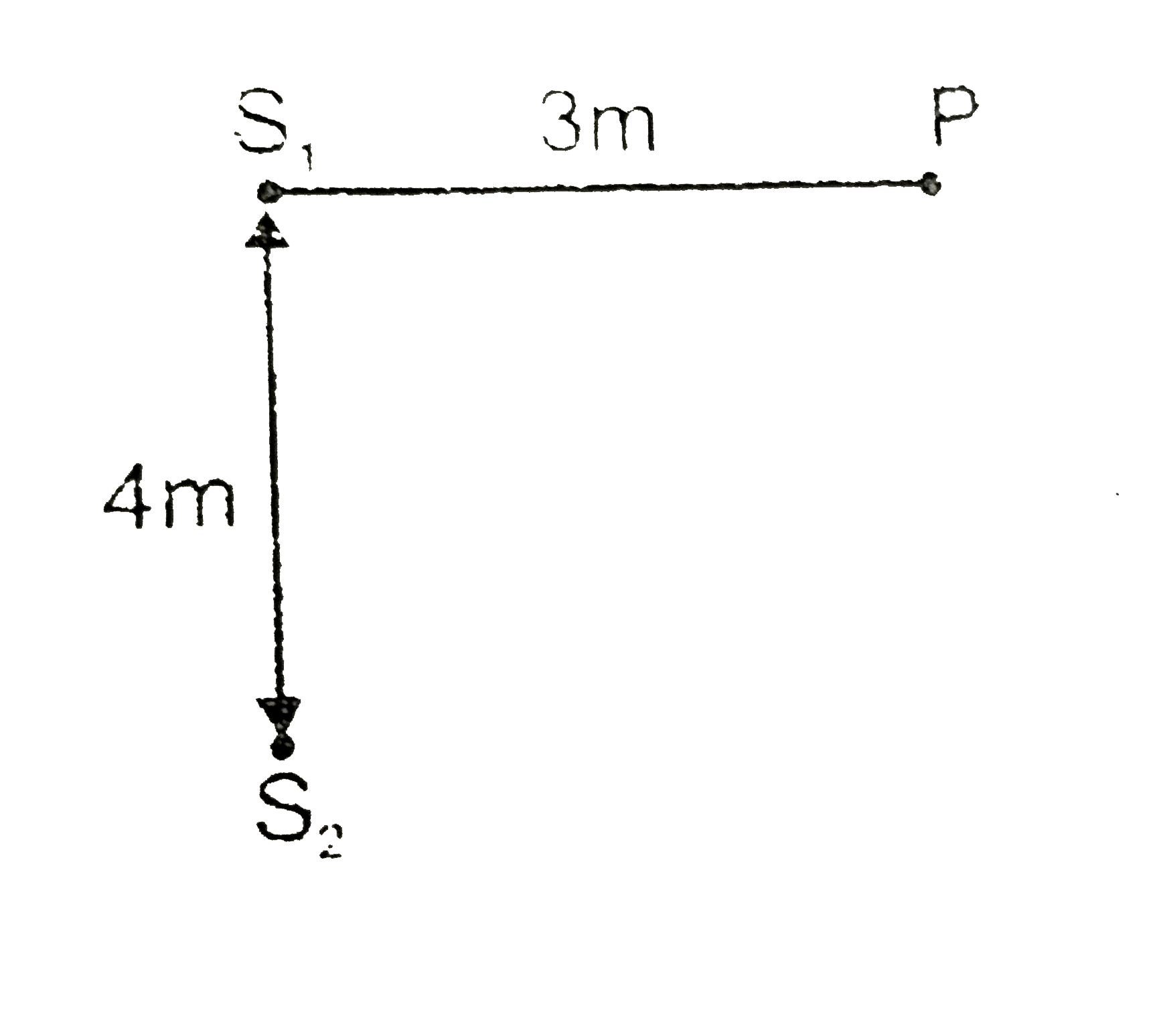
`S_(1)` and `S_(2)` are two coherent sources of frequency `f` each.`(theta _(1)=theta_(2)=0^(@)) V_(sound)=330m//s.`
(i) so that constructive interfence at `'p'`
(ii) so that destructive interfrece at `'p'`

Text Solution

Verified by Experts

For constructive interference
`K Delta x =2npi`
`(2pi)/(lambda)xx2=2npi`
`lambda=(2)/(n) , V=lambdaf rArr V=(2)/(n)f`
`f=(330)/(2)xxn`
For destructive interference
`K Delta x=(2n+1)pi`
`(2pi)/(lambda).2=(2n+1)pi`
`(1)/(lambda)=((2n+1))/(4), f=(V)/(lambda)=(330xx(2n+1))/(4)`
Promotional Banner

Topper's Solved these Questions

  • WAVE OPTICS

    RESONANCE ENGLISH|Exercise Exercise-1 (Part-1)|13 Videos
  • WAVE OPTICS

    RESONANCE ENGLISH|Exercise Exercise-1 (Part-2)|13 Videos
  • WAVE ON STRING

    RESONANCE ENGLISH|Exercise Exercise- 3 PART II|7 Videos

Similar Questions

Explore conceptually related problems

S_(1) and S_(2) are two coherent sources of sound of frequency 110Hz each they have no initial phase difference. The intensity at a point P due to S_(1) is I_0 and due to S_2 is 4I_0 . If the velocity of sound is 330m//s then the resultant intensity at P is

Two sound sources S_(1) and S_(2) emit pure sinussoidal waves in phase . If the speed of sound is 350 m//s , then (a) for what frequencies does constructive interference occur at point P ? (b) for what frequencies does destructive interference occur at point P ?

S_(1) and S_(2) are two sources of sound emitting sine waves. The two sources are in phase. The sound emitted by the two sources interfers at point F . The waves of wavelength :

S_(1) and S_(2) are two coherent sources of sound having no intial phase difference. The velocity of sound is 330 m//s . No maximum will be formed on the line passing through S_(2) and prependicular to the line joining S_(1) and S_(2) . If the frequency of both the sources is

Consider an interference arrangement similar to YDSE. Slits S_(1) and S_(2) are illuminated with coherent microwave sources each of frequency 2 MHz The sources are synchronized to have zero phase difference. The slits are separated by distance d= 75m. The intensity I_((theta)) is measured as a function of theta where theta is defined as shown in figure. if I_(0) is maximum intensity then calculated I_((theta)) for (i) theta= 0^(@), (ii) theta=pi//6 and (iii) theta = pi//2

S_(1) and S_(2) are two equally intense coherent point second sources vibrating in phase. The resultant intensity at P_(1) is 80 SI units then resultant intensity at P_(2) in SI units will be

In the case of light waves from two coherent sources S_(1) and S_(2) , there will be constructive interference at an arbitrary point P, the path difference S_(1)P - S_(2)P is

In an interference arrangement similar to Young's double-slit experiment, the slits S_1 and S_2 are illuminated with coherent microwave sources, each of frequency 10^6 Hz. The sources are synchronized to have zero phase difference. The slits are separated by a distance d=150.0 m. The intensity I (theta) is measured as a function of theta, where theta is defined as shown. If I_0 is the maximum intensity, then I (theta) for 0lethetale90degree is given by

Given frequency of source f=100Hz, v_(s)=20m//s and v=330 m//s. The beat frequencies f_(1) and f_(2) are

Consider two coherent, monochromatic (wavelength lambda ) sources S_(1) and S_(2) , separated by a distance d. The ratio of intensities of S_(1) and that of S_(2) (which is responsible for interference at point P, where detector is located) is 4. The distance of point P from S_(1) is (if the resultant intensity at point P is equal to (9)/(4) times of intensity of S_(1) ) ("Given : "angleS_(2)S_(1)P=90^(@), d gt0 and n" is a positive integer")
