Home
Class 12
PHYSICS
Two parallel beams of light of wavelengt...

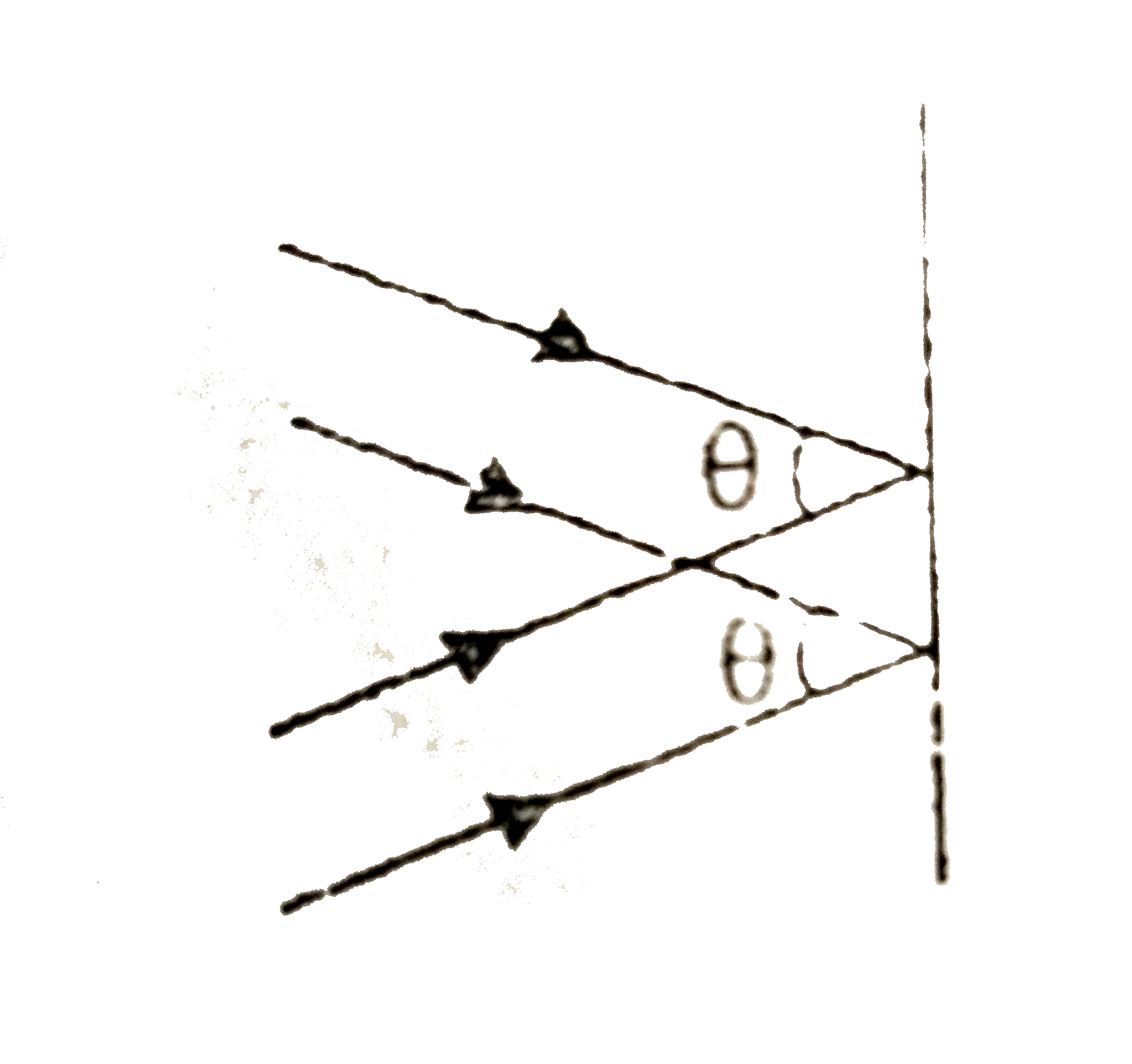
Two parallel beams of light of wavelength `lambda` inclined to each other at angle `theta (ltlt1)` are incident on a plane at near normal incidence. The fringe width will be :

A

`(lambda)/(2theta)`

B

`(2theta)/(theta)`

C

`(lambda)/(theta)`

D

`2lambda sin theta`

Text Solution

Verified by Experts

The correct Answer is:
C


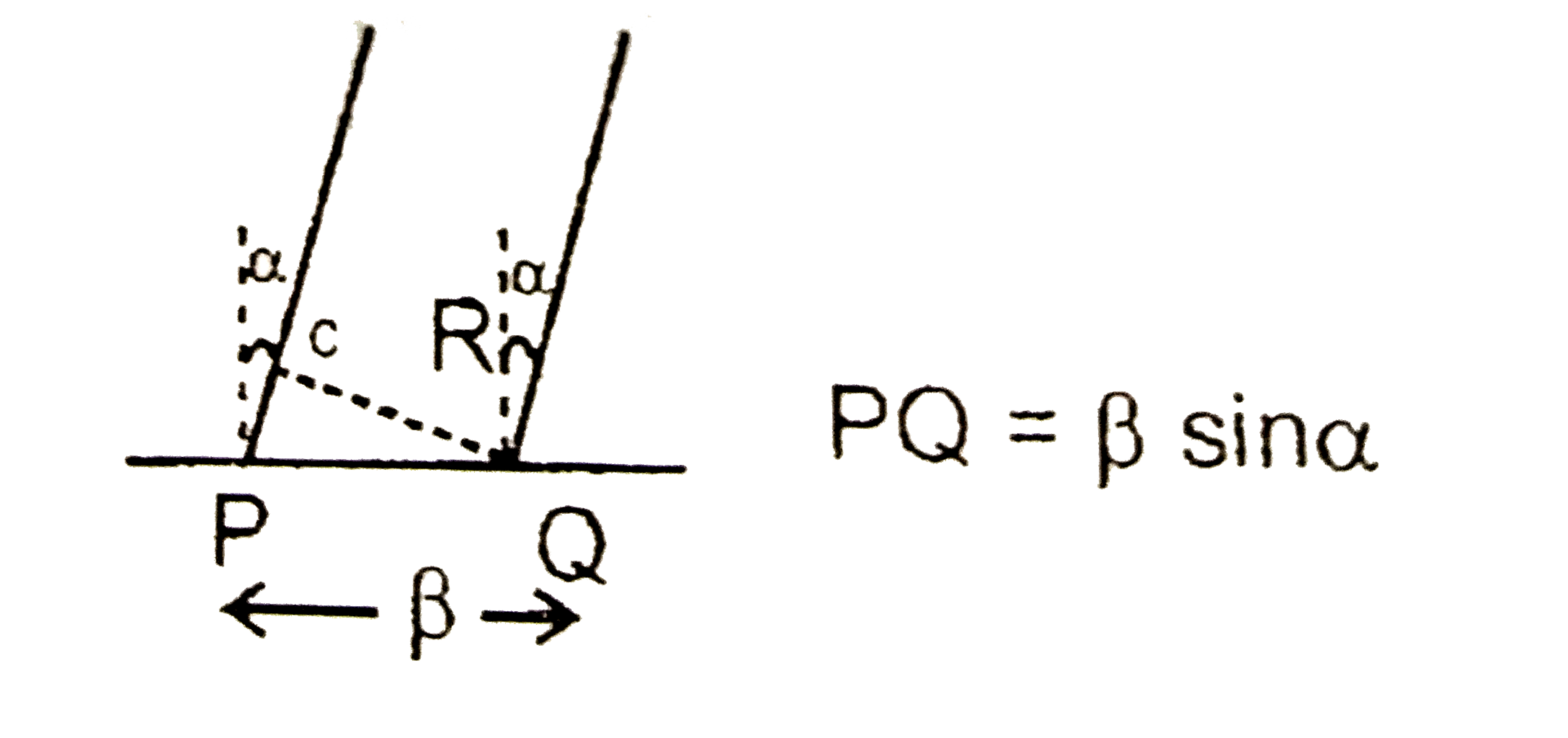
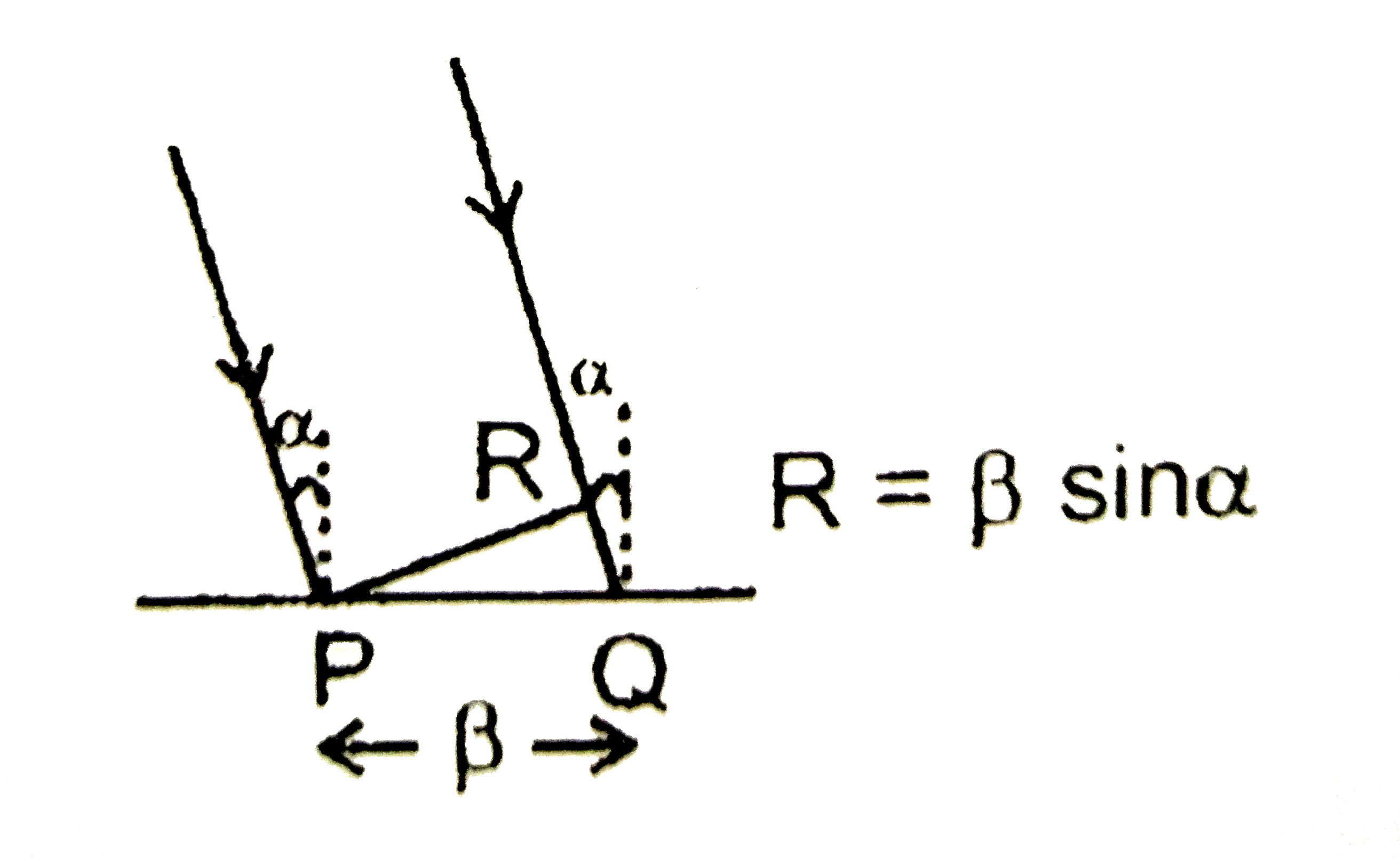
`R=beta sinalpha`
`QR` is the difference between the light reaching at `Q` and `P` respectively

`PQ=beta sinalpha`
for given case `alpha=(theta)/(2)`

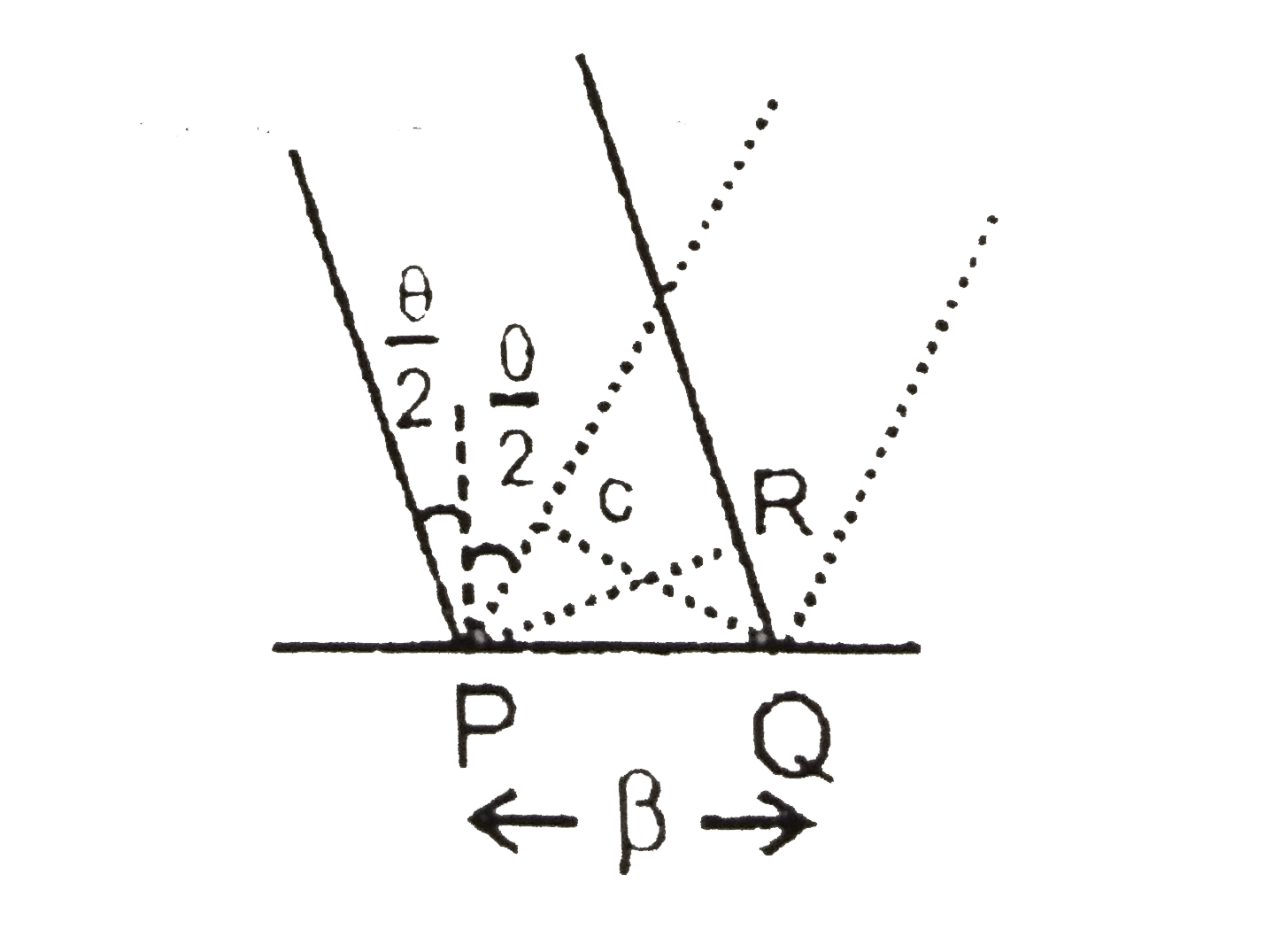
For `PQ` to be one fringe. the path difference between the interfering light beams will change by `lambda` while moving from `P` to `Q`
`|"path difference at" P-"path difference at" Q|=lambda`
`|(betasin'(theta)/(2)-(-betasin'(theta)/(2)))|=lamda rArr2beta sin'(theta)/(2)=lambda beta=(lambda)/(2sin(theta//2))`
for near normal incidence `sintheta~theta beta=(lambda)/(theta)`

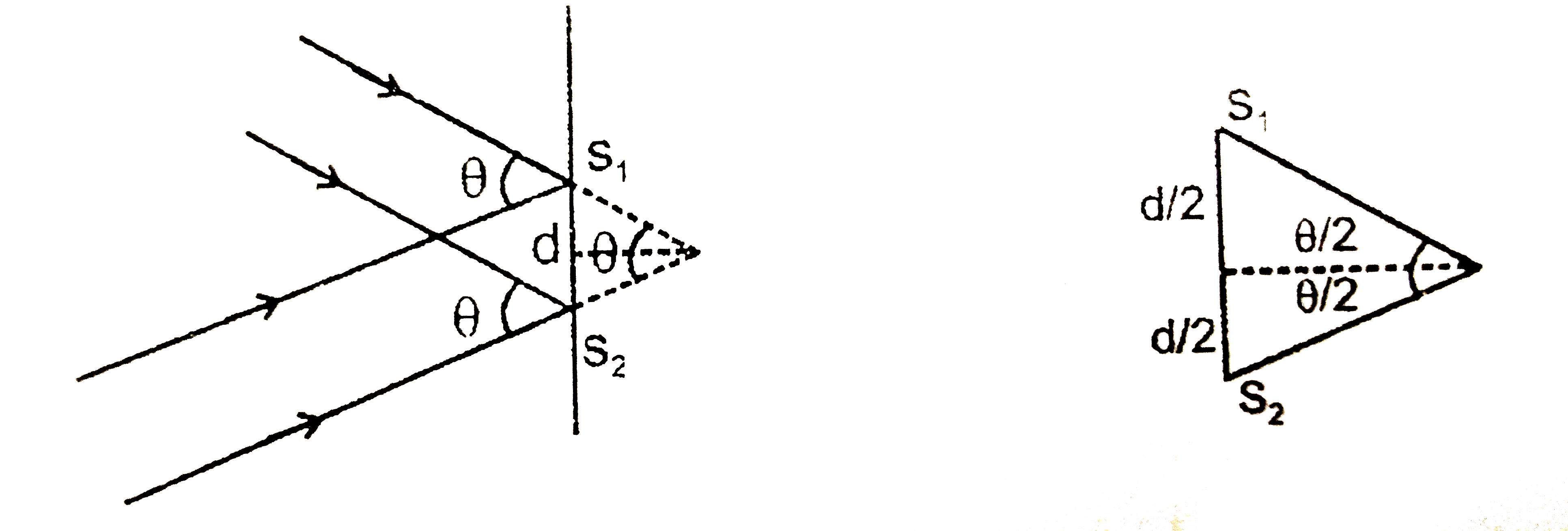
`tan theta//2=(d//2)/(D) (therefore tan theta//2~theta//2)`
`therefore theta=(d)/(D)`
`beta=(lambdaD)/(d)`
`beta=(lambda)/(theta)`
Promotional Banner

Topper's Solved these Questions

  • WAVE OPTICS

    RESONANCE ENGLISH|Exercise Exercise-2 (Part-2)|5 Videos
  • WAVE OPTICS

    RESONANCE ENGLISH|Exercise Exercise-2 (Part-3)|5 Videos
  • WAVE OPTICS

    RESONANCE ENGLISH|Exercise Exercise-1 (Part-2)|13 Videos
  • WAVE ON STRING

    RESONANCE ENGLISH|Exercise Exercise- 3 PART II|7 Videos

Similar Questions

Explore conceptually related problems

A parallel beam of light (lambda= 5000 Å) is incident at an angle theta=30^@ with the normal to the slit plane in a Young's double slit experiment. The intensity due to each slit is I_0 . Point O is equidistant from S_1 and S_2 . The distance between slits is 1mm.

A parallel beam of monochromatic light of wavelength 663 nm is incident on a totally reflection plane mirror. The angle of incidence is 60^@ and the number of photons striking the mirror per second is 1.0xx10^19 . Calculate the force exerted by the light beam on the mirror.

Light of wavelength lambda is incident on a slit of width d and distance between screen and slit is D. Then width of maxima and width of slit will be equal if D is

Two plane mirrors are inclined to each other at an angle theta . A ray of light is reflected at one mirror and then at the other. Find the total deviation of the ray.

A parallel beam of light of wavelength lambda passes through a slit of width d. The transmitted light is collected on a screen D aways (D gt gt d) . Find the distance between the two second order minima.

A parallel beam of monochromatic light of wavelength 663 nm is incident on a totally reflecting plane mirror. The angle of incidence is 60^@ and the number of photons striking the mirror per second is 1.0 xx 10^19 . Calculate the force exerted by the light beam on the mirror.

For a parallel beam of monochromatic light of wavelength 'lambda' diffraction is produced by a single slit whose width 'a' is of the order of the wavelength of the light. If 'D' is the distance of the screen from the slit, the width of the central maxima will be

A parallel beam of monochromatic light of wavelength 500 nm is incident normally on a rectangular slit. The angular width of the central fringe of Fraunhofer diffraction is found to be 60^(@) . Find the width of the slit in metre.

Two plane mirror are inclined to each other at 90^(@) . A ray of light is incident on one mirror. The ray will undergo a total deviation of

A parallel coherent beam of light falls on fresnel biprism of biprism of refractive index mu and angle alpha .The fringe width on a screen at a distance D from biprism will be (wavelength = lambda )