Home
Class 12
PHYSICS
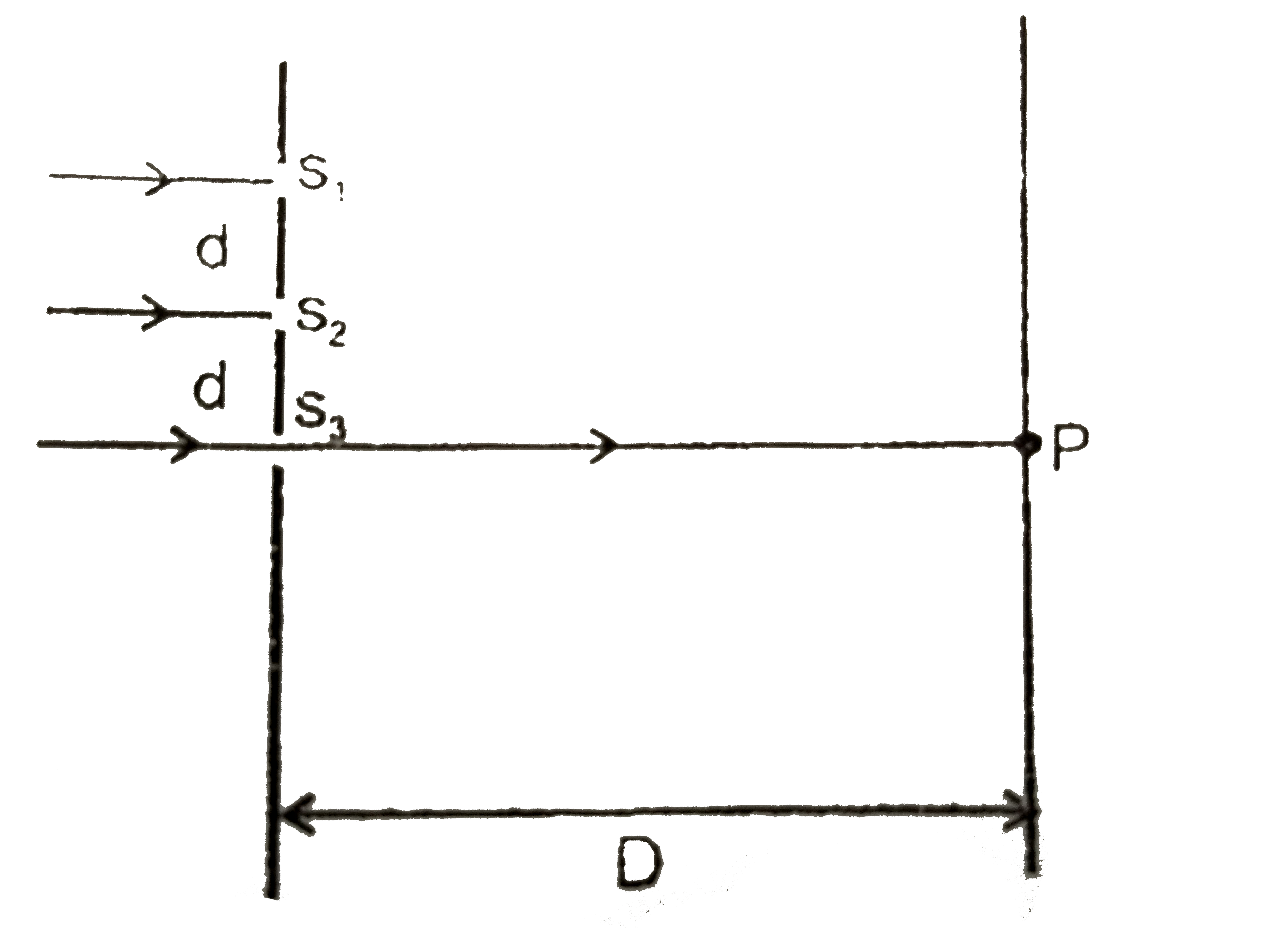
In the figure shown three slits s(1),s(2...

In the figure shown three slits `s_(1),s_(2)` and `s_(3)` are illuminated with of wavelength `lambda.lambda ltltd` and `D gtgt d.` Each slit prouduces same intensity `I` on the screen. If intensity at the point on screen directly infront of `s_(2)` is `3I` then the maximum value of `lambda` is `(nd^(2))/(2D)` Find value of `n.`

Text Solution

Verified by Experts

The correct Answer is:

3

N//a
Promotional Banner

Topper's Solved these Questions

  • WAVE OPTICS

    RESONANCE ENGLISH|Exercise Exercise-2 (Part-3)|5 Videos
  • WAVE OPTICS

    RESONANCE ENGLISH|Exercise Exercise-2 (Part-4)|8 Videos
  • WAVE OPTICS

    RESONANCE ENGLISH|Exercise Exercise-2 (Part-1)|10 Videos
  • WAVE ON STRING

    RESONANCE ENGLISH|Exercise Exercise- 3 PART II|7 Videos

Similar Questions

Explore conceptually related problems

In a Young's double slit experiment, slits are seperated by a distance d and screen is at distance D, (D gt gt d) from slit plane. If light source of wavelength lambda(lambda ltlt d) is used. The minimum distance from central point on the screen where intensity is one fourth of the maximum is (D lambda)/(nd) . Find the value of n.

In YDSE pattern with light of wavelength lambda_1 = 500nm , 15 fringes are obtained on a certain segment of screen. If number of fringes for light of wavelength lambda_2 on same segment of screen is 10, then the value of lambda_2 (in nm) is-

In YDSE pattern with light of wavelength lambda_1 = 500nm , 15 fringes are obtained on a certain segment of screen. If number of fringes for light of wavelength lambda_2 on same segment of screen is 10, then the value of lambda_2 (in nm) is-

A Young's double slit experiment uses a monochromatic light of wavelength lambda . The intensity of each slit is same and is equal to I_(0) . What will be the resultant intensity at a point where waves interfere at a path difference of (lambda)/2 ?

Two ideal slits S_(1) and S_(2) are at a distance d apart, and illuninated by light of wavelength lambda passing through an ideal source slit S placed on the line through S_(2) as shown. The distance between the planes of slits and the source slit is D.A screen is held at a distance D from the plane of the slits. The minimum value of d for which there is darkness at O is (dlt lt D)

Light from two coherent sources of the same amplitude A and wavelength lambda illuminates the screen. The intensity of the central maximum is I_(0) . If the sources were incoherent, the intensity at the same point will be

In the figure , the intensity of waves arriving at D from two coherent soucrces s_(1) and s_(2) is I_(0) . The wavelength of the wave is lambda = 4 m . Resultant intensity at D will be

In young's double slit experiment, distance between the slit S_1 and S_2 is d and the distance between slit and screen is D . Then longest wavelength that will be missing on the screen in front of S_1 is

Consider the situation shown in figure. The two slite S_1 and S_2 placed symmetrically around the centre line are illuminated by a monochromatic light of wavelength lambda. The separation between the slits is d. The light transmitted by the slits falls on a screen M_1 placed at a distance D from the slits. The slit S_3 is at the centre line and the slit S_4 is at a distance y form S_3 . Another screen M_2 is placed at a further distance D away from M_1 . Find the ration of the maximum to minimum intensity observed on M_2 if y is equal to (dltltD) .

Consider the situation shown in figure. The two slits S_1 and S_2 placed symmetrically around the central line are illuminated by a monochromatic light of wavelength lamda . The separation between the slits is d. The light transmitted by the slits falls on a screen Sigma_1 placed at a distance D from the slits. The slit S_3 is at the placed central line and the slit S_4 , is at a distance z from S_3 . Another screen Sigma_2 is placed a further distance D away from 1,1. Find the ratio of the maximum to minimum intensity observed on Sigma_2 if z is equal to a. z=(lamdaD)/(2d) b. (lamdaD)/d c. (lamdaD)/(4d)
