Home
Class 12
PHYSICS
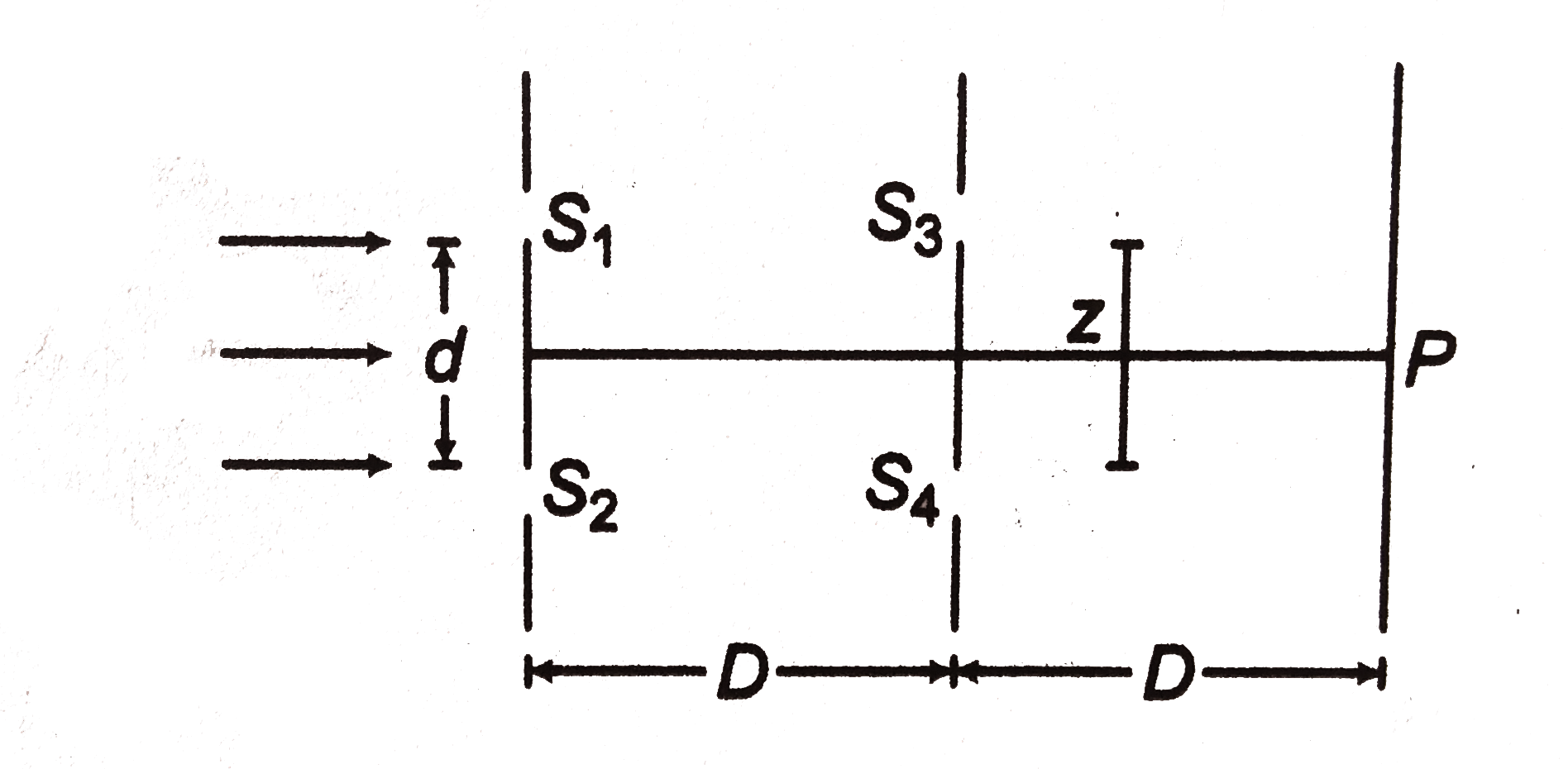
Consider the arrangement shown in figure...

Consider the arrangement shown in figure. By some mechanism,
the separation between the slits `S_3 and S_4` can be changed. The intensity is
measured at the point P which is at the common perpendicular bisector of `S_1 S_2`
and `S_3 S_4`. When `z=(Dlambda)/(2d)`, the intensity measured at P is I. Find the intensity when
z is equal to

`(a)(Dlambda)/d (b)(3Dlambda)/(2d) (c) (2Dlambda)/d ` .

Text Solution

Verified by Experts

The correct Answer is:
2

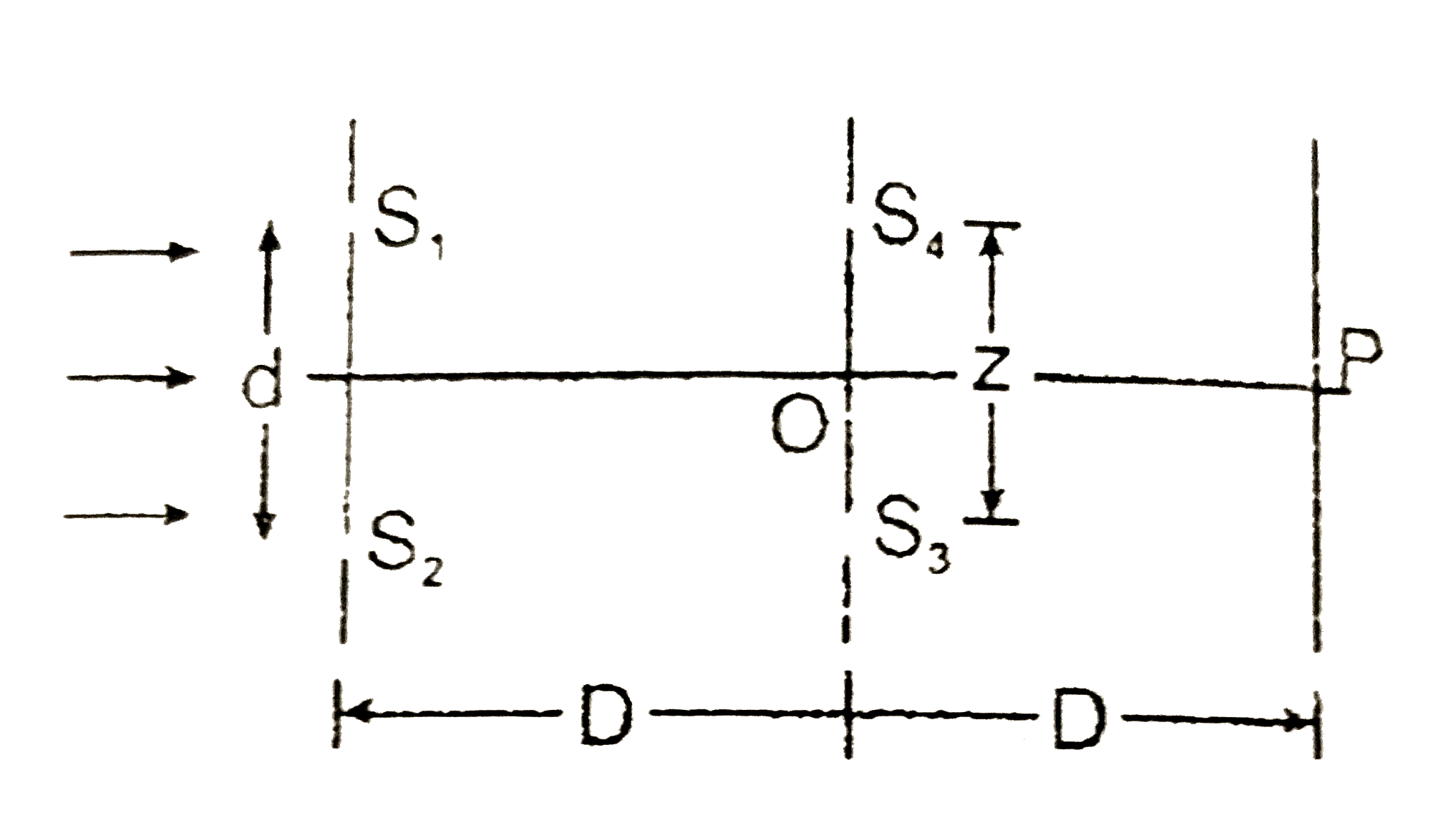
Where `Z= (Dlambda)/(2d)=(beta)/(2) rArr OS_(4) = (beta)/(4)` as shown.
If intensity at `'p'` is `I` then intensity of light at `S_(3)` and `S_(4)` is `I//4 & I//4`
`therefore` Path difference `S_(4) P-S_(3)P=0`
So, intensity of slits `S_(1)` and `S_(2)`
`Deltaphi` at `S_(4)`
`Deltap=(yd)/(D)=(d)/(D)((z)/(2))=(lambda)/(4)`
`Deltaphi=(2pi)/(lambda).(lambda)/(4)=(pi)/(2)`
`(I)/(4)-I_(R)=I_(1)+I_(1)+2sqrt(I_(1)I_(1)) cos' (pi)/(2)`
`I_(1)=I_(2)=(I)/(8)` intensity of `S_(1)` and `S_(2).`
If `z=4.(lambdaD)/(d)=4beta`
`Deltap=(yd)/(D)=(z)/(2).(d)/(D)=((4lambdaD)/(d))xx(1)/(2)xx(d)/(D)=2lambda`
`Deltaphi=(2pi)/(lambda).2d=4pi`
`I_(3)=I_(4)=(I)/(8)+(I)/(8)+(2I)/(8) cos 4pi=(1)/(2)`
at `'p'I_(p)=(I)/(2)+(I)/(2)+2sqrt(I/(2).(I)/(2)) cos 0^(@)`
Promotional Banner

Topper's Solved these Questions

  • WAVE OPTICS

    RESONANCE ENGLISH|Exercise Exercise-2 (Part-3)|5 Videos
  • WAVE OPTICS

    RESONANCE ENGLISH|Exercise Exercise-2 (Part-4)|8 Videos
  • WAVE OPTICS

    RESONANCE ENGLISH|Exercise Exercise-2 (Part-1)|10 Videos
  • WAVE ON STRING

    RESONANCE ENGLISH|Exercise Exercise- 3 PART II|7 Videos

Similar Questions

Explore conceptually related problems

In the arrangement shown in Fig., slits S_(1) and S_(4) are having a variable separation Z. Point O on the screen is at the common perpendicular bisector of S_(1) S_(2) and S_(3) S_(4) . When Z = (lambda D)/(2d) , the intensity measured at O is I_(0) . The intensity at O When Z = (2 lambda D)/(d) is

In the arrangement shown in Fig., slits S_(1) and S_(4) are having a variable separation Z. Point O on the screen is at the common perpendicular bisector of S_(1) S_(2) and S_(3) S_(4) . The minimum value of Z for which the intensity at O is zero is

In the arrangement shown in Fig., slits S_(1) and S_(4) are having a variable separation Z. Point O on the screen is at the common perpendicular bisector of S_(1) S_(2) and S_(3) S_(4) . If a hole is made at O' on AO' O and the slit S_(4) is closed, then the ratio of the maximum to minimum observed on screen at O , if O' S_(3) is equal to (lambda D)/(4d) , is

In arrangement shown in figure, plane wavefront of monochromatic light of wavelength lamda is incident on identical slits S_(1) and S_(2) . There is another pair of indentical slits S_(3) and S_(4) which are having separation Z = (lamda D)/(2d) Point O is on the screen at the common perpendicular bisector of S_(1)S_(2) and S_(3) S_(4).I_(1) is the intensity at point O Now the board having slits S_(3)S_(4) is moved upward parallel to itself and perpendicular to line AO till slit S_(4) is on line AO and it is observed that now intensity at point O is I_(2) then (I_(2))/(I_(1)) is :

A monochromatic light source of wavelength lamda is placed at S. three slits S_(1),S_(2) and S_(3) are equidistant from the source S and the point P on the screen S_(1)P-S_(2)P=lamda//6 and S_(1)P-S_(3)P=2lamda//3 . if I be the intensity at P when only one slit is open the intensity at P when all the three slits are open is-

In a Young's double slit experiment, the separation between the two slits is d and the wavelength of the light is lamda . The intensity of light falling on slit 1 is four times the intensity of light falling on slit 2. Choose the correct choice (s).

Consider the situation shown in figure. The two slits S_1 and S_2 placed symmetrically around the central line are illuminated by a monochromatic light of wavelength lamda . The separation between the slits is d. The light transmitted by the slits falls on a screen Sigma_1 placed at a distance D from the slits. The slit S_3 is at the placed central line and the slit S_4 , is at a distance z from S_3 . Another screen Sigma_2 is placed a further distance D away from 1,1. Find the ratio of the maximum to minimum intensity observed on Sigma_2 if z is equal to a. z=(lamdaD)/(2d) b. (lamdaD)/d c. (lamdaD)/(4d)

In the figure shown S_(1)O-S_(2)O=S_(3)O-S_(2)O=(lambda)/(4) , Intensity at O due to any one of the slits is I_(0) . What is the intensity due to all the three coherent sources S_(1), S_(2) and S_(3) ?

In the arrangement shown in figure, light of wavelength 6000 Å is incident on slits S_(1) and S_(2) have been opened such that S_(3) is the position of first maximum above the central maximum and S_(4) is the closest position where intensity is same as that of the ligth used, below the central maximum Point O is equidistant from S_(1) and S_(2) and O' is equidistant from S_(3) and S_(4) . Then intensity of inciden light is I_(0) Find the intensity at O' (on the screen).

In the arrangement shown in figure, light of wavelength 6000 Å is incident on slits S_(1) and S_(2) have been opened such that S_(3) is the position of first maximum above the central maximum and S_(4) is the closest position where intensity is same as that of the ligth used, below the central maximum Point O is equidistant from S_(1) and S_(2) and O' is equidistant from S_(3) and S_(4) . Then intensity of inciden light is I_(0) Find the intensity of the brightest fringe.

