Home
Class 12
PHYSICS
In the figure an arrangement of young's ...

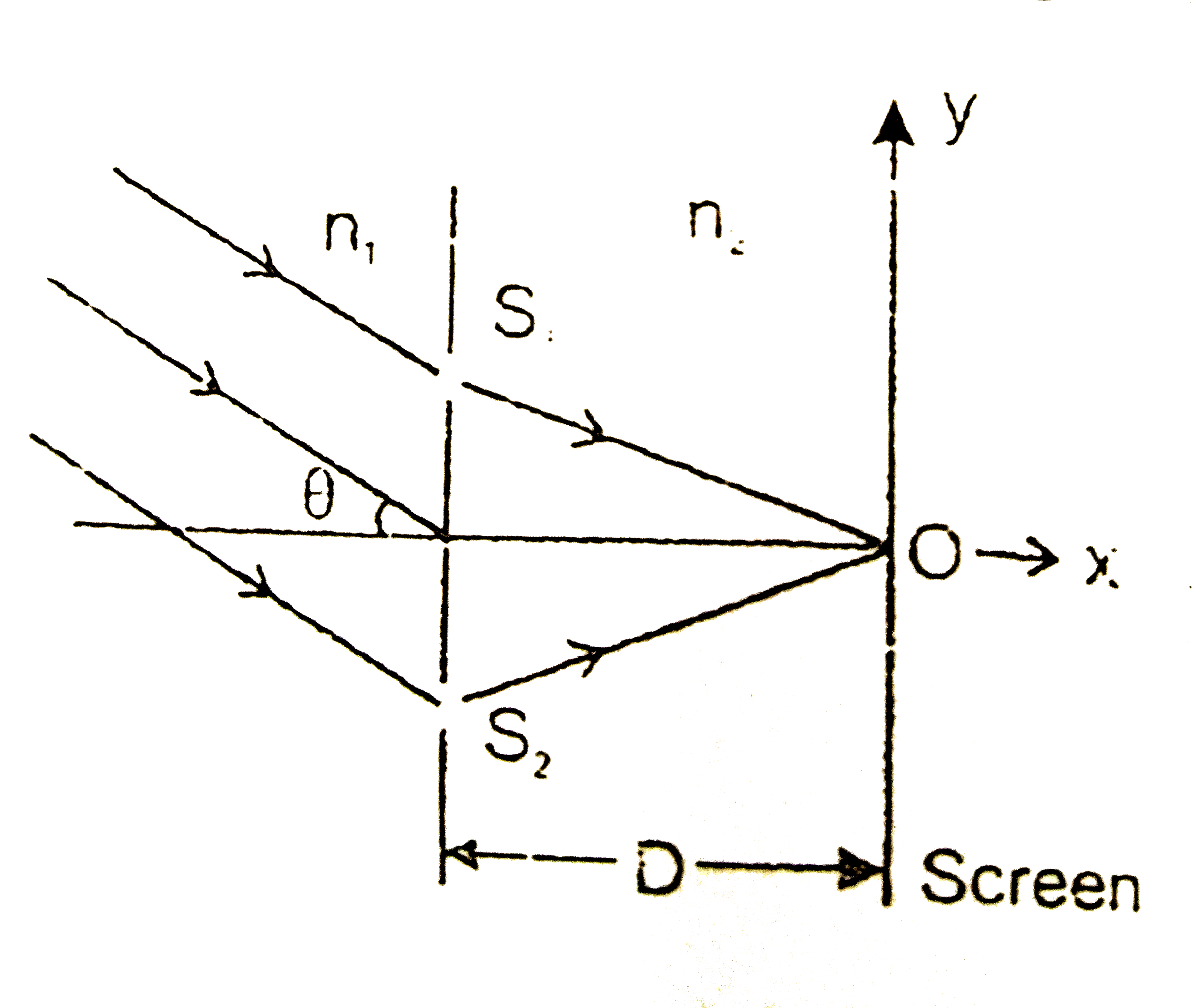
In the figure an arrangement of young's double slit experiment is shown. `A` parallel beam of light of wavelength `'lambda'` (in medium `n_(1)`) is incident at an angle `'theta'` as shown. Distance `S_(1)O = S_(2)O.` Point `'O'` is the origin of the coordinate system. The medium on the left and right side of the plane of slits has refractive index `n_(1)` and `n_(2)` respectively. Distance between the slits is `d.` The distance between the screen and the plane of slits is `D.`
Using `D=1m , d =1mm, theta=30^(@), lambda=0.3mm,n_(1)=(4)/(3),n_(2)=(10)/(9),` answer the following

They-corrdinate of the point where the total phase difference between the interefering waves is zero, is

A

`y = 0`

B

`y = + (3)/(4)m`

C

`y = - (3)/(4)m`

D

`-(1)/(sqrt3)`

Text Solution

Verified by Experts

The correct Answer is:

C

N//a
Promotional Banner

Topper's Solved these Questions

  • WAVE OPTICS

    RESONANCE ENGLISH|Exercise Exercise-3 (Part-1)|11 Videos
  • WAVE OPTICS

    RESONANCE ENGLISH|Exercise Exercise-3 (Part-2)|15 Videos
  • WAVE OPTICS

    RESONANCE ENGLISH|Exercise Exercise-2 (Part-3)|5 Videos
  • WAVE ON STRING

    RESONANCE ENGLISH|Exercise Exercise- 3 PART II|7 Videos

Similar Questions

Explore conceptually related problems

In the figure an arrangement of young's double slit experiment is shown. A parallel beam of light of wavelength 'lambda' (in medium n_(1) ) is incident at an angle 'theta' as shown. Distance S_(1)O = S_(2)O. Point 'O' is the origin of the coordinate system. The medium on the left and right side of the plane of slits has refractive index n_(1) and n_(2) respectively. Distance between the slits is d. The distance between the screen and the plane of slits is D. Using D=1m , d =1mm, theta=30^(@), lambda=0.3mm,n_(1)=(4)/(3),n_(2)=(10)/(9), answer the following If the intensity due to each light wave at point 'O' is I_(0) then the resultant intensity at point 'O' will be -

In the figure an arrangement of young's double slit experiment is shown. A parallel beam of light of wavelength 'lambda' (in medium n_(1) ) is incident at an angle 'theta' as shown. Distance S_(1)O = S_(2)O. Point 'O' is the origin of the coordinate system. The medium on the left and right side of the plane of slits has refractive index n_(1) and n_(2) respectively. Distance between the slits is d. The distance between the screen and the plane of slits is D. Using D=1m , d =1mm, theta=30^(@), lambda=0.3mm,n_(1)=(4)/(3),n_(2)=(10)/(9), answer the following If the intensity due to each light wave at point 'O' is I_(0) then the resultant intensity at point 'O' will be -

In Young's double slit experiment, the sepcaration between the slits is halved and the distance between the slits and the screen is doubled. The fringe width is

In Young's double slit experiment, the sepcaration between the slits is halved and the distance between the slits and the screen is doubled. The fringe width is

In Young's double slit experiment, the separation between the slits is halved and the distance between the slits and the screen is doubled. The fringe width is

In Young's double-slit experiment, the separation between the slits is halved and the distance between the slits and the screen in doubled. The fringe width is

In Young's double slit experiment the 7th maximum with wavelength lambda_(1) is at a distance d_(1) , and that with wavelength lambda_(2) is at distance d_(2) . Then d_(1)//d_(2) is

Consider a Young's double slit experiment as shown in figure. What would be the slit separation d in terms of wavelength lamda such that the first minima occurs directly in front of the (S_(1)) ?

In a Young's double slit experiment, (slit distance d) monochromatic light of wavelength lambda is used and the fringe pattern observed at a distance D from the slits. The angular position of the bright fringes are

In Young's experiment the distance between two slits is d/3 and the distance between the screen and the slits is 3D. The number of fringes in 1/3 metre on the screen, formed by monochromatic light of wavelength 3lambda , will be:
