Home
Class 12
PHYSICS
How is a wavefront defined? Using Huygen...

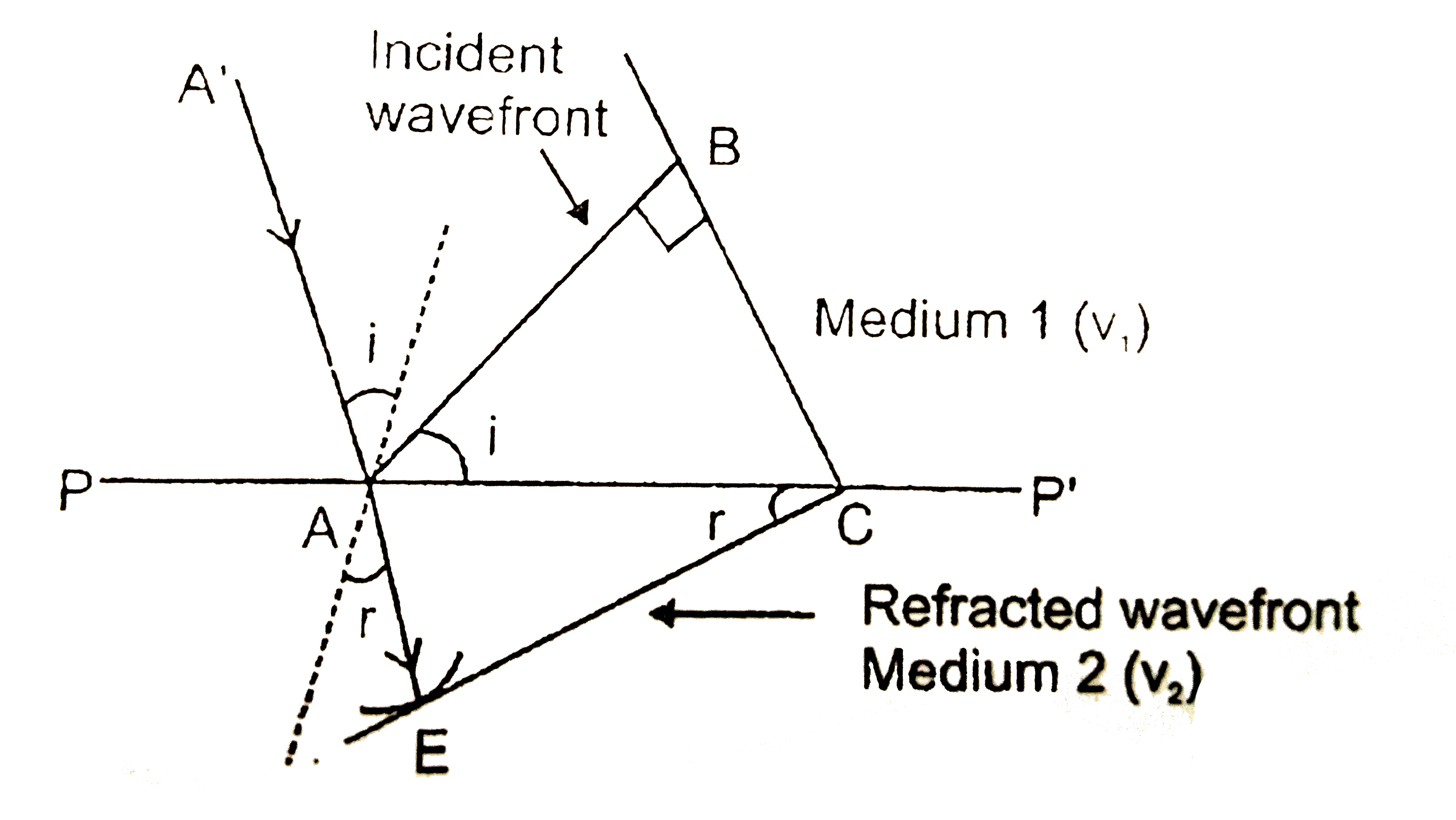
How is a wavefront defined? Using Huygen's construction , draw a figure showing the propagation of a plane wave refracting at a plane surface separating two media. Hence verify Snell's law of refraction.

Text Solution

Verified by Experts
Wavefront : The continuous locus of all the particles of a medium, which are vibrating in the same phse is called a wavefront.
(ii) Snell's law of refraction : Let `PP'` represent the surface separating medium `1` and medium `2` as shown in fig.

Let `v_(1)` and `v_(2)` represents the speed of light in medium `1` and medium `2` respectively. We assume a plane wavefront `AB` propagating in the direction `A'A` incident on the interface at an angle `i.` Let `t` be the time taken by the wavefront to travel the distance `BC`.
`therefore BC=v_(1)t ["distance=speed"xx"time"],AE=v_(2)t`
`therefore CE` would represent the refracted wavefront.
In `Delta ABC` and `Delta AEC,` we have
`sini =(BC)/(AC)=(v_(1)t)/(AC)`
and `sinr=(AE)/(AC)=(v_(2)t)/(AC)`
where `i` and `r` the angles of incident and refraction respectively.
`therefore(sini)/(sinr)=(u_(1))/(AC).(AC)/(u_(2)t)`
`(sini)/(sinr)=(u_(1))/(u_(2))`
If `C` represents the speed of ligth in vacuum, then
`n_(1)=(C)/(u_(1)) and n_(2)=(C)/(u_(2)) rArr v_(1)=(C)/(n_(1))and v_(2)(C)/(n_(2))`
Where `n_(1) and n_(2)` are the refractive indices of medium `1` and medium `2`.
`therefore (sini)/(sinr)=(C//n_(1))/(C//n_(2))rArr(sini)/(sinr)=(n_(2))/(n_(1))`
`rArrn_(1)sini=n_(2)sinr`
This is the Snell's law of refraction
Promotional Banner

Topper's Solved these Questions

  • WAVE OPTICS

    RESONANCE ENGLISH|Exercise Advanced Level Problems|8 Videos
  • WAVE OPTICS

    RESONANCE ENGLISH|Exercise Exercise-3 (Part-2)|15 Videos
  • WAVE ON STRING

    RESONANCE ENGLISH|Exercise Exercise- 3 PART II|7 Videos

Similar Questions

Explore conceptually related problems

Using Huygen's construction, draw a figure showing the propagation of a plane wave reflecting at the interface of the two media. Show that the angle of incidene is equal to the angle of reflection.

Using Huygen's construction, draw a figure showing the propagation of a plane wave reflecting at the interface of the two media. Show that the angle of incidence is equal to the angle of reflection.

Use Huygen's principle to show how a plane wavefront propagates from a denser to rarer medium. Hence verift snell's law of refreaction.

A plane wavefront propagating from a rarer into a denser medium is incident at an angle of incidence i on a refracting surface. Draw a diagram showing incident wavefront and refracted wavefront . Hence verify Snell's laws of refraction.

The diagram, given below, shows the refracton of a plane wavefront, incident on the surface PP' separating two media, (1) and (2). Which of the media is the rarer one ?

(a) State Huygen's principle . Using this principle draw a diagram to show how a plane wave front incident at the interface of the media gets refracted when it propagates from a rarer to a denser medium. Hence verify Snell's law of refraction. (b) When monochromatic light travels from a rarer to a denser medium, explain the following, giving reasons- (i) Is the frequency of reflected and refracted light same as the frequency of incident light? (ii) Does the decrease in speed imply a reduction in the energy carried by light wave?

Draw a diagram to show refraction of a plane wave front incident in a convex lens and hence draw the refracted wave front

Answer the following: (a) What is a wave front? How does it propagate? Using Huygens' principle, explain reflection of a plane wavefront from a surface and verify the laws of reflection. (b) A parallel beam of light of wavelength 500 nm falls on a narrow slit and the resulting diffraction pattern is obtained on a screen 1 m away. If the first minimum is formed at a distance of 2.5 mm from the centre of screen, find the (i) width of the slit, and (ii) distance of first secondary maximum from the centre of the screen.

Using Huygen.s principle, verify Snell.s law of refraction of plane wave propagating from denser medium to rarer medium.

RESONANCE ENGLISH-WAVE OPTICS-Exercise-3 (Part-3)
  1. (a) What is plane polarised light? Two polaroid sare placed at 90^(@)...

    Text Solution

    |

  2. What is meant by a linearly polarised light? Which type of waves can b...

    Text Solution

    |

  3. How is a wavefront defined? Using Huygen's construction , draw a figu...

    Text Solution

    |

  4. (a) Light, from a sodium lamp, is passed through two polaroid sheets P...

    Text Solution

    |

  5. In a Young's double slit experiment , the slits are Kept 2mm apart and...

    Text Solution

    |

  6. In Young's double slit experiment ,momochromatic light of wavelength 6...

    Text Solution

    |

  7. In a singleslit diffraction experiment, when a tiny circular obstacle ...

    Text Solution

    |

  8. The diagram, given below, shows the refracton of a plane wavefront, in...

    Text Solution

    |

  9. How would the angular separation of interference fringes in Young's do...

    Text Solution

    |

  10. Two polaroid A and B are set in crossed positions. A third polaroid C ...

    Text Solution

    |

  11. In Young's double slit experiment , the two slits 0.20 mm apart are il...

    Text Solution

    |

  12. State Huygens' principle of diffraction of light.

    Text Solution

    |

  13. State the importance of coherent sources in the phenomenon of interfer...

    Text Solution

    |

  14. Answer the following: (a) What is a wave front? How does it propagat...

    Text Solution

    |

  15. (a) Define a wavefront. Use Huygen' principle to shown diagrammaticall...

    Text Solution

    |

  16. (a) Why are coherent sources necessary to produce a sustained interfer...

    Text Solution

    |

  17. Answer the following: (a) In Young's double slit experiment, derive ...

    Text Solution

    |

  18. Which of the following waves can be polarized (i) Heat waves (ii) Soun...

    Text Solution

    |

  19. Two wavelengths of sodium light 590 nm and 596 nm are used, in turn, ...

    Text Solution

    |

  20. The ratio of the intensities at minima to maxima in Young's double sli...

    Text Solution

    |

