Home
Class 12
PHYSICS
(a) Light, from a sodium lamp, is passed...

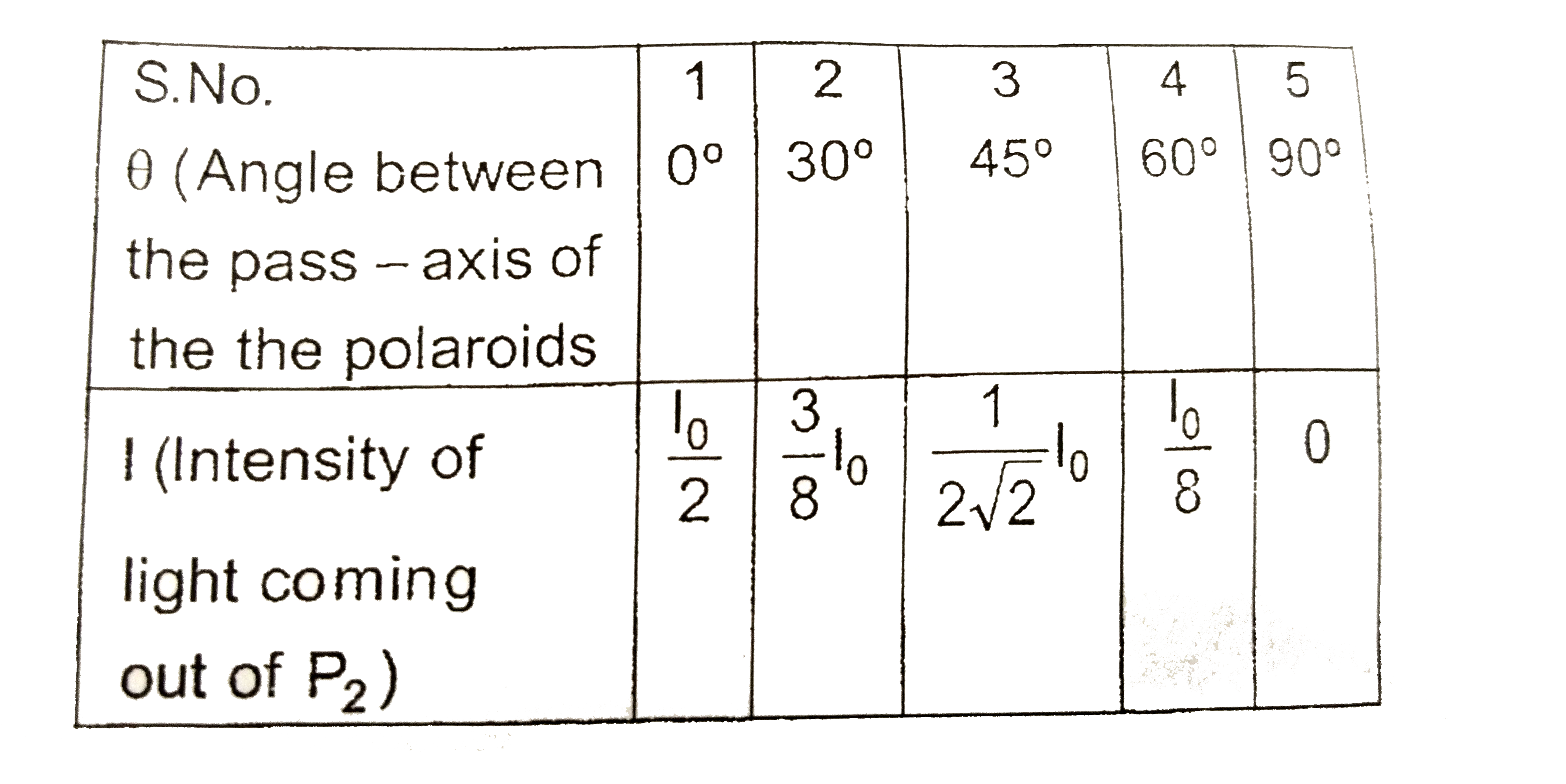
(a) Light, from a sodium lamp, is passed through two polaroid sheets `P_(1)` and `P_(2)` kept one after the other. Keeping `P_(1)` fixed, `P_(2)` is rotated so the its 'pass-axis' can be at different angles, `theta,` with respect to the pass-axis of `P_(1)`
An experimentalist records the following data for the intensity of light coming out `P_(2)` as a function of the angle `theta.`

[`I_(0)=` Intensity of beam falling on `P_(1)`]
One of these observation is not is agreement with expected theoretical variation of `l.` ldentify this observation and write the correct expression.
(b) Define Brewster angle and write the expression for it in terms of the refractive index of the medium.

Text Solution

Verified by Experts

(a) If `l_(0)` is the irradiate of incoming beam, then the irradiance is reduced to `l_(1)=l_(1)=(l_(0))/(2)` after passing through the first polariser.
`therefore l_(2)=l_(1) cos^(2)30^(@) [therefore l=l_(0) cos^(2) theta]`
`=(l_(0))/(2)((sqrt3)/(2))^(2)=l_(0)/(2)xx(3)/(4)=(3l_(0))/(8)`
`l_(3)=l_(2) cos^(2)45^(@)`
`=(3l_(0))/(8)((1)/(sqrt2))^(2)=(3l_(0))/(8)xx(1)/(2)=(3l_(0))/(16)`
`l_(4)=l_(4) cos^(2)60^(@)`
`=(3l_(0))/(64)xx0=0`
Obesrvations `(3) and (4)` are not in agreement with the expected theoretical variations of `l`. `thereore` Conrrect observations are
`l_(3)=(3l_(0))/(16) and l_(4)=(3l_(0))/(64)`
(b) Brewster's angle : The angle of incidence at which, when ordinary light is incident on transparent refracting medium, the reflected light becomes maximum in plane, polarised light is called Brewster's angle or polarising angle. It is denoted by in.
The relation between retroactive index `mu` and in is `mu=tan i_(p)`.
Promotional Banner

Topper's Solved these Questions

  • WAVE OPTICS

    RESONANCE ENGLISH|Exercise Advanced Level Problems|8 Videos
  • WAVE OPTICS

    RESONANCE ENGLISH|Exercise Exercise-3 (Part-2)|15 Videos
  • WAVE ON STRING

    RESONANCE ENGLISH|Exercise Exercise- 3 PART II|7 Videos

Similar Questions

Explore conceptually related problems

Light from sodium lamp is made to pass through two polaroids placed one after the other in the path of light. Taking the intensity of the incident light as 100% , the intensity of the out coming light that can be varied in the range

Unpolarised light is passed through a polaroid P_(1) . When this poalrised beam passes through another polaroid P_(2) , and if the pass axis of P_(2) makes an angle theta with pass axis of P_(1) , then write the expression for the polarised beam passing through P_(2) . Draw a plot showing the variation of intensity when theta varies from 0 to 2 pi .

Two Polaroids, P_(1)andP_(2) are set-up so that their pass-axis are crossed with respect to each other. A third Polaroids, P_(3) is now introduced between these two so that its pass-axis makes and angle theta with the pass-axis of P_(1) . A beam of unpolarised light, of intensity I, is incident on P_(1) . If the intensity of light, that gets transmitted through this combination of three Polaroids is I' find the ratio ((I')/(I)) when theta equals. (i) 30^(@)" "(ii)45^(@)

Two Polaroids P_(1) and P_(2) are placed with their axis perpendicular to eachother. Unpolarised light I_(0) is nicident on P_(1) . A third polaroid P_(3) is kept in between P_(1) and P_(2) such that its axis makes an angle 45^(@) with that of P_(1) . The intensity of transmitted light through P_(2) is

Two Polaroids P_(1) and P_(2) are placed with their axis perpendicular to eachother. Unpolarised light I_(0) is nicident on P_(1) . A third polaroid P_(3) is kept in between P_(1) and P_(2) such that its axis makes an angle 45^(@) with that of P_(1) . The intensity of transmitted light through P_(2) is

Two polaroids P_(1)" and "P_(2) are placed with their axis perpendicular to each other. Unpolarised light I_(0) is incident of P_1 . A third polaroid P_3 is kept in between P_(1)" and "P_(2) such that its axis makes an angle 45^(@) with that of P_(1) . The intensity of transmitted light through P_(2) is :

Unpolarised light passes through two polaroids, the axis of one is vertical and that of the other is at 45^(@) to the vertical. Then, the intensity of the transmitted light is

Two 'crossed' polaroids A and B are placed in the path of a light-beam. In between these, a third polaroid is C is placed whose polarisation axis makes an angle theta with a polarisation axis of the polaroid A. If the intensity of light emerging from the polaroid a is I_(o) then the intensity of light emerging from polaroid B will be

If P_(n) = cos^(n)theta +sin^(n)theta , then P_(2) - P_(1) is equal to :

A polaroid sheet is rotated in between two crossed polaroids P _(1) and P _(2) At what theta of pass axis of polaroid sheet with pass-axis of polaroid P _(1) must be kept so that the final intensity of transmitted light be maximum? (P = polaroid sheet axis)

RESONANCE ENGLISH-WAVE OPTICS-Exercise-3 (Part-3)
  1. (a) What is plane polarised light? Two polaroid sare placed at 90^(@)...

    Text Solution

    |

  2. What is meant by a linearly polarised light? Which type of waves can b...

    Text Solution

    |

  3. How is a wavefront defined? Using Huygen's construction , draw a figu...

    Text Solution

    |

  4. (a) Light, from a sodium lamp, is passed through two polaroid sheets P...

    Text Solution

    |

  5. In a Young's double slit experiment , the slits are Kept 2mm apart and...

    Text Solution

    |

  6. In Young's double slit experiment ,momochromatic light of wavelength 6...

    Text Solution

    |

  7. In a singleslit diffraction experiment, when a tiny circular obstacle ...

    Text Solution

    |

  8. The diagram, given below, shows the refracton of a plane wavefront, in...

    Text Solution

    |

  9. How would the angular separation of interference fringes in Young's do...

    Text Solution

    |

  10. Two polaroid A and B are set in crossed positions. A third polaroid C ...

    Text Solution

    |

  11. In Young's double slit experiment , the two slits 0.20 mm apart are il...

    Text Solution

    |

  12. State Huygens' principle of diffraction of light.

    Text Solution

    |

  13. State the importance of coherent sources in the phenomenon of interfer...

    Text Solution

    |

  14. Answer the following: (a) What is a wave front? How does it propagat...

    Text Solution

    |

  15. (a) Define a wavefront. Use Huygen' principle to shown diagrammaticall...

    Text Solution

    |

  16. (a) Why are coherent sources necessary to produce a sustained interfer...

    Text Solution

    |

  17. Answer the following: (a) In Young's double slit experiment, derive ...

    Text Solution

    |

  18. Which of the following waves can be polarized (i) Heat waves (ii) Soun...

    Text Solution

    |

  19. Two wavelengths of sodium light 590 nm and 596 nm are used, in turn, ...

    Text Solution

    |

  20. The ratio of the intensities at minima to maxima in Young's double sli...

    Text Solution

    |
