Home
Class 12
PHYSICS
(a) Define a wavefront. Use Huygen' prin...

(a) Define a wavefront. Use Huygen' principle to shown diagrammatically the propagation of a plane wavefront from the intant `t_(1)=0` to later time `t_(2)`.
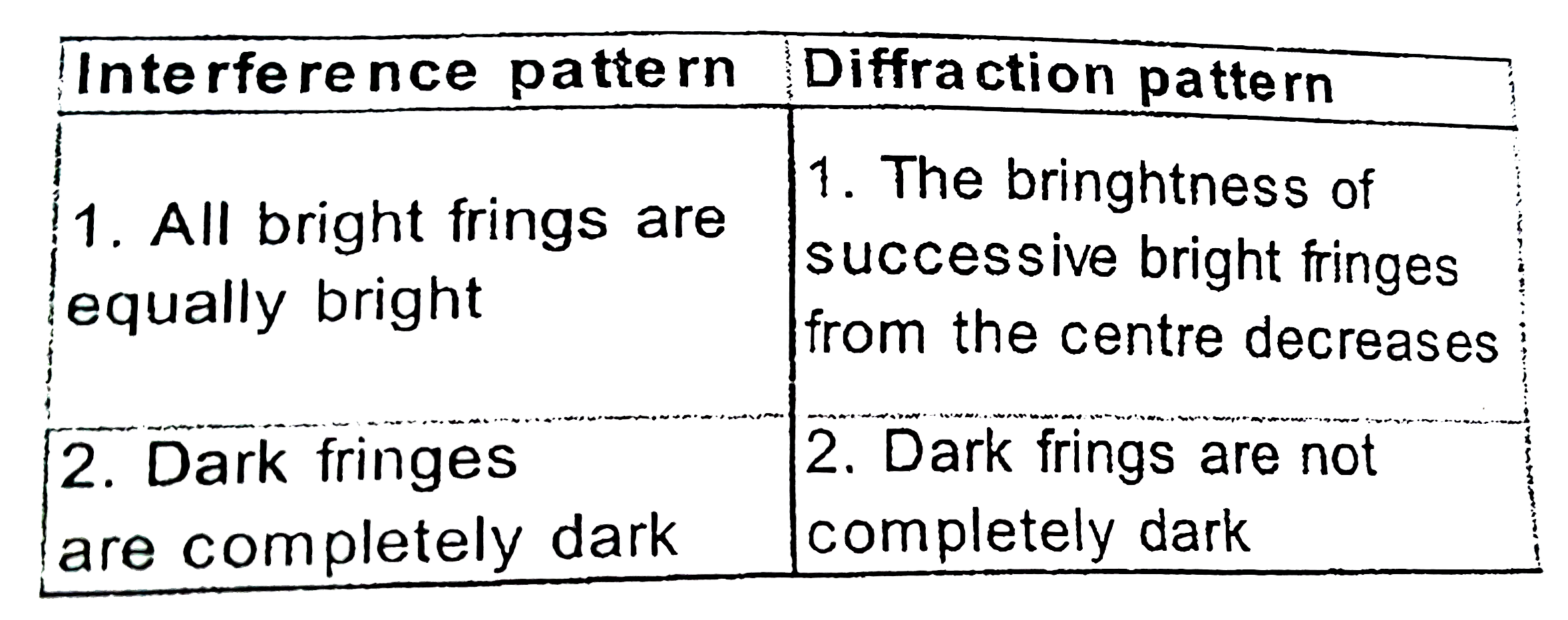
(b) State briefly two features which can distinguish the characteristic features of an interference pattern from those observed in the diffraction pattern due a single slit.

Text Solution

Verified by Experts
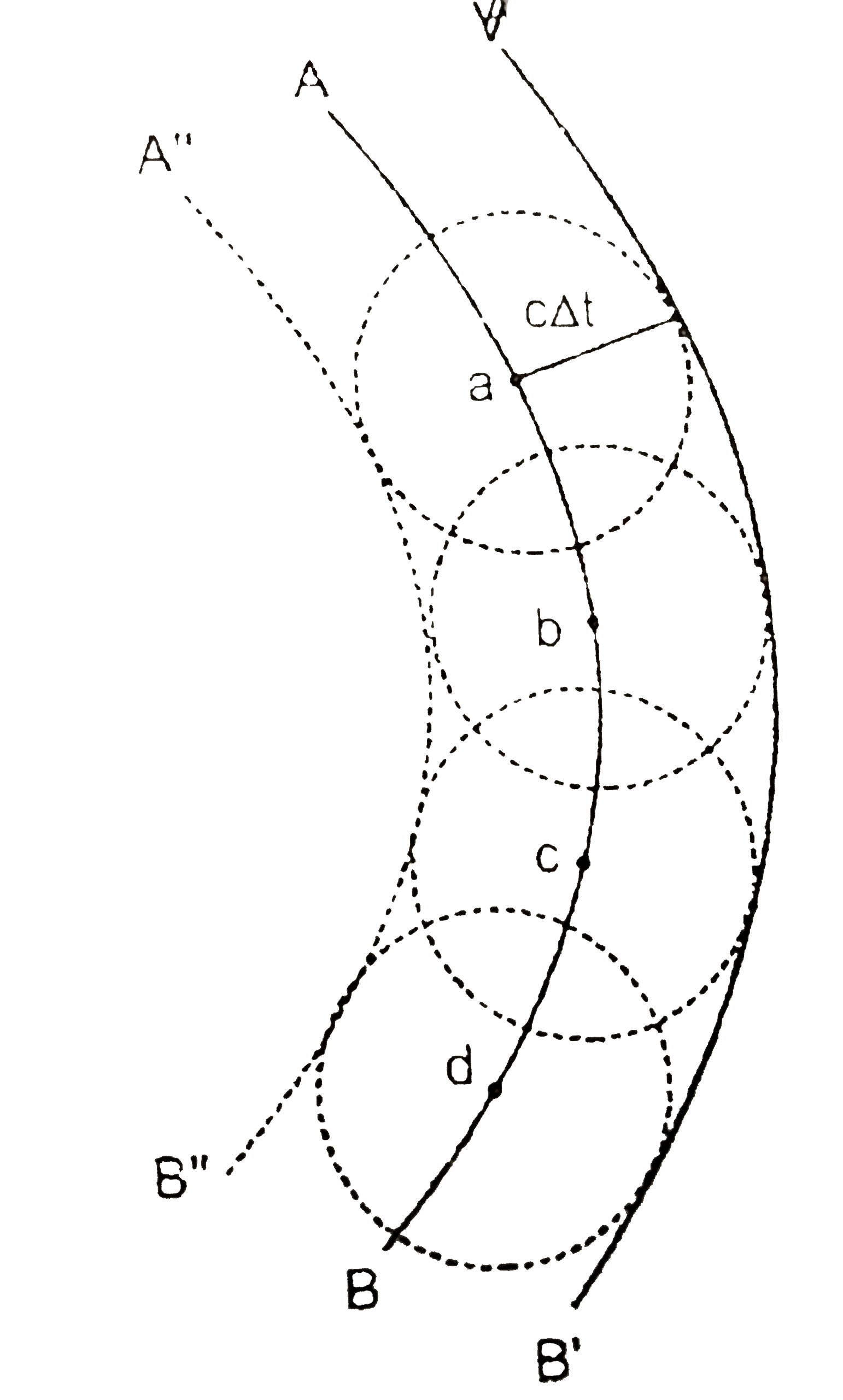
(a) Wavefront : The locus of all the particles of the medium, which at any instant are vibrating in the same phase, is called the wavefront.
Huygen's priciple is a geometrical constrution which is used to determine the new position of a wavefront at a later time its given position at any instant.

Consider a point source of light. Let `AB` be a section of primary spherical wavefront at any time `t,` The new position of wavefront at time `t+Deltat,` conside a number of points `a,b,c,d-` on the primary wavefront. The partition of the wavelet, which lies just on the back of the secondary wavefront, `O` is equal to `180^(@)` adn likewise the factor `(1)/(2)(1+costheta)` is equal to zero. Therefore, the forward secondary wavefront `A'B'` is the new position of the wavefront at time `t+Deltat`.
(b) Difference between Interference and Diffraction.
Promotional Banner

Topper's Solved these Questions

  • WAVE OPTICS

    RESONANCE ENGLISH|Exercise Advanced Level Problems|8 Videos
  • WAVE OPTICS

    RESONANCE ENGLISH|Exercise Exercise-3 (Part-2)|15 Videos
  • WAVE ON STRING

    RESONANCE ENGLISH|Exercise Exercise- 3 PART II|7 Videos

Similar Questions

Explore conceptually related problems

In a singleslit diffraction experiment, when a tiny circular obstacle is placed in the path of light from a distant source, a bright spot is seen at the centre of the shadow of the obstacle. Explain why ? State two points of difference the interference pattern obtained in Young's double slit experiment and the diffraction pattern due to a single slit.

(a) Define a wavefront. Using Huygen's principle, verify the laws of reflection at a plane surface . (b) In a single slit diffraction experiment the wildth of the slit is made double the orignal width. How does this affect the size and intensity of the central diffraction band ? Explain. (c) When a tiny circular obstacle in placed in the path of light from a distance source, a bright spot is seen at the centre of the obstacle . Explain why.

Answer the following: (a) What is a wave front? How does it propagate? Using Huygens' principle, explain reflection of a plane wavefront from a surface and verify the laws of reflection. (b) A parallel beam of light of wavelength 500 nm falls on a narrow slit and the resulting diffraction pattern is obtained on a screen 1 m away. If the first minimum is formed at a distance of 2.5 mm from the centre of screen, find the (i) width of the slit, and (ii) distance of first secondary maximum from the centre of the screen.

Huygen was the figure scientist who proposed the idea of wave theory of light he said that the light propagates in form of wavelengths. A wavefront is a imaginary surface of every point of which waves are in the same. phase. For example the wavefront for a point source of light is collection of concentric spheres which have centre at the origin w_(1) is a wavefront w_(2) is another wavefront. The radius of the wavefront at time 't' is 'ct' in thic case where 'c' is the speed of light the direction of propagation of light is perpendicular to the surface of the wavelength. the wavefronts are plane wavefronts in case of a parallel beam of light. Huygen also said that every point of the wavefront acts as the source of secondary wavelets. The tangent drawn to all secondary wavelets at a time is the new wavefront at that time. The wavelets are to be considered only in the forward direction (i.e., the direction of propagation of light) and not in the reverse direction if a wavefront w_(1) and draw spheres of radius 'cDeltat' they are called secondary wavelets. Draw a surface w_(2) which is tangential to all these secondary wavelets w_(2) is the wavefront at time t+Deltat Huygen proved the laws of reflection and laws of refraction using concept of wavefront. Q. Wavefronts incident on an interface between the media are shown in the figure. the refracted wavefront will be as shown in

Huygen was the figure scientist who proposed the idea of wave theory of light he said that the light propagates in form of wavelengths. A wavefront is a imaginary surface of every point of which waves are in the same. phase. For example the wavefront for a point source of light is collection of concentric spheres which have centre at the origin w_(1) is a wavefront w_(2) is another wavefront. The radius of the wavefront at time 't' is 'ct' in thic case where 'c' is the speed of light the direction of propagation of light is perpendicular to the surface of the wavelength. the wavefronts are plane wavefronts in case of a parallel beam of light. Huygen also said that every point of the wavefront acts as the source of secondary wavelets. The tangent drawn to all secondary wavelets at a time is the new wavefront at that time. The wavelets are to be considered only in the forward direction (i.e., the direction of propagation of light) and not in the reverse direction if a wavefront w_(1) and draw spheres of radius 'cDeltat' they are called secondary wavelets. Draw a surface w_(2) which is tangential to all these secondary wavelets w_(2) is the wavefront at time t+Deltat Huygen proved the laws of reflection and laws of refraction using concept of wavefront. Q. Plane are incident on a spherical mirror as shown in the figure. the reflected wavefronts will be

Huygen was the figure scientist who proposed the idea of wave theory of light he said that the light propagates in form of wavelengths. A wavefront is a imaginary surface of every point of which waves are in the same. phase. For example the wavefront for a point source of light is collection of concentric spheres which have centre at the origin w_(1) is a wavefront w_(2) is another wavefront. The radius of the wavefront at time 't' is 'ct' in thic case where 'c' is the speed of light the direction of propagation of light is perpendicular to the surface of the wavelength. the wavefronts are plane wavefronts in case of a parallel beam of light. Huygen also said that every point of the wavefront acts as the source of secondary wavelets. The tangent drawn to all secondary wavelets at a time is the new wavefront at that time. The wavelets are to be considered only in the forward direction (i.e., the direction of propagation of light) and not in the reverse direction if a wavefront w_(1) and draw spheres of radius 'cDeltat' they are called secondary wavelets. Draw a surface w_(2) which is tangential to all these secondary wavelets w_(2) is the wavefront at time t+Deltat Huygen proved the laws of reflection and laws of refraction using concept of wavefront. Q. Plane are incident on a spherical mirror as shown in the figure. the reflected wavefronts will be

Huygen was the figure scientist who proposed the idea of wave theory of light he said that the light propagates in form of wavelengths. A wavefront is a imaginary surface of every point of which waves are in the same. phase. For example the wavefront for a point source of light is collection of concentric spheres which have centre at the origin w_(1) is a wavefront w_(2) is another wavefront. The radius of the wavefront at time 't' is 'ct' in thic case where 'c' is the speed of light the direction of propagation of light is perpendicular to the surface of the wavelength. the wavefronts are plane wavefronts in case of a parallel beam of light. Huygen also said that every point of the wavefront acts as the source of secondary wavelets. The tangent drawn to all secondary wavelets at a time is the new wavefront at that time. The wavelets are to be considered only in the forward direction (i.e., the direction of propagation of light) and not in the reverse direction if a wavefront w_(1) and draw spheres of radius 'cDeltat' they are called secondary wavelets. Draw a surface w_(2) which is tangential to all these secondary wavelets w_(2) is the wavefront at time t+Deltat Huygen proved the laws of reflection and laws of refraction using concept of wavefront. Q. Certain plane wavefronts are shown in figure the refractive index of medius is

Huygen was the figure scientist who proposed the idea of wave theory of light he said that the light propagates in form of wavelengths. A wavefront is a imaginary surface of every point of which waves are in the same. phase. For example the wavefront for a point source of light is collection of concentric spheres which have centre at the origin w_(1) is a wavefront w_(2) is another wavefront. The radius of the wavefront at time 't' is 'ct' in thic case where 'c' is the speed of light the direction of propagation of light is perpendicular to the surface of the wavelength. the wavefronts are plane wavefronts in case of a parallel beam of light. Huygen also said that every point of the wavefront acts as the source of secondary wavelets. The tangent drawn to all secondary wavelets at a time is the new wavefront at that time. The wavelets are to be considered only in the forward direction (i.e., the direction of propagation of light) and not in the reverse direction if a wavefront w_(1) and draw spheres of radius 'cDeltat' they are called secondary wavelets. Draw a surface w_(2) which is tangential to all these secondary wavelets w_(2) is the wavefront at time t+Deltat Huygen proved the laws of reflection and laws of refraction using concept of wavefront. Q. Certain plane wavefronts are shown in figure the refractive index of medius is

Huygen was the figure scientist who proposed the idea of wave theory of light he said that the light propagates in form of wavelengths. A wavefront is a imaginary surface of every point of which waves are in the same. phase. For example the wavefront for a point source of light is collection of concentric spheres which have centre at the origin w_(1) is a wavefront w_(2) is another wavefront. The radius of the wavefront at time 't' is 'ct' in thic case where 'c' is the speed of light the direction of propagation of light is perpendicular to the surface of the wavelength. the wavefronts are plane wavefronts in case of a parallel beam of light. Huygen also said that every point of the wavefront acts as the source of secondary wavelets. The tangent drawn to all secondary wavelets at a time is the new wavefront at that time. The wavelets are to be considered only in the forward direction (i.e., the direction of propagation of light) and not in the reverse direction if a wavefront w_(1) and draw spheres of radius 'cDeltat' they are called secondary wavelets. Draw a surface w_(2) which is tangential to all these secondary wavelets w_(2) is the wavefront at time t+Deltat Huygen proved the laws of reflection and laws of refraction using concept of wavefront. Q. The wavefrot of a light beam is given by the equation x+2y+3z=c (where c is arbitrary constant) then the angle made by the direction of light with the y-axis is

Huygen was the first scientist who proposed the idea of wave theory of light. He said that the light propagates in form of wavefronts. A wavefront is an imaginary surface at every point of which waves are in the same phase. For example the wavefronts for a point source of light is collectionof concentric spheres which have centre at the origin. w_(1) is a wavefront. w_(2) is another wavefront. The redius of the wavefront at time 't' is 'ct' in this case where 'c' is the speed of light. The direction of propagation of light is perpendicular to the surface of the wavefront. The wavefronts are plane wavefronts in case of a parallel beam of light. Huygen also said that every point of the wavefront acts as the source of secondary wavelets. The tangent drawn to all secondary wavelets at a time is the new wavefront at that time. The wavelets are to be consid-ered only in the forward direction ( i.e. the direction of propagation of light) and not in the reverse direction. If a wavefront w_(1) at time t is given, then to draw the wavefront at time t+Deltat0 take some points on the wavefront w_(1) and draw spheres of radius 'cDeltat'. They are called secondary wavelets Draw a surface w_(2) which is tangential to all these secondary wavelets. w_(2) is the wavefront at time 't+Deltat'. Huygen proved the laws of reflection and laws of refraction using concept of wavefronts. A point source of light is placed at origin, in air. The equation of wave front of the wave at time t, emitted by source at t=0, is (take refractive index of air as 1 )

RESONANCE ENGLISH-WAVE OPTICS-Exercise-3 (Part-3)
  1. (a) What is plane polarised light? Two polaroid sare placed at 90^(@)...

    Text Solution

    |

  2. What is meant by a linearly polarised light? Which type of waves can b...

    Text Solution

    |

  3. How is a wavefront defined? Using Huygen's construction , draw a figu...

    Text Solution

    |

  4. (a) Light, from a sodium lamp, is passed through two polaroid sheets P...

    Text Solution

    |

  5. In a Young's double slit experiment , the slits are Kept 2mm apart and...

    Text Solution

    |

  6. In Young's double slit experiment ,momochromatic light of wavelength 6...

    Text Solution

    |

  7. In a singleslit diffraction experiment, when a tiny circular obstacle ...

    Text Solution

    |

  8. The diagram, given below, shows the refracton of a plane wavefront, in...

    Text Solution

    |

  9. How would the angular separation of interference fringes in Young's do...

    Text Solution

    |

  10. Two polaroid A and B are set in crossed positions. A third polaroid C ...

    Text Solution

    |

  11. In Young's double slit experiment , the two slits 0.20 mm apart are il...

    Text Solution

    |

  12. State Huygens' principle of diffraction of light.

    Text Solution

    |

  13. State the importance of coherent sources in the phenomenon of interfer...

    Text Solution

    |

  14. Answer the following: (a) What is a wave front? How does it propagat...

    Text Solution

    |

  15. (a) Define a wavefront. Use Huygen' principle to shown diagrammaticall...

    Text Solution

    |

  16. (a) Why are coherent sources necessary to produce a sustained interfer...

    Text Solution

    |

  17. Answer the following: (a) In Young's double slit experiment, derive ...

    Text Solution

    |

  18. Which of the following waves can be polarized (i) Heat waves (ii) Soun...

    Text Solution

    |

  19. Two wavelengths of sodium light 590 nm and 596 nm are used, in turn, ...

    Text Solution

    |

  20. The ratio of the intensities at minima to maxima in Young's double sli...

    Text Solution

    |