Home
Class 12
PHYSICS
A ball is hung vertically by a thread of...

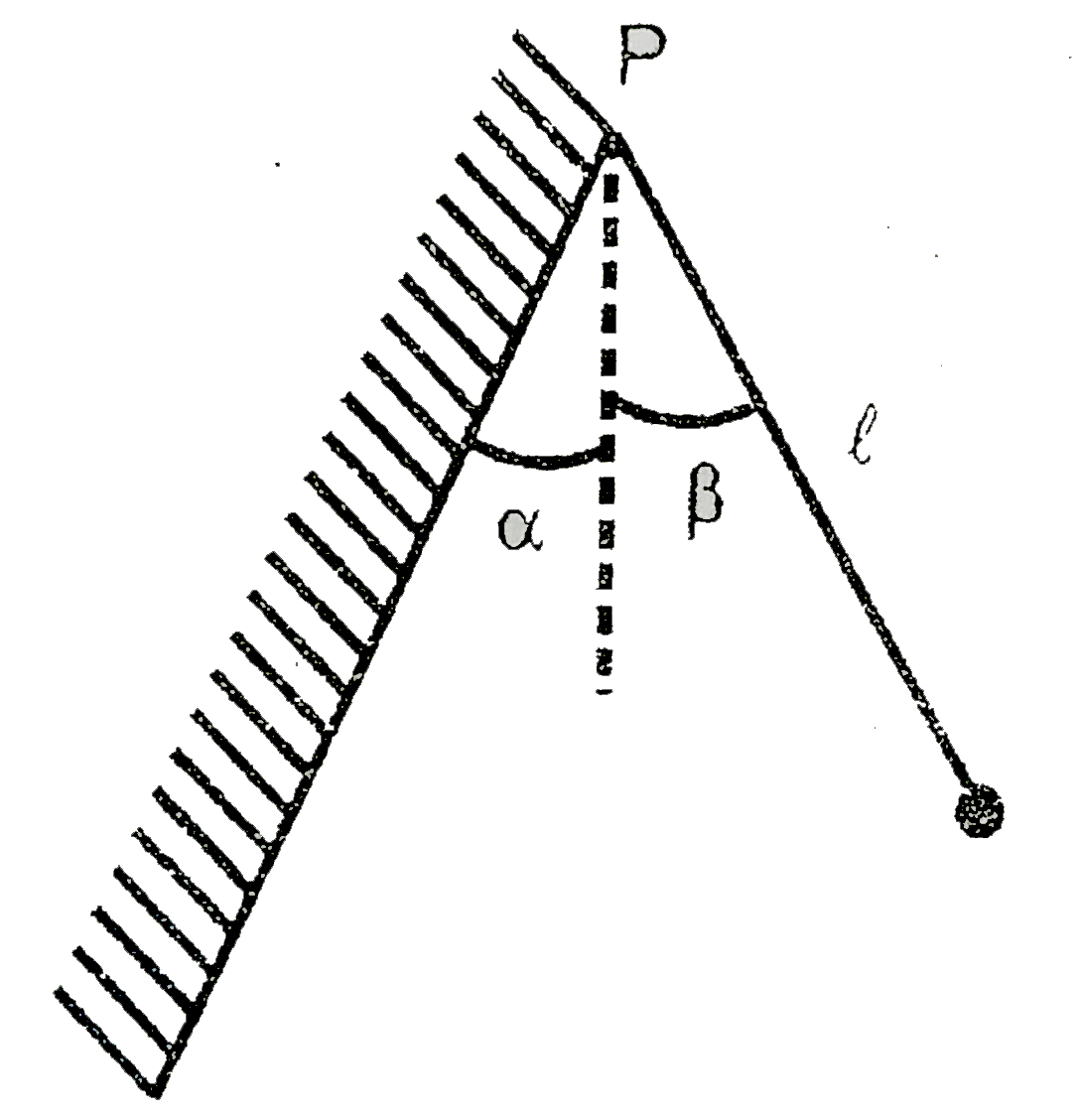
A ball is hung vertically by a thread of length `'l'` from a point `'P'` of a clined wall that makes an angle with thte cerical. The thread with the vertical. The thread with the ball is then deviated through a small angle `'beta' (beta gt alpha)` and set free Assuming the wall to tbe perfectly elastic, the period of such pendulum is//are

A

`2sqrt((t)/(g))[sin^(-1)((alpha)/(beta))]`

B

`2sqrt((l)/(g))[(pi)/(2)+sin^(-1)(alpha/(beta))]`

C

`2sqrt((l)/(g))[cos^(-1)(alpha/(beta))]`

D

`2sqrt((l)/(g))[cos^(-1)(-alpha/(beta))]`

Text Solution

Verified by Experts

The correct Answer is:

B, D
Promotional Banner

Topper's Solved these Questions

  • SIMPLE HARMONIC MOTION

    RESONANCE ENGLISH|Exercise Exercise- 2, PART - IV|8 Videos
  • SIMPLE HARMONIC MOTION

    RESONANCE ENGLISH|Exercise Exercise- 3, PART - I|20 Videos
  • SIMPLE HARMONIC MOTION

    RESONANCE ENGLISH|Exercise Exercise- 2, PART - II|1 Videos
  • SEMICONDUCTORS

    RESONANCE ENGLISH|Exercise Exercise 3|88 Videos
  • TEST PAPERS

    RESONANCE ENGLISH|Exercise PHYSICS|784 Videos

Similar Questions

Explore conceptually related problems

A ball is suspended by a thread of length l at the point O on an incline wall as shown. The inclination of the wall with the vertical is α.The thread is displaced through a small angle β away from the vertical and the ball is released. Find the period of oscillation of pendulum. Consider both cases a. alpha gt beta b. alpha lt beta Assuming that any impact between the wall and the ball is elastic.

A ball is suspended by a thread of length l at the point O on an incline wall as shown. The inclination of the wall with the vertical is (a)the thread is displacement througha small angle away from the vertical and (b) the ball is released. Find the period of obcillation of pendulum. Consider both cases a. alpha gt beta b. alpha lt beta Assuming that any impact between the wall and the ball is elastic.

A ball is suspended on a thread from the ceiling of a car. The brakes are applied and the speed of car changes from 5m//sec to 5//3m//sec during the time interval of 3 seconds. Find the angle that the thread with the ball will deviate from vertical.

A ladder rest against a wall making an angle alpha with the horizontal. The foot of the ladder is pulled away from the wall through a distance x , so that it slides a distance y down the wall making an angle beta with the horizontal. THEN x=

A small ball is suspended from point O by a thread of length l. A nail is driven into the wall at a distance of l//2 below O, at A. The ball is drawn aside so that the thread takes up a horizontal position at the level of point O and then released. Find a. At what angle from the vertical of the ball's trajectory, will the tension in the thread disappear? b. What will be the highest point from the lowermost point of circular track, to which it will rise?

Two small spheres each of mass m and charge q are tied from the same rigid support with the help of silk threads of length L . They make angle theta with the vertical as shown in the fig. If length L is decreased, then angle theta with the vertical.

A ball is suspended by a thread from the ceiling of a tram car. The brakes are applied and the speed of the car changes uniformly from 36 kmh^(-1) to zero is 5s . The angle by which the ball deviates from the vertical is (g =10ms^(-2)) .

A pendulum consists of a small mass m at the end of a string of length L. The pendulum is pulled aside making an angle theta with the vertical and released. Taking the suspension point as the axis, at the instant of release

A ball is projected from a given point with velocity u at some angle with the horizontal and after hitting a vertical wall returns to the same point. Show that the distance of the point from the wall must be less than (eu^2)/((1+e)g) , where e is the coefficient of restitution.

A solid spherical ball of radius (5)/(9)m is connected to a point A on the wall with the help of a string which makes an angle theta=45^(@) with the vertical. The sphere can rotate freely about its central axis and it is set into rotational motion against the vertical face of the wall with an angular velocity face of the wall with an angular velocity "100 rad s"^(-1) . In how much time (in s) will it come to rest ? [mu=0.1]
