Home
Class 12
PHYSICS
A particle of mass 'm' moves on a horizo...

A particle of mass `'m'` moves on a horizont smooth line `AB` of length `'a'` such that when particle is at any general point `P` on the line two force act on it. A force `(mg(AP))/(a)` towards `A` and another force `2(mg(BP))/(a)` towards `B`.
Find its time period when released from rest from mid-point of line `AB`.

A

`T = 2pisqrt((3a)/(g))`

B

`T = 2pisqrt((a)/(2g))`

C

`T = 2pisqrt((a)/(g))`

D

`T = 2pisqrt((a)/(3g))`

Text Solution

Verified by Experts

The correct Answer is:
D

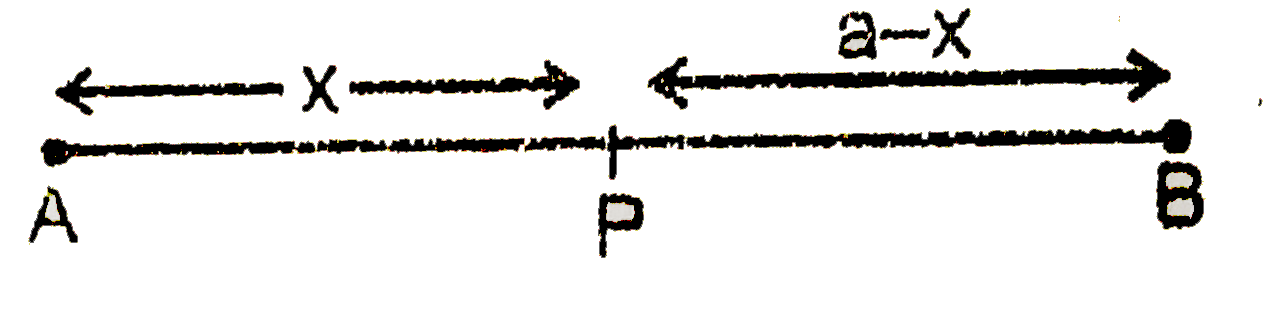
`(i)` force on particle at point `P`
`f = (2mg(a-x))/(a)-(mg(x))/(a)`
`F = (mg)/(a)(2a - 3x)`
m `F = (-3mg)/(a)(x - 2a//3)`

`(ii)` So this is equation of `S.H.M. (F = momega^(2)x)` so particle
Perform `S.H.M.` with mean position `x - 2a//3 = 0`
So `omega^(2) = (3g)/(a) rArr omega = sqrt(3g//a)`
So Time period `T = 2pi sqrt(a//3g)`
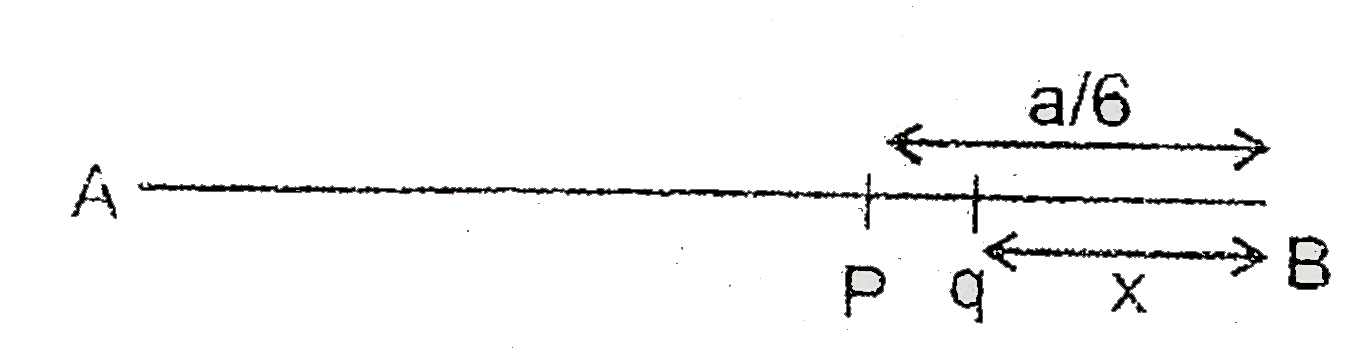
and amplitude `= 2a//3 - a//2 = a//6`
`(iii)` minimum distance from `B`
`= a - (2a//3 + a//6) = a//6`
`(iv)` at point `P` velocity of partivle `= 0`
and force `= (2mgx)/(a)`
(at point `q`)
acc. `= (2gx)/(a) rArr overset(v)underset(o)(int)vdv = overset(a//6)underset(o)(int)(2gxdx)/(a) rArr V = (sqrt(2ga))/(6)`
Promotional Banner

Topper's Solved these Questions

  • SIMPLE HARMONIC MOTION

    RESONANCE ENGLISH|Exercise Exercise- 3, PART - I|20 Videos
  • SIMPLE HARMONIC MOTION

    RESONANCE ENGLISH|Exercise Exercise- 3, PART - II|17 Videos
  • SIMPLE HARMONIC MOTION

    RESONANCE ENGLISH|Exercise Exercise- 2, PART - III|12 Videos
  • SEMICONDUCTORS

    RESONANCE ENGLISH|Exercise Exercise 3|88 Videos
  • TEST PAPERS

    RESONANCE ENGLISH|Exercise PHYSICS|784 Videos

Similar Questions

Explore conceptually related problems

A particle of mass 'm' moves on a horizont smooth line AB of length 'a' such that when particle is at any general point P on the line two force act on it. A force (mg(AP))/(a) towards A and another force (2mg(BP))/(a) towards B . particle released from rest from mid point of AB. Find the minimum distance of the particle from B during the motion.

A particle of mass 'm' moves on a horizont smooth line AB of length 'a' such that when particle is at any general point P on the line two force act on it. A force (mg(AP))/(a) towards A and another force (2mg(BP))/(a) towards B . If the force acting towards A stops acting when the particle is nearest to B then find the velocity with which it crosses point B.

A particle of mass 1 g moves on a straight line. The variation of its velocity with time is shown in fig. Find the force acting on the particle att = 1 s,4s and 7 s.

A particle has a time period of 1s under the action of a certain force and 2 s under the action of another force. Find the time period when the forces are acting in the same direction simultaneously.

Force acting on a particle of mass m moving in straight line varies with the velocity of the particle as F=K//V K is constant then speed of the particle in time t

A particle of mass m moves from rest under the action of a constant force F which acts for two seconds. The maximum power attained is

A particle of mass m moves in the XY plane with a velocity v along the straight line AB . If the angular momentum of the particle with respect to origin O is L_(A) when it is at A and L_(B) when it is at B, then

A particle of mass m moves on positive x-axis under the influence of force acting towards the origin given by -kx^2 hat i. If the particle starts from rest at x=a, the speed it will attain when it crosses the origin is

A: The magnetic field lines also represent the lines of force on a moving charged particle at every point. R: Force on a moving charge acts parallel to the magnetic field.

A particie of mass 10 kg is driven by a machine that delivers a constant power of 20 watts. If particle starts from rest and moves along a straight line, then force (in Newton) on particle at time t(t> 0) is