Home
Class 12
PHYSICS
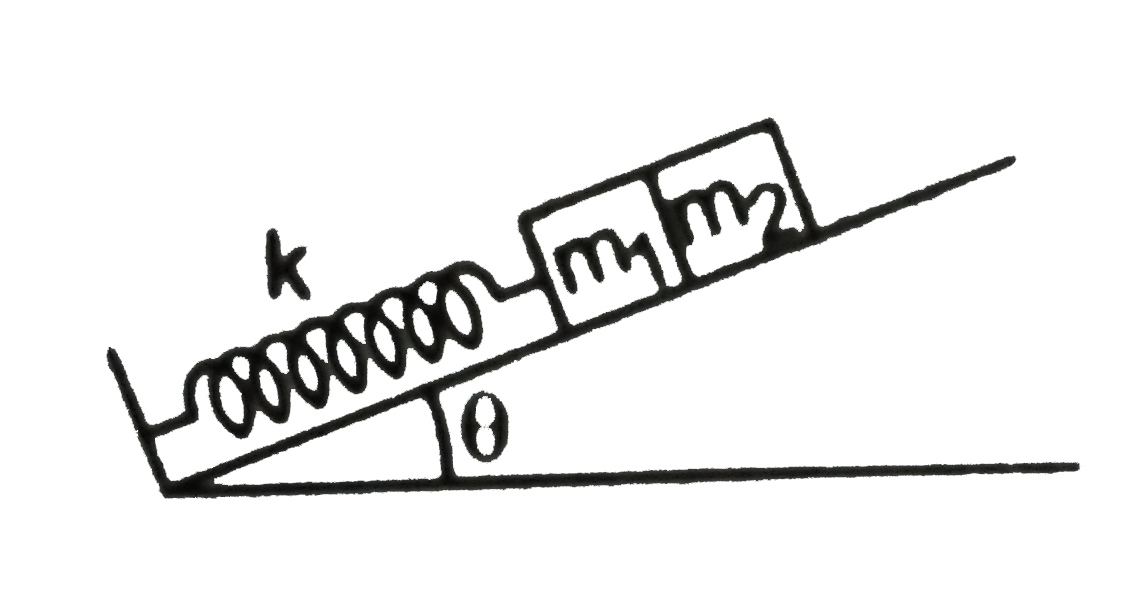
The block of mass m1 shown in figure is ...

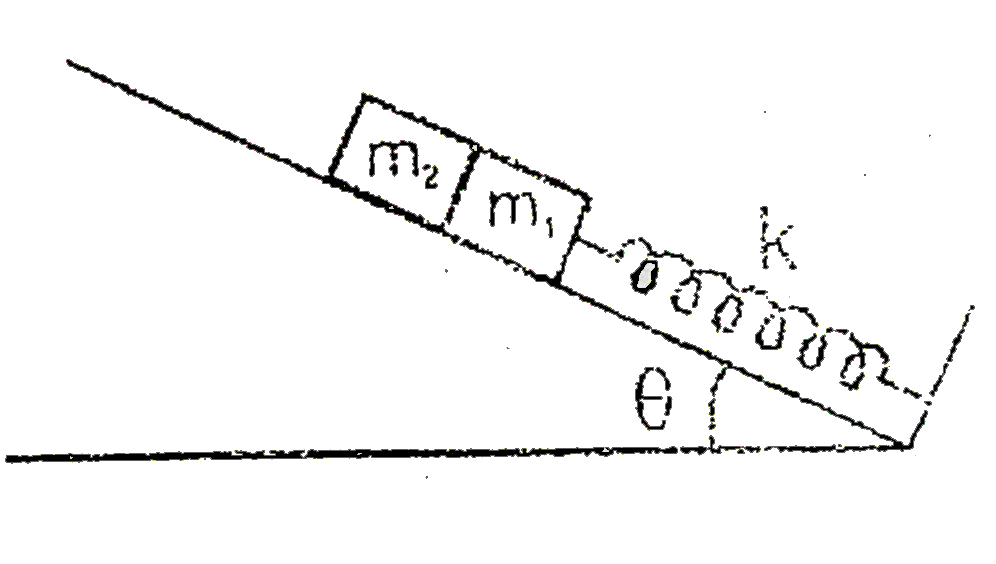
The block of mass `m_1` shown in figure is fastened to the spring and the block of mass `m_2` is placed asgainst ilt. A. Find the compression of the spring in the equilibrium position. b.The blocks are pushed a further distance `(2/k)(m_1+m_2)gsintheta` against the spring and released. Find the position where the two blocks separate.

A

`(sqrt((1)/(3k)(m_(1)+m_(2))))gsintheta`

B

`(sqrt((2)/(k)(m_(1)+m_(2))))gsintheta`

C

`(sqrt((3)/(k)(m_(1)+m_(2))))gsintheta`

D

`(sqrt((1)/(k)(m_(1)+m_(2))))gsintheta`

Text Solution

Verified by Experts

The correct Answer is:
C

At equilibrium position : `rarr`
`Kx_(0) = m_(1)g sintheta + m_(2)g sintheta`
`x_(0) = ((m_(1) + m_(2))gsintheta)/(k)`
Block will separate when acceleration of block of mass `m_(1)` will be just equal to `g sin theta`
`rArr a = omega^(2)x = g sintheta`
`rArr (K)/(m_(1) + m_(2)) xx x = g sin theta`
`x = (m_(1) + m_(2))/(K)g sintheta = x_(0)`
So, blocks will separate when blocks are at distance `x = (m_(1) + m_(2))/(K) g sintheta`
From mean position
i.e. spring is at its natural position (amplitude `A = ((2)/(K)(m_(1) + m_(2))g sintheta')`)
Blocks will seoparte at distance `x = x_(0)` from mean position.
`v = sqrt(A^(2) - x_(0)^(2))`
`= sqrt((K)/(m_(1) + m_(2))) sqrt(((2)/(K)(m_(1) + m_(2))g sintheta)^(2) - (((m_(1) + m_(2))/(K))g sintheta)^(2))`
`= sqrt((3)/(k)(m_(1) + m_(2)))gsintheta`
Promotional Banner

Topper's Solved these Questions

  • SIMPLE HARMONIC MOTION

    RESONANCE ENGLISH|Exercise Exercise- 3, PART - I|20 Videos
  • SIMPLE HARMONIC MOTION

    RESONANCE ENGLISH|Exercise Exercise- 3, PART - II|17 Videos
  • SIMPLE HARMONIC MOTION

    RESONANCE ENGLISH|Exercise Exercise- 2, PART - III|12 Videos
  • SEMICONDUCTORS

    RESONANCE ENGLISH|Exercise Exercise 3|88 Videos
  • TEST PAPERS

    RESONANCE ENGLISH|Exercise PHYSICS|784 Videos

Similar Questions

Explore conceptually related problems

A block of mass m moving at a speed 'v' compresses as spring through a distance 'x' before its speed is halved. Find the spring constant of the spring.

Two blocks of masses m_1 and m_2 are connected as shown in the figure. The acceleration of the block m_2 is :

A block of mass m moving at a speed v compresses a spring throgh a distance x before its speed is halved. Find the spring constant of the spring.

A block of mass m is connected to another .block of mass M by a massless spring of spring constant k. A constant force f starts action as shown in figure, then:

Two spring are connected toa block of mass M placed a frictionless surface as shown if both the spring have a spring constant k the frequency of oscillation block is

The system is released from rest with both the springs in unstretched positions. Mass of each block is 1 kg and force constant of each spring is 10 N//m . In the equilibrium position, speed of the block placed horizontally is

A block of mass m hangs from a vertical spring of spring constant k. If it is displaced from its equilibrium position, find the time period of oscillations.

A block of 200 g mass is dropped from a height of 2 m on to a spring and compress the spring to a distance of 50 cm. The force constant of the spring is

The block of mass m is released when the spring was in its natrual length. Spring constant is k. Find the maximum elongation of the spring.

In the figure, the block of mass m, attached to the spring of stiffness k is in correct with the completely elastic wall, and the compression in the spring is e. The spring is compressed further by e by displacing the block towards left and is then released. If the collision between the block and the wall is completely eleastic then the time period of oscillation of the block will be

