Home
Class 12
PHYSICS
When a particle of mass m moves on the x...

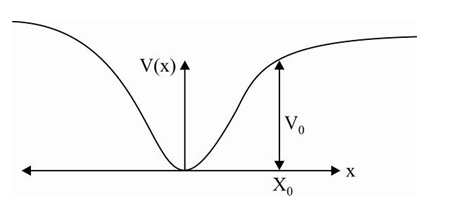
When a particle of mass m moves on the x-axis in a potential of the form `v(x)=kx^(2)` it performs simple harmonic motion. The corresponding time period is proportional to m, k as can be seen easily using dimensional analysis. However, the motion of particle can be periodic even when its potential energy increases on both sides of x = 0 in a way different from `kx^(2)` and its total energy is such that the particle does not escape to infinity. Consider a particle of mass m moving on the x-axis. Its potential energy is `v(x)=ax^(4)(a>0)`for |x| near the origin and becomes a constant equal to `v_(0)` for`|x|geX_(0)`.
Q If the total energy of the particle is E, it will perform periodic motion only if :

A

propotional to `V_(0)`

B

propotional to `V_(0)/(mX_(0))`

C

propotional to `sqrt((V_(0))/(mX_(0)))`

D

zero

Text Solution

Verified by Experts

The correct Answer is:

D

`F = -(dU)/(dx)`
as for `|x| gt x_(0) V = V_(0) =` constant
`rArr (dU)/(dx) = 0 rArr F = 0`.
Promotional Banner

Topper's Solved these Questions

  • SIMPLE HARMONIC MOTION

    RESONANCE ENGLISH|Exercise Exercise- 3, PART - II|17 Videos
  • SIMPLE HARMONIC MOTION

    RESONANCE ENGLISH|Exercise Advanced Level Problems|13 Videos
  • SIMPLE HARMONIC MOTION

    RESONANCE ENGLISH|Exercise Exercise- 2, PART - IV|8 Videos
  • SEMICONDUCTORS

    RESONANCE ENGLISH|Exercise Exercise 3|88 Videos
  • TEST PAPERS

    RESONANCE ENGLISH|Exercise PHYSICS|784 Videos

Similar Questions

Explore conceptually related problems

When a particle of mass m moves on the x-axis in a potential of the form V(x) =kx^(2) it performs simple harmonic motion. The correspondubing time period is proprtional to sqrtm/h , as can be seen easily using dimensional analusis. However, the motion of a particle can be periodic even when its potential energy increases on both sides of x=0 in a way different from kx^(2) and its total energy is such that the particle does not escape toin finity. Consider a particle of mass m moving on the x-axis. Its potential energy is V(x)=ax^(4)(agt0) for |x| neat the origin and becomes a constant equal to V_(0) for |x|impliesX_(0) (see figure). If total energy of the particle is E, it will perform perildic motion only if.

When a particle is mass m moves on the x- axis in a potential of the from V(x) = kx^(2) , it performs simple harmonic motion. The corresponding thime periond is proportional to sqrt((m)/(k)) , as can be seen easily asing dimensional analysis. However, the motion of a pariticle can be periodic even when its potential enem increases on both sides x = 0 in a way different from kx^(2) and its total energy is such that the particel does not escape to infinity. consider a particle of mass m moving onthe x- axis . Its potential energy is V(x) = omega (alpha gt 0 ) for |x| near the origin and becomes a constant equal to V_(0) for |x| ge X_(0) (see figure) If the total energy of the particle is E , it will perform is periodic motion why if :

When a particle is mass m moves on the x- axis in a potential of the from V(x) = kx^(2) , it performs simple harmonic motion. The corresponding thime periond is proportional to sqrt((m)/(k)) , as can be seen easily asing dimensional analysis. However, the motion of a pariticle can be periodic even when its potential enem increases on both sides x = 0 in a way different from kx^(2) and its total energy is such that the particel does not escape to infinity. consider a particle of mass m moving onthe x- axis . Its potential energy is V(x) = omega (alpha gt 0 ) for |x| near the origin and becomes a constant equal to V_(0) for |x| ge X_(0) (see figure) If the total energy of the particle is E , it will perform is periodic motion why if :

When a particle is mass m moves on the x- axis in a potential of the from V(x) = kx^(2) , it performs simple harmonic motion. The corresponding thime periond is proportional to sqrt((m)/(k)) , as can be seen easily asing dimensional analysis. However, the motion of a pariticle can be periodic even when its potential enem increases on both sides x = 0 in a way different from kx^(2) and its total energy is such that the particel does not escape to infinity. consider a particle of mass m moving onthe x- axis . Its potential energy is V(x) = omega (alpha gt 0 ) for |x| near the origin and becomes a constant equal to V_(0) for |x| ge X_(0) (see figure) If the total energy of the particle is E , it will perform is periodic motion why if :

When a particle of mass m moves on the x-axis in a potential of the form V(x) =kx^(2) it performs simple harmonic motion. The correspondubing time period is proprtional to sqrtm/h , as can be seen easily using dimensional analusis. However, the motion of a particle can be periodic even when its potential energy increases on both sides of x=0 in a way different from kx^(2) and its total energy is such that the particle does not escape toin finity. Consider a particle of mass m moving on the x-axis. Its potential energy is V(x)=ax^(4)(agt0) for |x| neat the origin and becomes a constant equal to V_(0) for |x|impliesX_(0) (see figure). . The acceleration of this partile for |x|gtX_(0) is (a) proprtional to V_(0) (b) proportional to.

A particle is executing simple harmonic motion. Its total energy is proportional to its

The distance moved by a particle in simple harmonic motion in one time period is

The total energy of a particle having a displacement x, executing simple harmonic motion is

A particle moves on the X-axis according to the equation x=x_0 sin^2omegat . The motion simple harmonic

A particle moves on the X-axis according to the equation x=5sin^2omegat . The motion simple harmonic

RESONANCE ENGLISH-SIMPLE HARMONIC MOTION -Exercise- 3, PART - I
  1. When a particle of mass m moves on the x-axis in a potential of the fo...

    Text Solution

    |

  2. A simple pendulum has time period T1. The point of suspension is now m...

    Text Solution

    |

  3. A block is performin SHM of amplitude 'A' in vertical direction. When ...

    Text Solution

    |

  4. Function x=Asin^(2)omegat+Bcos^(2)omegat+Csinomegatcosomegat represent...

    Text Solution

    |

  5. A uniform thin cylindrical disc of mass M and radius R is attached to ...

    Text Solution

    |

  6. A uniform thin cylindrical disc of mass M and radius R is attached to ...

    Text Solution

    |

  7. A uniform thin cylindrical disc of mass M and radius R is attached to ...

    Text Solution

    |

  8. The acceleration a of a particle undergoing SHM is shown in the figure...

    Text Solution

    |

  9. A uniform rod of length l and mass M is pivoted at the centre. Its two...

    Text Solution

    |

  10. The mass M shown in figure ocillates in simple harmonic motion with am...

    Text Solution

    |

  11. When a particle of mass m moves on the x-axis in a potential of the fo...

    Text Solution

    |

  12. When a particle is mass m moves on the x- axis in a potential of the f...

    Text Solution

    |

  13. When a particle is mass m moves on the x- axis in a potential of the f...

    Text Solution

    |

  14. A metal rod of length 'L' and mass 'm' is pivoted at one end. A thin d...

    Text Solution

    |

  15. Phase space diagrams are useful tools in analyzing all kinds of dynami...

    Text Solution

    |

  16. Phase space diagrams are useful tools in analyzing all kinds of dynami...

    Text Solution

    |

  17. Phase space diagrams are useful tools in analyzing all kinds of dynami...

    Text Solution

    |

  18. A point mass is subjected to two simultaneous sinusoidal displacement ...

    Text Solution

    |

  19. A small block is connected to one end of a massless spring of un-stret...

    Text Solution

    |

  20. A particle of mass m is attached to one end of a mass-less spring of f...

    Text Solution

    |

  21. Two independent harmonic oscillators of equal mass are oscillating abo...

    Text Solution

    |
