Home
Class 12
CHEMISTRY
When an atom X absorbs radiation with a ...

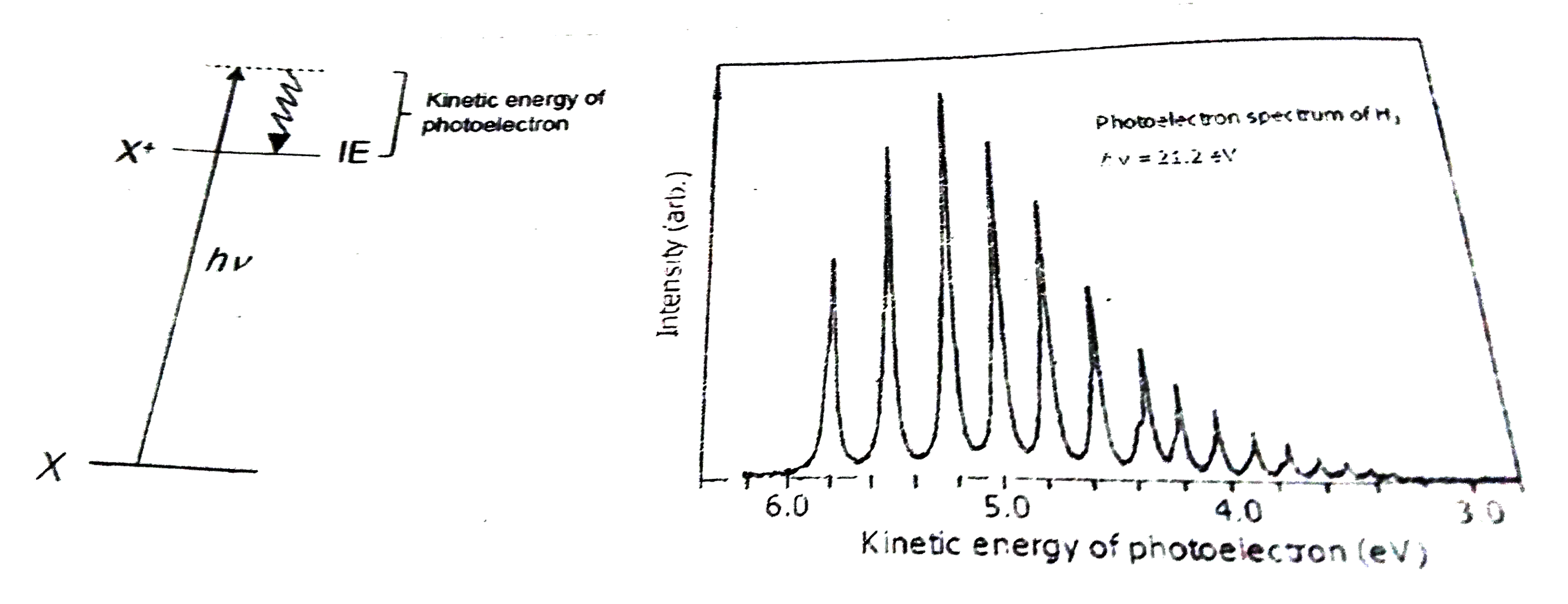
When an atom X absorbs radiation with a photon energy than the ionization energy of the atom, the atom is ionized to generate an ion `X^(+)` and the electron (called a photoelectron) is ejected at the same time. In this event, the energy is conserved as shown in Figure `1`, that is,
Photon energy (h)=ionization energy (IE) of `X+` kinetic energy of photoelectron.
When a molecule, for example, `H_(2)`, absorbs short-wavelength light, the photoelectron is ejected and an `H_(2)`, ion with a variety of vibrational states is produced. A photoelectron spectrum is a plot of the number of photoelectrons as a function of the kinetic energy of the photoelectrons. Figure-2 shows a typical photoelectron spectrum when `H_(2)` in the lowest vibrational level is irradiated by monochromatic light of `21.2 eV`. No photoelectrons are detected above `6.0 eV`. (eV is a unit of energy and `1.0 eV` is equal to `1.6xx10^(-19) J`)

Figure 1 Schematic diagram of photoelectron spectroscopy.
Figure 2 Photoelectron spectrum of `H_(2)`. The energy of the incident light is `21.2 eV`
`ul("Determine")` the bond energy `E_(C)(eV)` of `H_(2)` to the first decimal place.

Text Solution

Verified by Experts

The correct Answer is:

`24.9 eV`= binding energy of a hydrogen molecule `+10.2 eV+10.2 eV`
Thus, the binding energy of a hydrogen molecule `E_(C)=4.5 eV`
Promotional Banner

Similar Questions

Explore conceptually related problems

When an atom X absorbs radiation with a photon energy than the ionization energy of the atom, the atom is ionized to generate an ion X^(+) and the electron (called a photoelectron) is ejected at the same time. In this event, the energy is conserved as shown in Figure 1 , that is, Photon energy (h)=ionization energy (IE) of X+ kinetic energy of photoelectron. When a molecule, for example, H_(2) , absorbs short-wavelength light, the photoelectron is ejected and an H_(2) , ion with a variety of vibrational states is produced. A photoelectron spectrum is a plot of the number of photoelectrons as a function of the kinetic energy of the photoelectrons. Figure-2 shows a typical photoelectron spectrum when H_(2) in the lowest vibrational level is irradiated by monochromatic light of 21.2 eV . No photoelectrons are detected above 6.0 eV . (eV is a unit of energy and 1.0 eV is equal to 1.6xx10^(-19) J ) Figure 1 Schematic diagram of photoelectron spectroscopy. Figure 2 Photoelectron spectrum of H_(2) . The energy of the incident light is 21.2 eV Considering an energy cycle, ul("determine") the bond energy E_(D)( eV) of H_(2)^(+) to the first decimal place. If you were unable to determine the values for E_(B) and E_(C) , then use 15.0 eV and 5.0 eV for E_(B) and E_(C) , respectively.

the ionization energy of Li ^(++) is equal to

The ratio of the third ionization energy of lithium and ionization energy of H atom is of H-atom and that of Li^(+2) ion is:

The ionization energy of H-atom is 13.6eV . Calculate the is ionization energy of Li^(+2) ion-

The ionization energy will be maximum for the process.

The ionization energy will be maximum for the process.

Ionization energy of He^(+) ion at minimum energy position is

Why the third ionization energy of manganese (atomic number 25) unexpectedly high?

Should the energy of a photon be called its kinetic energy or its internal energy?

Ionization energy is influenced by :
