Home
Class 12
CHEMISTRY
When a system is taken from state A to s...

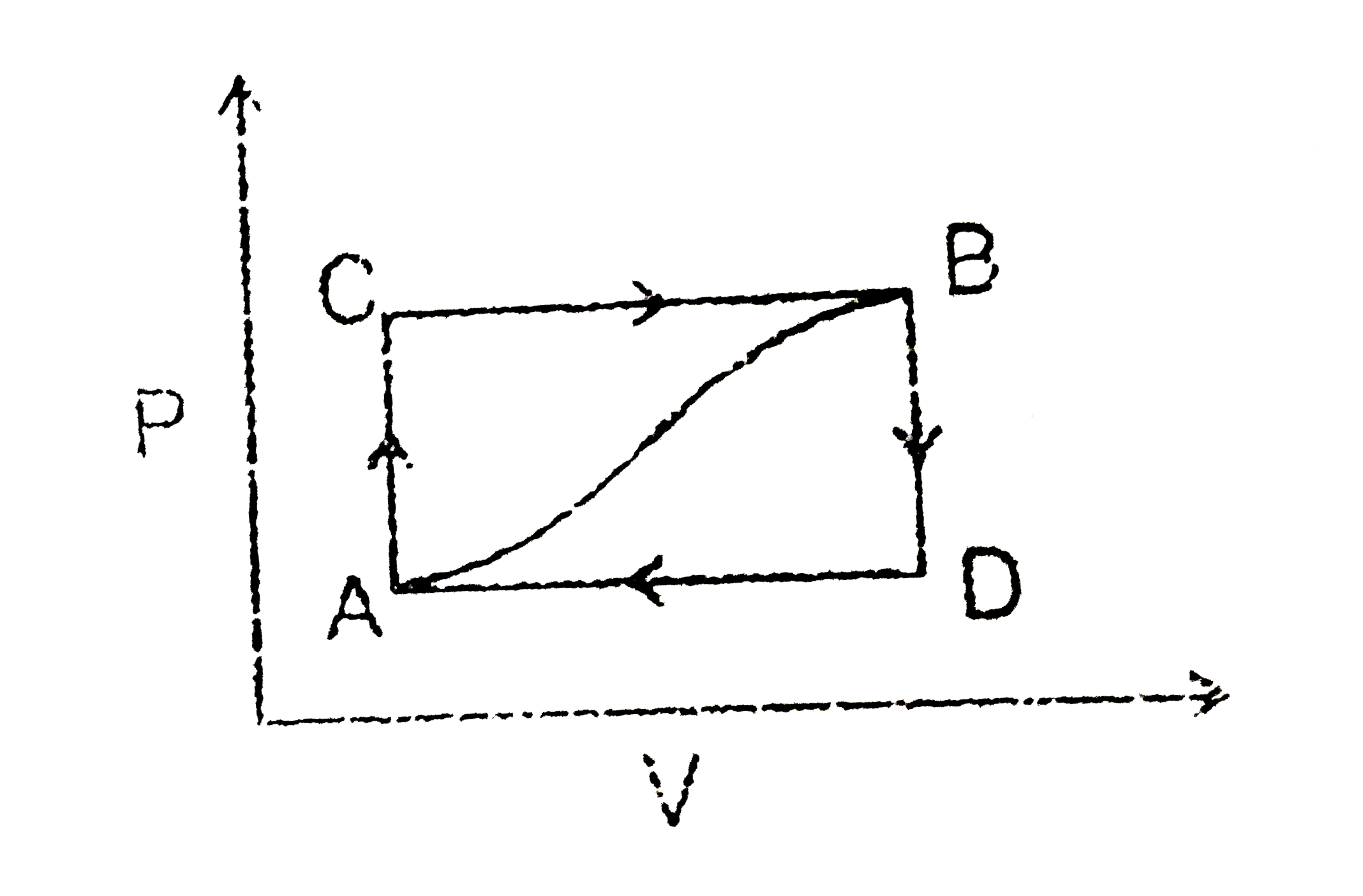
When a system is taken from state `A` to state `B` along path `ACB` as shown in figure below, `80 J` of heat flows into the system and the system does `30 J` of work.

When the system is returned from state `B` to `A` along the curve path, the work done on the system is `20 J`.
Does the system absorb or liberate heat and by how much ?

A

`- 70 J`, heat is liberated.

B

`-60 J`, heat is liberated

C

`+70 J`, heat is absorbed

D

`+60 J`, heat is absorbed.

Text Solution

Verified by Experts

The correct Answer is:

A

For `B` to `A`,
`Delta E= -50 J`
`w= +20 J`
`q= -50-20= -70`
heat is liberate.
Promotional Banner

Topper's Solved these Questions

  • THERMODYNAMICS

    RESONANCE ENGLISH|Exercise Exercise-3 Part-1: JEE (ADVANCED)|11 Videos
  • THERMODYNAMICS

    RESONANCE ENGLISH|Exercise Main|5 Videos
  • THERMODYNAMICS

    RESONANCE ENGLISH|Exercise Exercise 2- III : One or more than one options correct type|14 Videos
  • TEST SERIES

    RESONANCE ENGLISH|Exercise CHEMISTRY|50 Videos

Similar Questions

Explore conceptually related problems

When a system is taken from state A to state B along path ACB as shown in figure below, 80 J of heat flows into the system and the system does 30 J of work. How much heat flows into the system along path ADB if the work done by the system is 10 J :

When a system is taken from state A to state B along path ACB as shown in figure below, 80 J of heat flows into the system and the system does 30 J of work. If E_(D)-E_(A)= -40 J , the heat absorbed in the processes AD and DB are respectively

When a system is taken from state a to state b, in figure along the path a to c to b , 60J of heat flow into the system, and 30 J of work is done : (i) How much heat flows into the system along the path a to d to b if the work is 10J . (ii) When the system is returned from b to along the curved path, the work done by the system is -20J . Does the system absorb or liberate heat, and how much ? (iii) If , U_(a) = 0 and U_(d)= 22J , find the heat absorbed in the process a to d and d to b .

When an ideal gas is taken from state a to b , along a path acb, 84 kJ of heat flows into the gas and the gas does 32 kJ of work. The following conclusions are drawn. Mark the one which is not correct.

When a system is taken from A to C through path ABC, 10 J of heat flows to the system and 4 J of work is done by the system. How much heat flows into the system in path ADC, if the work done by the system is 3 J ?

when a system is taken through the process abc shown in the fig. 80 J of heat is absorbed by the system and 30 J of work is done by it. If the system does 10 J work during the process adc, how much heat flows into it during the process ?

What is the change in internal energy if 10 J of heat is given to system at constant pressure and 20 J of work is done by the system?

In the above question, if the work done on the system along the curved path 'ba' is 52J , heta abosrbed is

When a system is taken from state 'a' to state 'b' along the path 'acb', it is found that a quantity of heat Q = 200 J is absorbed by the system and a work W = 80 J is done by it. Along the path 'adb', Q = 144 J In the above question, if the work done on the system along the curved path 'ba' is 52J, heat absorbed is

A gas can be taken from A to B via two different processes ACB and DB. When path ACB is used 60 J of heat flows into the system and 30J of work done by the system is 10 J , the heat flows into the system in the path ADB is :
