Home
Class 12
CHEMISTRY
For an ideal gas, consider only P-V work...

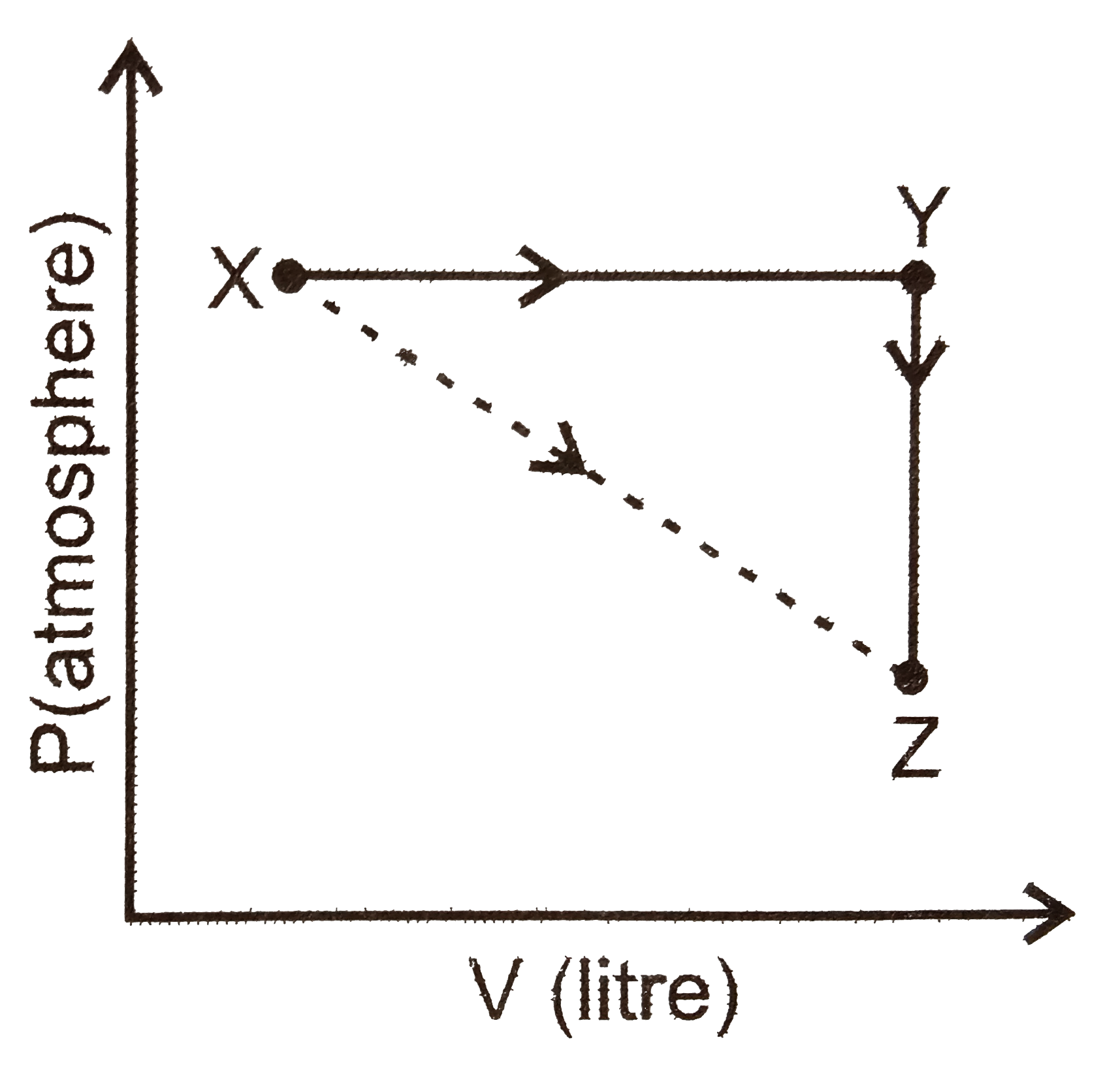
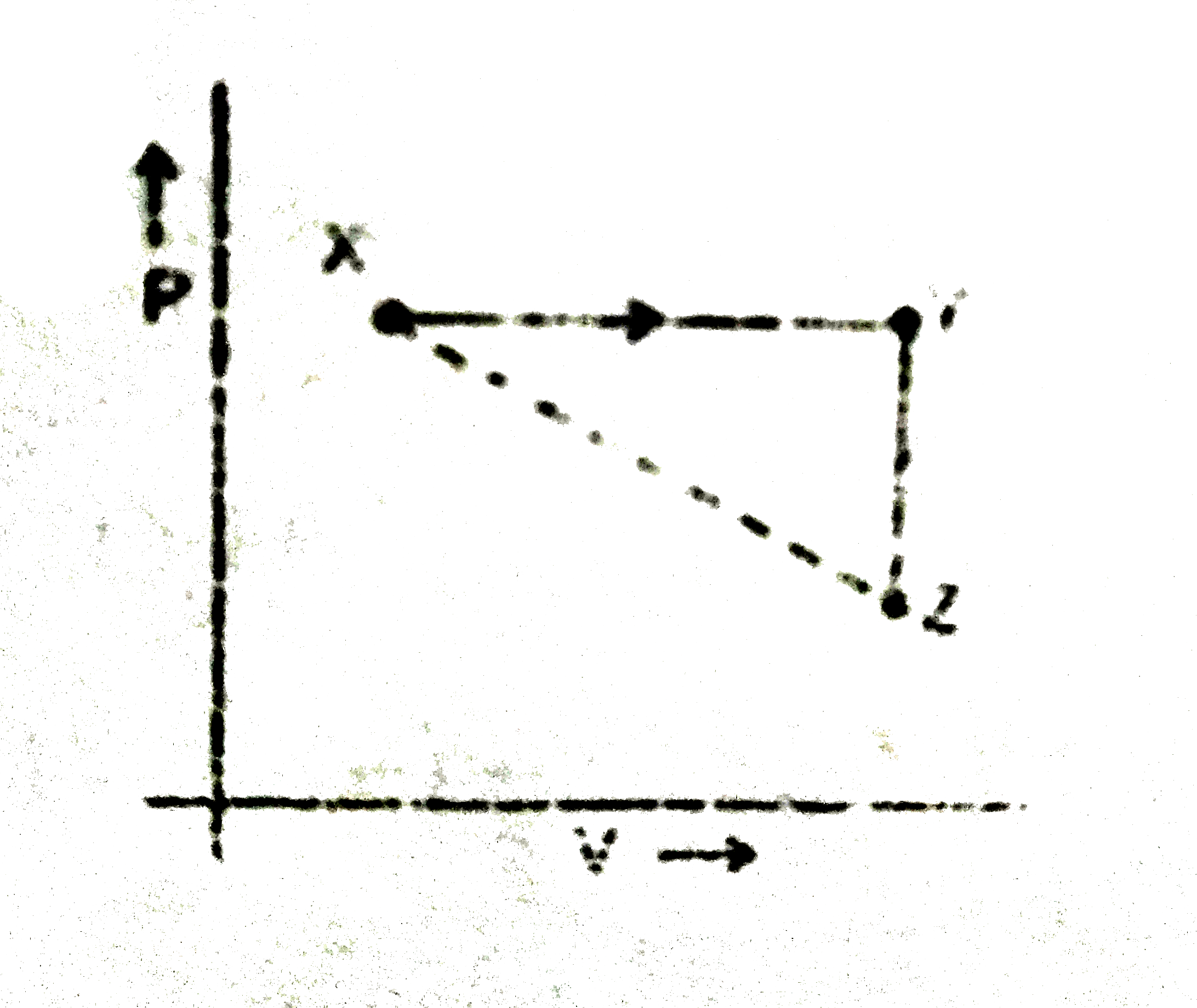
For an ideal gas, consider only `P-V` work in going from an initial state `X` to the final state `Z`. The final state `Z` can be reached by either of the two paths shown in the figure. Which of the following choice(s) is (are) correct? [Take `DeltaS` as change in entropy and `w` as work done]

A

`DeltaS_(XrarrZ)=DeltaS_(XrarrY) + DeltaS_(xrarrz)`

B

`W_(xrarrz) = W_(x rarry) + W_(yrarrz)`

C

`W_(xrarr yrarrz) = W_(xrarry)`

D

`DeltaS_(xrarryrarrz) = DeltaS_(xrarry)`

Text Solution

Verified by Experts

The correct Answer is:
A, C

`{:((A) DeltaS_(xrarr2) = DeltaS_(x-y) + DeltaS_(yrarrz) ,("correct")),((B)W_(xrarry)=W_(x-y) + W_(y-z) , ("Incorrect")),((C)W_(xrarr yrarrz)=W_(x-y),("correct")),((D)DeltaS_(xrarr yrarr z) = DeltaS_(x-y),("Incorrect")):}`
Promotional Banner

Topper's Solved these Questions

  • THERMODYNAMICS

    RESONANCE ENGLISH|Exercise exercise-3 part-1 Advanced level Solutions|30 Videos
  • THERMODYNAMICS

    RESONANCE ENGLISH|Exercise exercise-3 part-2 Advanced level Solutions|27 Videos
  • THERMODYNAMICS

    RESONANCE ENGLISH|Exercise exercise-2 Part:(IV): comprehension|8 Videos
  • TEST SERIES

    RESONANCE ENGLISH|Exercise CHEMISTRY|50 Videos

Similar Questions

Explore conceptually related problems

An ideal gas is taken from an initial state i to a final state f in such a way that the ratio of the pressure to the absolute temperature remains constant. What will be the work done by the gas ?

P - V diagram of an ideal gas is shown. The gas undergoes from initial state A to final state B such that initial and final volumes are same. Select the correct alternative for given process AB.

A system can be taken from the initial state p_(1),V_(1) to the final state p_(2,V_(2) by two different methods, let DeltaQ and DeltaW represent the heat given to the system and the work done by the system. Which of the following must be the same in both the method?

An ideal gas change from state a to state b as shown in Fig. what is the work done by the gas in the process?

shows three paths through which a gas can be taken from the state A to the state B. calculate the work done by the gas in each of the three paths.

An ideal gas can be taken form initial state 1 to final state 2 by two different process. Let DeltaQ and W represent the heat given and work done by the system. Then which quantities is/are same in both process (where DeltaU = internal energy of gas)

When a sample of ideal gas is changed from an initial state to a final state, various curves can be plotted for the process like P-V curve, V-T curve,P-T curve etc. For example, P-V curve for a fixed amount of an ideal gas at constant temperature is a rectangular hyperbola, V-T curve for a fixed amount of an ideal gas at constant volume is again a straight line. However, the shapes may vary if the constant parameters are also changed. Now, answer the following questions : Which of the following graphs is not possible for a fixed amount of ideal gas upon moving from initial state A to final state B :

An ideal gas is undergoing a cyclic thermodynamic process in different ways as shown in the corresponding P-V diagrams in column 3 of the table. Consider only the path from state 1 to state 2. W denotes the corresponding work done on the system. The equations and plots in the table have standard notations as used in thermodynamic process. Here is the ratio of heat capacities at constant pressure and constant volume. The number of moles in the gas in n. Which of the following options is the only correct representation of a process in which Delta U = Delta Q - P Delta V ?

Two moles of an ideal monoatomic gas are expanded according to the equation pT=constant form its initial state (p_0, V_0) to the final state due to which its pressure becomes half of the initial pressure. The change in internal energy is

1 mol of a gas is changed from its initial state (15 L, 2 atm) to final state (4 L, 10 atm) . If this change can be represented by a straight line in P-V curve, calculate the maximum temperature that, the gas attained.

RESONANCE ENGLISH-THERMODYNAMICS-exercise-3 Part:(I)
  1. The thermodynamic property that measures the extent of molecular disor...

    Text Solution

    |

  2. N(2) + 3H(2) hArr 2NH(3)" "K=4xx 10^(6)"at"298 " ...

    Text Solution

    |

  3. The value of log(10)K for a reaction A hArr B is (Given: Delta(f)H(298...

    Text Solution

    |

  4. For the process H(2)O(l) (1 "bar", 373 K) rarr H(2)O(g) (1"bar", 373 K...

    Text Solution

    |

  5. Statement -1: For every chmical reaction at equilibrium , standard Gid...

    Text Solution

    |

  6. Assertion (A) : There is a natural asymmetry between converting work t...

    Text Solution

    |

  7. Match the transformation in colums I with appropriate options in colum...

    Text Solution

    |

  8. For an ideal gas, consider only P-V work in going from an initial stat...

    Text Solution

    |

  9. For the process H(2)O(l)toH(2)O(g) at t=100^(@)C and 1 atmosphere pres...

    Text Solution

    |

  10. Match the thermodynamic processes given under column I with the expres...

    Text Solution

    |

  11. For a spontaneous reaction, DeltaG, equilibrium constant K and E("cell...

    Text Solution

    |

  12. Identify the correct statement regarding a spontaneous process:

    Text Solution

    |

  13. In conversion of limestone to lime , CaCO3(s) rarrCaO(s)+CO2(g) the va...

    Text Solution

    |

  14. Standard entropies of X(2), Y(2) and XY(3) are 60, 40 and 50 JK^(–1) m...

    Text Solution

    |

  15. In a fuel cell methanol is used as fuel and oxygen gas is used as an o...

    Text Solution

    |

  16. For a particular reversible reaction at temperature T, DeltaH and Delt...

    Text Solution

    |

  17. The entropy change involved in the isothermal reversible expansion of ...

    Text Solution

    |

  18. In view of the signs of DeltarG^@ for the following reactions PbO2 +...

    Text Solution

    |

  19. The incorrect expression among the following is

    Text Solution

    |

  20. The standard free energy of formation of NO(g) is 86.6 kJ/ mol at 29...

    Text Solution

    |

