Home
Class 12
CHEMISTRY
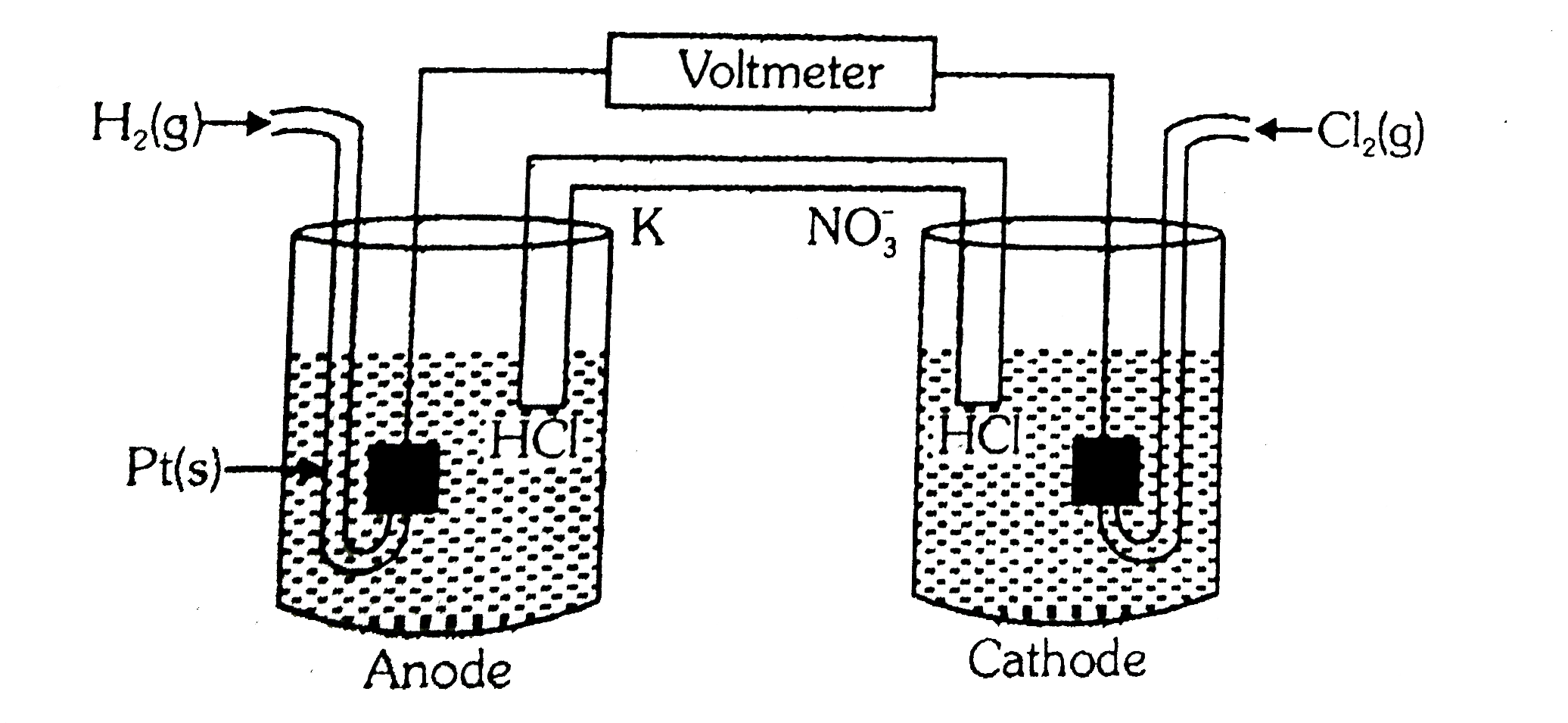
Consider the following Galvanic cell:- ...

Consider the following Galvanic cell:-

By what value the cell voltage when concentration of ions in anodic and cathodic compartments both increased by factor of 10 at 298K:

A

`+0591`

B

`-0.0591`

C

`-0.1182`

D

`0`

Text Solution

Verified by Experts

The correct Answer is:

C

`E_(cell)=-(0.0591)/(1)log_(10)[H^(+)][Cl^(-)]` and `E_(cell)^(')=E_(cell)^(0)-(0.0591)/(1)log_(10)100[H^(+)][Cl^(-)]`
`E_(cell)^(')-E_(cell)=-2xx0.0591=-0.1182`
Promotional Banner

Topper's Solved these Questions

  • ELECTROCHEMISRY

    RESONANCE ENGLISH|Exercise CBSE Problems|34 Videos
  • ELECTRO CHEMISTRY

    RESONANCE ENGLISH|Exercise PHYSICAL CHEMITRY (ELECTROCHEMISTRY)|53 Videos
  • EQUIVALENT CONCEPT & TITRATIONS

    RESONANCE ENGLISH|Exercise Part -IV|22 Videos

Similar Questions

Explore conceptually related problems

Write the Nernst equation for the cell reaction in the Daniel cell. How will the E_("cell") be affected when concentration of Zn^(+) ions is increased?

Consider the following eqilibrium PCl5(g))--->PCl_((3)(g)) + Cl_((2)(g)), What happens to the equillibrium when concentration of Cl2 is increased

Consider the following relations for emf of a electrochemical cell (i) emf of cell = (Oxidation potential of anode)-(Reduction potential of cathode) (ii) emf of cell = (Oxidation potential of anode)+(Reduction potential of cathode) (iii) emf of cell = (Reduction potential of anode)+(Reduction potential of cathode) (iv) emf of cell = (Oxidation potential of anode)-(Oxidation potential of cathode) Which of the above realtions are correct?

What is the pH value of the solution when the hydrogen ion concentration is 10^(-5) ?

Draw the diagram a of galvanic cell involving following reactions : Zn+Cu^(+) to Zn^(2+) +Cu and answer the following questions: (i) Label the cathode and anode (ii) How does the e.m.f. of the cell changes with the decrease in the concentration of Cu^(2+) ions ? (iii) What is the function of salt bridge in it? (iv) Name the salt to be used in salt bridge. (v) Write the reactions occurring at each electrode. (vi) In which direction the electrons would flow in the external circuit? (vii) How electrical neutrality is maintained in both the half cells?

The product of the concentration of the ions of an electrolyte raised to power of their coefficients in the balanced chemical equation in the solution at any concentration . Its value is not constant and varies with change in concentration . Its value is not constant and varies with change in concentration . Its value is not constant and varies with change in concentration . Ionic product of the saturated solution is called solubility product K_(sp) (i) When K_(ip) = K_(sp) , the solution is just saturated and no precipitation takes place . (ii) When K_(ip) lt K_(sp) the solution is unsaturated and precipitation will not take place . When K_(ip) gt K_(sP) the solution is supersaturated and precipitation takes place . The concentration of Ag^(+) ions in a given saturated solution of AgCl at 25^(@)C is 1.06 xx10^(-5) g ion per litre . The solubility product of AgCl is :

Consider the following electrochemical cell. (a). Write a balanced net ionic equation for the spontaneous reaction that take place in the cell. (b). Calculate the standard cell potential E^(0) for the cell reaction. (c). If the cell emf is 1.6V what is the concentration of Zn^(2+) ? (d). How will the cell potential be affected if Kl is added to Ag^(+) half-cell?

In a concentration cell the same reagents are present in both the anode and the cathode compartments , but at different concentrations. Calculate the emf of a cell of a cell containing 0.040 M. Cr^(3+) in one compartment and 1.0 M Cr^(3+) in the other if Cr electrodes are used in both.

Consider a Galvenic cell, Zn(s) |Zn^(2+) (0.1M) ||Cu^(2+) (0.1M)|Cu(s) by what factor, the electrolyte in anodic half cell should be diluted to increase the emf by 9 mili volt at 298K .

Calculate the pH value of the solution in which the concentration of OH^(-) " ions is " 5.0 xx 10^(-9) " mol " L^(-1) at 298 K

RESONANCE ENGLISH-ELECTROCHEMISRY-Advanced Level Problems
  1. Which statement is correct?

    Text Solution

    |

  2. During the electrolysis of 0.1 M CuSO(4) solution using coppepr electr...

    Text Solution

    |

  3. Consider the following Galvanic cell:- By what value the cell vol...

    Text Solution

    |

  4. For Pt,Cl(2)(p(1))|HCl(0.1M)|Cl(2)(p(2)), Pt, cell reaction will be sp...

    Text Solution

    |

  5. Pt |{:((H(2))),(1atm):}:| pH = 2:|:|:pH =3 |:{:((H(2))Pt),(1atm):}:|. ...

    Text Solution

    |

  6. In the given figure the electrolytic cell contains 1L of an aqueous 1M...

    Text Solution

    |

  7. By how much will the potential of half cell Cu^(+2)//Cu change if the ...

    Text Solution

    |

  8. Which of the following facts is not truegt

    Text Solution

    |

  9. Equivalent conductance of 1M CH(3)COOH is 10ohm^(-1)cm^(2) "equIv"^(-1...

    Text Solution

    |

  10. Adding powdered Pb and Fe to a solution containing 1.0 M each of Pb^(+...

    Text Solution

    |

  11. For the production of X L H2 at STP at cathode, cost of electricity is...

    Text Solution

    |

  12. The reaction : Zn(s) + 2AgCl(g) rightarrow ZnCl(2)(aq) + 2Ag(s) oc...

    Text Solution

    |

  13. If the pressure of hydrogen gas is increased from 1 atm. To 100 atm, k...

    Text Solution

    |

  14. The equilibrium Cu^(+2)(aq)+Cu(s) hArr2Cu^(+) established at 20^(@)C...

    Text Solution

    |

  15. The E^(@) in the given figure is

    Text Solution

    |

  16. What is cell entropy change of the following cell ? Pt(s)|H(2)(g)|C...

    Text Solution

    |

  17. Na- amalgam is prepared by electrolysis of NaCl solution using liquid...

    Text Solution

    |

  18. Zn amalgam is prepared by elctrtolysis of aqueous ZnCI(2) using 9 gram...

    Text Solution

    |

  19. A solution containing one mole per litre each of Cu(NO(3))(2),AgNO(3),...

    Text Solution

    |

  20. At 298K the standard free energy of formation of H(2)O(l) is -256.5 kJ...

    Text Solution

    |
