Home
Class 12
CHEMISTRY
A resistance of 50Omega is registered wh...

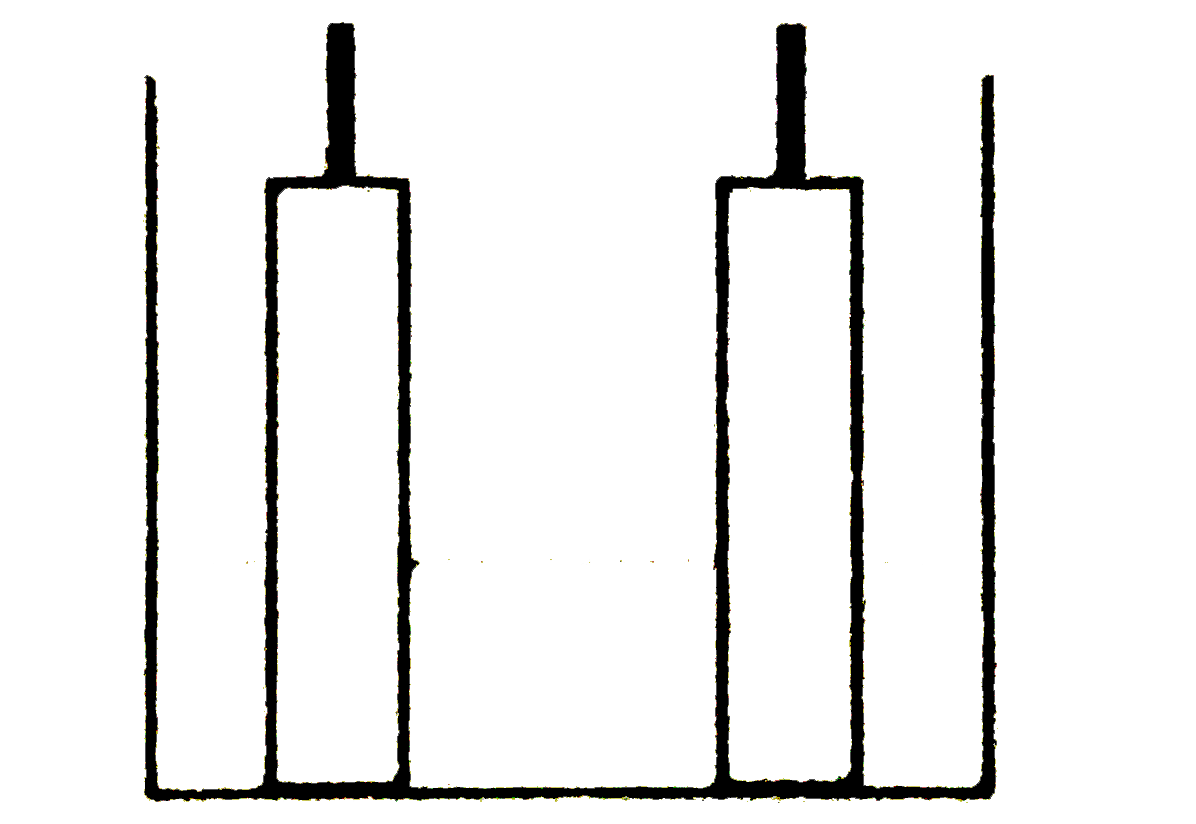
A resistance of `50Omega` is registered when two electrodes are suspended into a beaker containing a dilute solution of a strong electrolyte such that exactly half of them are submerged into solution as shown in figure. If the solution is diluted by adding pure water (negligible conductivity) so as to just completely submerge the electrodes, the new ressitance offered by the solution would be: ltbegt

A

`50Omega`

B

`100Omega`

C

`25Omega`

D

`200Omega`

Text Solution

Verified by Experts

The correct Answer is:

A

`R=(1)/(k)(l)/(A)` The k is halved while the A is doubled. Hence R remains `50Omega`
Promotional Banner

Topper's Solved these Questions

  • ELECTROCHEMISRY

    RESONANCE ENGLISH|Exercise CBSE Problems|34 Videos
  • ELECTRO CHEMISTRY

    RESONANCE ENGLISH|Exercise PHYSICAL CHEMITRY (ELECTROCHEMISTRY)|53 Videos
  • EQUIVALENT CONCEPT & TITRATIONS

    RESONANCE ENGLISH|Exercise Part -IV|22 Videos

Similar Questions

Explore conceptually related problems

In a conductivity cell the two platinum electrodes each of area 10 sq. cm are fixed 1.5 cm apart. The cell. Contained 0.05N solution of a salt. If the two electrodes are just half dipped into the solution which has a resistance of 50 ohms, find equivalent conductance of the salt solution.

The resistance of 0.5M solution of an electrolyte in a cell was found to be 50 Omega . If the electrodes in the cell are 2.2 cm apart and have an area of 4.4 cm^(2) then the molar conductivity (in S m^(2) mol^(-1)) of the solution is

The resistance of a 1N solution of salt is 50 Omega . Calculate the equivalent conductance of the solution, if the two platinum electrodes in solution are 2.1 cm apart and each having an area of 4.2 cm^(2) .

One normal salt solution surrounding two platinum electrodes, 2.1 cm apart and 6.3 cm^(2) in area was found to offer a resistance of 50 ohm. Calculate the equivalent conductivity solution.

Flow cytometry, illustrated in the figure, is a technique used to sort cells by type. The cells are placed in a conducting saline solution which is then forced from a nozzle. The stream breaks up into small droplets, each containing one cell. A metal collar surrounds the stream right at the point where the droplets seprate from the stream. Charging the collar polarizes the conducting liquid, causing the droplets to become charged as they break off from the steam. A leser beam probes the solution just upstream from the charging collar, looking for the presence of certain types of cells. All droplets containing one particular type of cell are given the same charge by the charging collar. Droplets with other desired types of cells receive a different charge, and droplats with no desired cell receive no charge. The charged. The charges droplets then pass between two parallel charged electrodes where they receive a horizontal force that directs force that directs them into different collection tubes, depending on air charge.

Flow cytometry, illustrated in the figure, is a technique used to sort cells by type. The cells are placed in a conducting saline solution which is then forced from a nozzle. The stream breaks up into small droplets, each containing one cell. A metal collar surrounds the stream right at the point where the droplets seprate from the stream. Charging the collar polarizes the conducting liquid, causing the droplets to become charged as they break off from the steam. A leser beam probes the solution just upstream from the charging collar, looking for the presence of certain types of cells. All droplets containing one particular type of cell are given the same charge by the charging collar. Droplets with other desired types of cells receive a different charge, and droplats with no desired cell receive no charge. The charged. The charges droplets then pass between two parallel charged electrodes where they receive a horizontal force that directs force that directs them into different collection tubes, depending on air charge. Another way to sort the droplets would be to given each droplet the same charge, then vary the electric field between the deflection plates. For the apparatus as sketched, this technique will not work because

Strong acid versus strong base: The principle of conductometric titrations is based on the fact that during the titration, one of the ions is replaced by the other and invariable these two ions differ in the ionic conductivity with the result that thhe conductivity of the solution varies during the course of the titration. take, for example, the titration between a strong acid, say HCl, and a string base, say NaOH before NaOH is added, the conductance of HCl solution has a high value due to the presence of highly mobile hydrogen ions. As NaOH is added, H^(+) ions are replaced by relatively slower moving Na^(+) ions. consequently the conductance of the solution decreases and this continues right upto the equivalence point where the solution contains only NaCl. Beyond the equivalence point, if more of NaOH is added, then the solution contains a excess of the fast moving OH^(-) ions with the result that its conductance is increased ad it condinues to increase as more and more of NaOH is added. If we plot the conductance value versus the amount of NaOH added, we get a curve of the type shown in Fig. The descending portion AB represents the conductances before the equivalence point (solution contains a mixture of acid HCl and the salt NaCl) and the ascending portion CD represents the conductances after the equivalence point (solution contains the salt NaCl and the excess of NaOH). The point E which represent the minium conductance is due to the solution containing only NaCl with no free acid or alkali and thus represents the equivalence point. this point can, however, be obtained by the extrapolation of the lines AB and DC, and therefore, one is not very particular in locating this point expermentally as it is in the case of ordinary acid-base titrations involving the acid-base indicators. Weak acid versus strong base: Let us take specific example of acetic acid being titrated against NaOH . Before the addition of alkali, the solution shows poor conductance due to feeble ionization of acetic acid. Initially the addition of alkali causes not only the replacement of H^(+) by Na^(+) but also suppresses the dissociation of acetic acid due to the common ion Ac^(-) and thus the conductance of the solution decreases in the beginning. but very soon the conductance start increasing as addition of NaOH neutralizes the undissociated HAc to Na^(+)Ac^(-) thus causing the replacement of non-conducting HAc with Strong-conducting electrolyte Na^(+)Ac^(-) . the increase in conductance continuous right up to the equivalence point. Beyond this point conductance increases more rapidly with the addition of NaOH due to the highly conducting OH^(-) ions, the graph near the equivalence point is curved due to the hydrolysis of the salt NaAc . The actual equivalence point can, as usual, be obtained by the extrapolation method. In all these graphs it has been assumed that the volume change due addition of solution from burrette is negnigible, hence volume change of the solution in beaker the conductance of which is measured is almost constant throughout the measurement. Q. The nature of curve obtained for the titration between weak acid versus strong base as described in the above passage will be:

A dilute solution NaCI was placed between two Pt electrodes 8 cm apart across which a potential of 4V was appied how far would the Na^(+) move in 2.5 hour? Ionic conductance of Na^(+) at infinit e dikution at 25^(@)C is 50.11 mho cm^(2)

A 100ml solution having activity 50 dps is kept in a beaker It is now constantly diluted by adding water at a constant rate of 10ml//sec and 2 ml//sec of solution is constantly being taken out. Find the activity of 10 ml solution which is taken out, assuming half life to be effectively very large :

RESONANCE ENGLISH-ELECTROCHEMISRY-Advanced Level Problems
  1. The enthalpy change for chemical reaction is denoted as DeltaH^(Theta)...

    Text Solution

    |

  2. A current of 0.1A was passed for 4hr through a solution of cuprocyanid...

    Text Solution

    |

  3. A resistance of 50Omega is registered when two electrodes are suspende...

    Text Solution

    |

  4. Calculate the cell EMF is mV for Pt|H(2)(1 atm)|HCl(0.01M)|AgCl(s)|A...

    Text Solution

    |

  5. Value of Lambdamoo for SrCl2 in water at 25^@ from the following data ...

    Text Solution

    |

  6. A current is passed through 2 voltmeters connected in series. The firs...

    Text Solution

    |

  7. Which of the following is not true about emf of a cell?

    Text Solution

    |

  8. The number of electrons delivered at the cathode during electrolysis b...

    Text Solution

    |

  9. During the electrolysis of an aqueoius nitric acid solution using pt e...

    Text Solution

    |

  10. How many gm of silver will be displaced from a solution of AgNO(3) by ...

    Text Solution

    |

  11. The number of Faradays required to deposit 1g equivalent of aluminium ...

    Text Solution

    |

  12. How many electrons will flow when a current of 5 amperes is passed thr...

    Text Solution

    |

  13. A current of 9.95 amp following for 10 minutes, deposits 3 gm of a met...

    Text Solution

    |

  14. Which of the following has been universally accepted as a reference el...

    Text Solution

    |

  15. A certain current liberates 0.5g of hydrogen in 2 hours. How many gra...

    Text Solution

    |

  16. The specific conductance of a saturated solution of Ag CI is K omega^(...

    Text Solution

    |

  17. Which of the following statements are correct?

    Text Solution

    |

  18. In the process of electroplating m gram of silver is deposited when 4 ...

    Text Solution

    |

  19. A spoon to be electroplated with gold should be

    Text Solution

    |

  20. Time required to deposit one millimole of aluminium metal by the passa...

    Text Solution

    |
