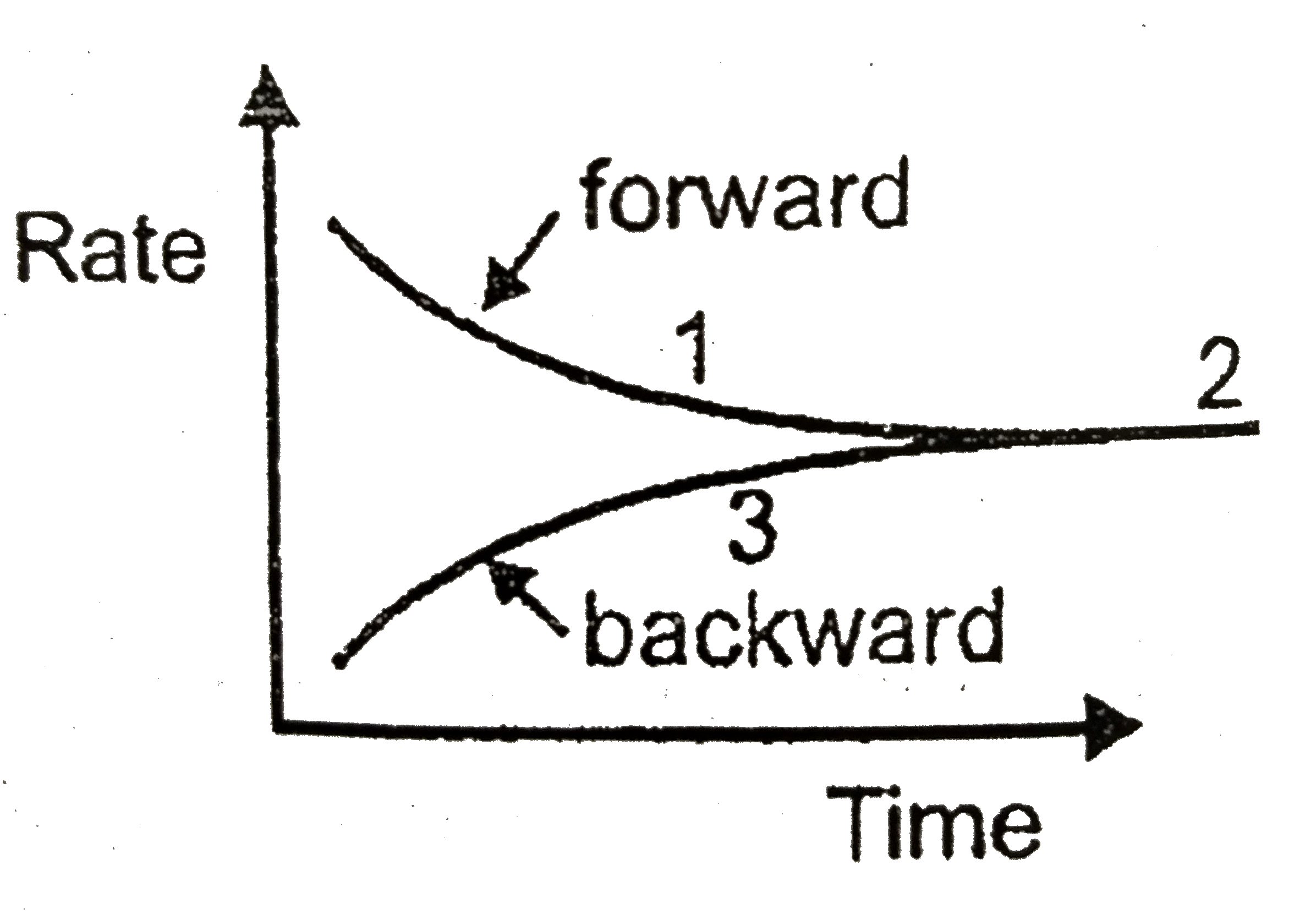
A
B
C
D
Text Solution
Verified by Experts
The correct Answer is:



Topper's Solved these Questions
CHEMICAL EQUILIBRIUM
RESONANCE ENGLISH|Exercise Advanced Level Problems (Part-2)(Section-1)|7 VideosCHEMICAL EQUILIBRIUM
RESONANCE ENGLISH|Exercise Advanced Level Problems (Part-2)(Section-2)|6 VideosCHEMICAL EQUILIBRIUM
RESONANCE ENGLISH|Exercise Exercise-3 (Part-2)|17 VideosCHEMICAL BONDING
RESONANCE ENGLISH|Exercise ORGANIC CHEMISTRY(Fundamental Concept )|6 VideosD & F-BLOCK ELEMENTS & THEIR IMPORTANT COMPOUNDS
RESONANCE ENGLISH|Exercise Match the column|1 Videos
Similar Questions
Explore conceptually related problems
RESONANCE ENGLISH-CHEMICAL EQUILIBRIUM-Advanced Level Problems (Part-1)
- The K(c) for H(2(g)) + I(2(g))hArr2HI(g) is 64. If the volume of the c...
Text Solution
|
- In equilibrium CH(3)COOH+H(2)OhArrCH(3)COO^(-)+H(3)O^(+) The equilib...
Text Solution
|
- In the esterification C(2)H(5)OH(l)+CH(3)COOH(l)" an "hArr CH(3)COOC...
Text Solution
|
- In the following reaction started only with A(8), 2A(8)(g) hArr3A(2)(g...
Text Solution
|
- Ina 0.25 litre tube dissociation of 4 moles of NO takes place. If its ...
Text Solution
|
- For the given reaction at constant pressure, {:(,nA(g)hArr,An(g)),("...
Text Solution
|
- On decomposition of NH(4)HS , the following equilibrium is estabilishe...
Text Solution
|
- At room temperature, the equilibrium constant for the reaction P + Q h...
Text Solution
|
- Calculate Delta,G^(Ө) for conversion of oxygen to ozone, 3/2 O(2)(g)ra...
Text Solution
|
- For the reaction, 4NH(3)(g) + 5O(2)(g)hArr4NO(g) + 6 H(2)O(l), Delt...
Text Solution
|
- The effect of adding krypton (Kr) gas on position of equilibrium, keep...
Text Solution
|
- Le-Chatelier's principle is applicable only to a
Text Solution
|
- Two solid comp0ounds X and Y dissociates at a ceritain temperature as ...
Text Solution
|
- The value of DeltaG^(@)for the phosphorylation of glucose in glycolysi...
Text Solution
|
- Which of the following statements is correct for a reversible process ...
Text Solution
|
- For the following isomerisation reaction cis-butene-2hArrtrans-buten...
Text Solution
|
- In the reaction PCl(5)(g)hArrPCl(3)(g)+Cl(2)(g) a graph in plotted...
Text Solution
|
- For the reaction PCl(5(g))hArrPCl(3(g))+Cl(2(g)), the forward reactio...
Text Solution
|
- Find out InK(eq) for the formation of NO(2) from NO and O(2) at 298 K ...
Text Solution
|
- If a reaction vessel at 400^(@)C is charged with equimolar mixture of ...
Text Solution
|