
Home
Class 11
CHEMISTRY
Which of the following is/are correct :...

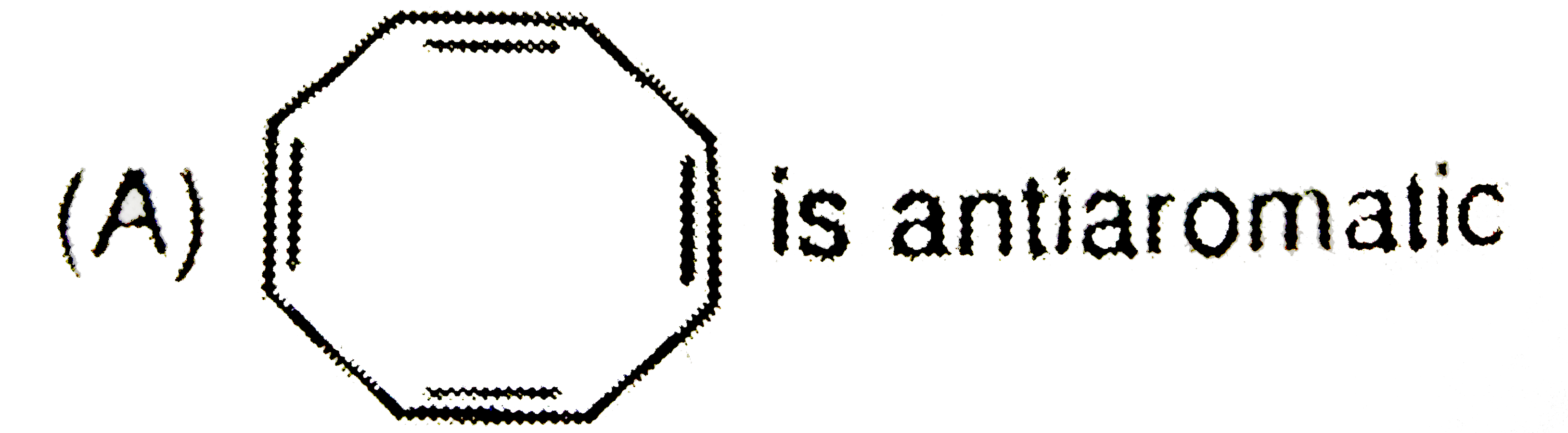
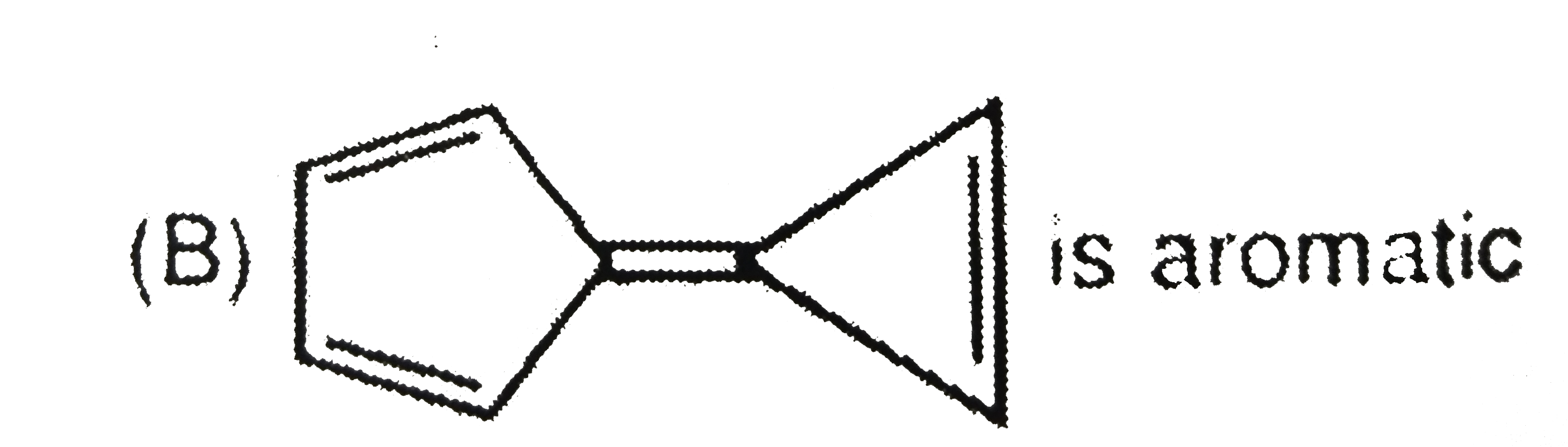
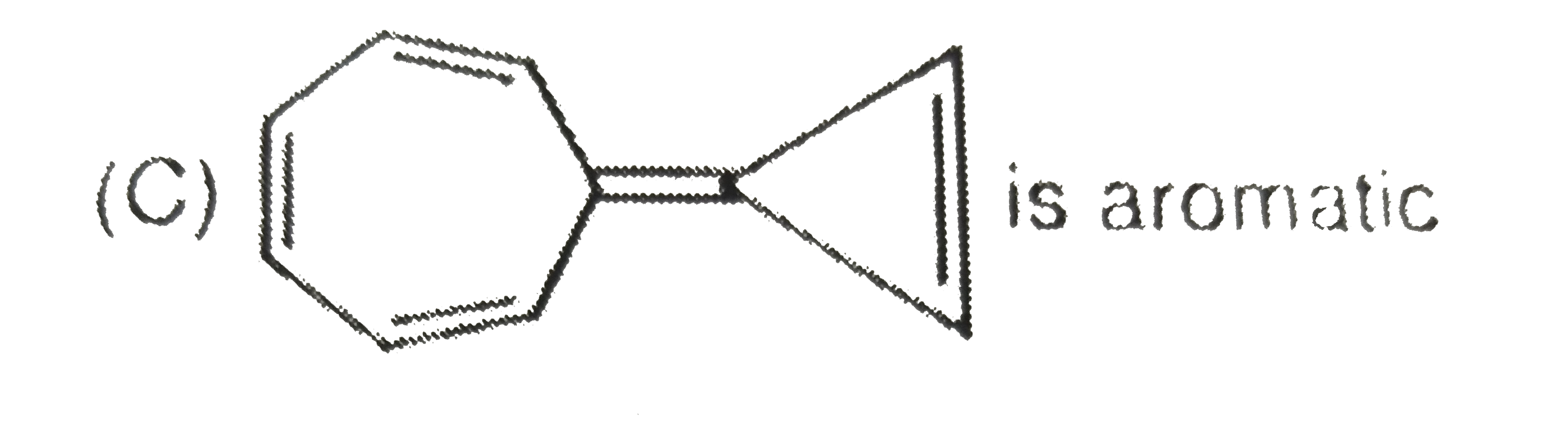
Which of the following is/are correct :

A

B

C

D

Text Solution

AI Generated Solution

The correct Answer is:

To determine which of the given statements about the compounds are correct, we need to analyze each statement based on the principles of aromaticity, anti-aromaticity, and non-aromaticity. ### Step-by-Step Solution: 1. **Understanding Aromaticity**: - Aromatic compounds must satisfy Huckel's rule, which states they should have \(4n + 2\) π electrons (where n is a non-negative integer). - They must also be cyclic, planar, and fully conjugated. 2. **Understanding Anti-aromaticity**: - Anti-aromatic compounds have \(4n\) π electrons. - Similar to aromatic compounds, they must also be cyclic, planar, and fully conjugated. 3. **Understanding Non-aromaticity**: - Non-aromatic compounds do not meet the criteria for aromaticity or anti-aromaticity. They may be non-planar or not fully conjugated. 4. **Analyzing the First Statement**: - The compound is said to be anti-aromatic. However, if the compound is non-planar (like a tub-like structure), it cannot be anti-aromatic. Therefore, this statement is incorrect. 5. **Analyzing the Second Statement**: - If a double bond is broken, and the resulting structure has 2 π electrons, it can be classified as aromatic if it follows the \(4n + 2\) rule. This statement is correct. 6. **Analyzing the Third Statement**: - If we introduce charges that result in a 4 π electron system, it will be classified as anti-aromatic. Therefore, this statement is incorrect. 7. **Analyzing the Fourth Statement**: - If the structure has 6 π electrons and meets the criteria for aromaticity, this statement is correct. ### Conclusion: The correct statements are those that indicate the compound is aromatic when it has 6 π electrons and non-aromatic when it is non-planar. Thus, the correct options are **B and D**. ### Final Answer: The correct options are **B and D**. ---
Promotional Banner

Topper's Solved these Questions

  • GENERAL ORGANIC CHEMISTRY-I

    RESONANCE ENGLISH|Exercise EXERCISE-2 PART-IV : COMPREHENSION|5 Videos
  • GENERAL ORGANIC CHEMISTRY-I

    RESONANCE ENGLISH|Exercise EXERCISE-3|11 Videos
  • GENERAL ORGANIC CHEMISTRY-I

    RESONANCE ENGLISH|Exercise EXERCISE-2 PART-II SINGLE AND DOUBLE VALUE INTEGER TYPE|11 Videos
  • GENERAL ORGANIC CHEMISTRY II

    RESONANCE ENGLISH|Exercise Part-III: Section-5: Matching List Type|1 Videos
  • HYDROGEN AND ITS COMPOUNDS

    RESONANCE ENGLISH|Exercise INORGANIC CHEMISTRY(Hydrogen & its compunds Y environment chemistry)|33 Videos

Similar Questions

Explore conceptually related problems

Which of the following is a correct statement?:

Which of the following is a correct statement?

Which of the following name is correct :-

Which of the following is the correct match ?

Which of the following is the correct match ?

Which of the following is a correct statement ?

Which of the following is a correct statement ?

Which of the following is not correct ?

Which of the following is not correct ?
