Home
Class 11
CHEMISTRY
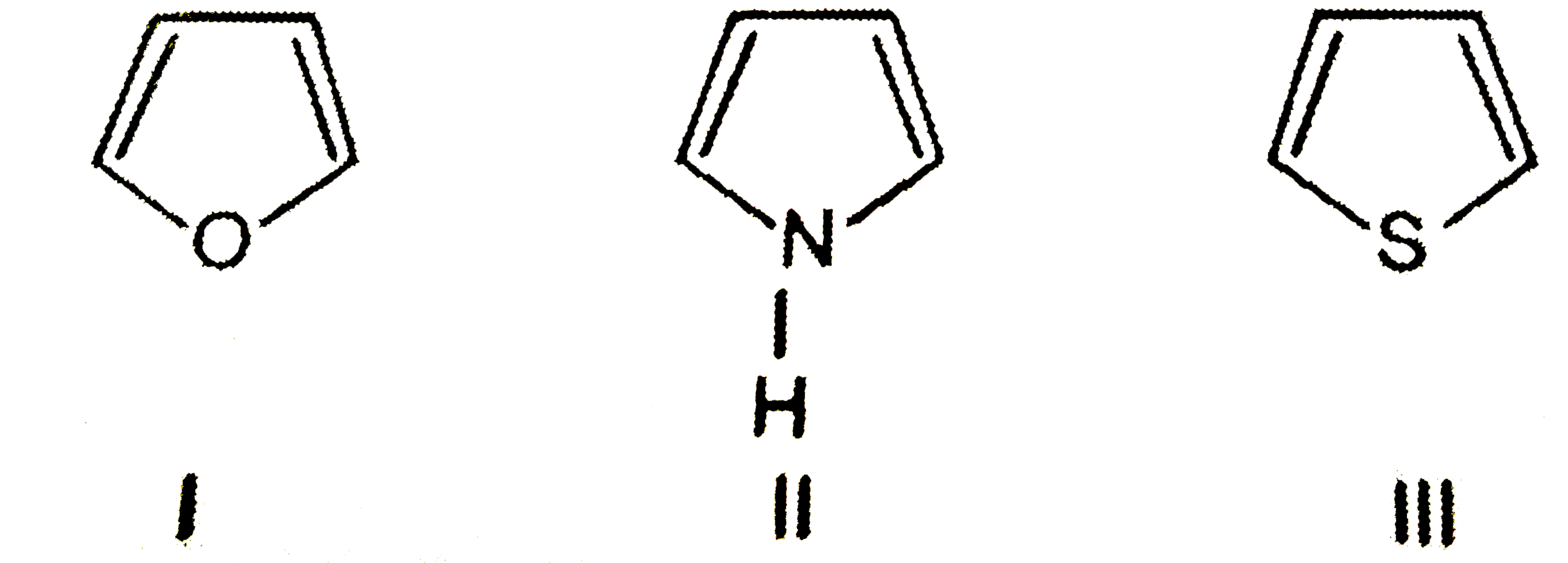
Match the resonance energies 67, 88 and ...

Match the resonance energies 67, 88 and 121 kJ `"mol"^(-1)` for the following compounds.

A

I - 67, II - 121, III- 88

B

I - 121, II-67, III-88

C

I-67, II-88, III-121

D

I-121, II-88, III-67

Text Solution

Verified by Experts

The correct Answer is:

C
Promotional Banner

Topper's Solved these Questions

  • GENERAL ORGANIC CHEMISTRY-I

    RESONANCE ENGLISH|Exercise PART-III : PRACTICE TEST-2|1 Videos
  • GENERAL ORGANIC CHEMISTRY-I

    RESONANCE ENGLISH|Exercise PART-III : PRACTICE TEST-3|1 Videos
  • GENERAL ORGANIC CHEMISTRY-I

    RESONANCE ENGLISH|Exercise PRACTICE TEST-1|30 Videos
  • GENERAL ORGANIC CHEMISTRY II

    RESONANCE ENGLISH|Exercise Part-III: Section-5: Matching List Type|1 Videos
  • HYDROGEN AND ITS COMPOUNDS

    RESONANCE ENGLISH|Exercise INORGANIC CHEMISTRY(Hydrogen & its compunds Y environment chemistry)|33 Videos

Similar Questions

Explore conceptually related problems

Anthrance has a resonance energy of 351 kJ mol^(-1) and the resonance energy of benzence is 150.5 kJ mol^(-1) . Which of the two is more easily oxidised or reduced ?

In a hypothetical reaction X to Y , the activation energy for the forward backward reactions are 15 and 9 kJ mol^(-1) respectively. The potential energy of X is 10 kJ mol^(-1) . Which of the following statement is/are correct? (i) The threshold energy of the reaction is 25 kJ mol^(-1) (ii) The potential energy of Y is 16 kJ mol^(-1) (iii) Heat of reaction is 6 kJ mol^(-1) The reaction is endothermic.

Average C – H bond energy is 416 kJ mol^(-1) . Which of the following is correct?

One mole of magnesium in the vapor state absorbed 1200 kJ mol^(-1) of enegry. If the first and second ionization energies of Mg are 750 and 1450 kJ mol^(-1) , respectively, the final composition of the mixture is

Resonance energy of benzene is 36 kcal mol^(-1) . This means

Calculate the resonance energy of toluene (use Kekule structure from the following data C_(7)H_(8)(l) +9O_(2)(g) rarr 7CO_(2)(g) +4H_(2)O(l)+ DeltaH, DeltaH^(Theta) =- 3910 kJ mol^(-1) C_(7)H_(8)(l) rarr C_(7)H_(8)(g), DeltaH^(Theta) = 38.1 kJ mol^(-1) Delta_(f)H^(Theta) (water) =- 285.8 kJ mol^(-1) Delta_(f)H^(Theta) [CO_(2)(g)] =- 393.5 kJ mol^(-1) Heat of atomisation of H_(2)(g) = 436.0 kJ mol^(-1) Heat of sublimation of C(g) = 715.0 kJ mol^(-1) Bond energies of C-H, C-C , and C=C are 413.0, 345.6 , and 610.0 kJ mol^(-1) .

Calculate the resonance energy of C_(6)H_(6) using kekule formula of C_(6)H_(6) from the following data. a. Delta_(f)H^(Theta) for C_(6)H_(6) =- 358.5 kJ mol^(-1) b. Heat of atomisation of C =716.8 kJ mol^(-1) c. Bond enegry of C-H, C-C, C=C and H-H are 490,340, 620, 436.9 kJ "mole"^(-1) respectively.

Hydrogen bond energy is around ............ kJ mol^(-1)

Calculate the resonance enegry of N_(2)O form the following data Delta_(f)H^(Theta) of N_(2)O = 82 kJ mol^(-1) Bond enegry of N-=N, N=N, O=O, and N=O bond is 946, 418, 498 , and 607 kJ mol^(-1) , respectively.

Calculate the resonance enegry of N_(2)O form the following data Delta_(f)H^(Theta) of N_(2)O = 82 kJ mol^(-1) Bond enegry of N-=N, N=N, O=O, and N=O bond is 946, 418, 498 , and 607 kJ mol^(-1) , respectively.

RESONANCE ENGLISH-GENERAL ORGANIC CHEMISTRY-I-PART-2(NSEC)
  1. The aromatic compound would be

    Text Solution

    |

  2. Inductive effect is a polarisation of a

    Text Solution

    |

  3. Match the resonance energies 67, 88 and 121 kJ "mol"^(-1) for the foll...

    Text Solution

    |

  4. The pair of resonanating structures among the following is

    Text Solution

    |

  5. Identity the aromatic compound from the following.

    Text Solution

    |

  6. Which of the following species is aromatic?

    Text Solution

    |

  7. The number of pi electrons required for a planar cyclic conjugated sys...

    Text Solution

    |

  8. Following is an example of CH(2)=CH-overset(O)overset(||)CHharrover...

    Text Solution

    |

  9. The relative stabilites of the following carbocations is : H(2)"CO C...

    Text Solution

    |

  10. Identify the odd species out (which of the species among the following...

    Text Solution

    |

  11. Which of the following represents the true order of bond dissociation ...

    Text Solution

    |

  12. The correct order of dipole moment for the following molecules is

    Text Solution

    |

  13. The order of decreasing stability is :

    Text Solution

    |

  14. The most Carbocations, carbanions, free radicals and radical cation ar...

    Text Solution

    |

  15. The electronegativities of acetylene, ethylene and ethane are in the o...

    Text Solution

    |

  16. Which of the following structure is aromatic ?

    Text Solution

    |

  17. Which of the following is most stable?

    Text Solution

    |

  18. How many hperconjugative structures are possible in the following carb...

    Text Solution

    |

  19. Which of the following is not a resonating structure for the phenoxide...

    Text Solution

    |

  20. Among the following, the compound that is both paramagnetic and colour...

    Text Solution

    |
