
Home
Class 11
CHEMISTRY
Identity the aromatic compound from the ...

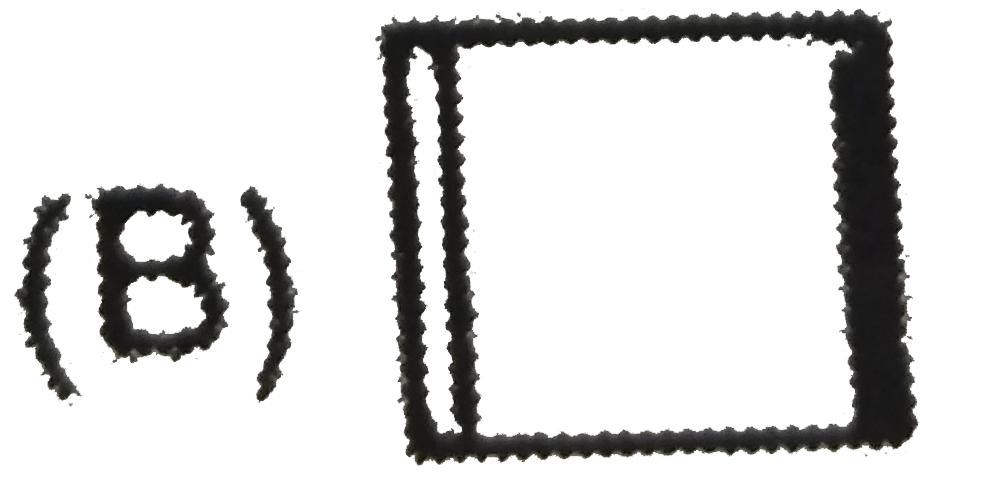
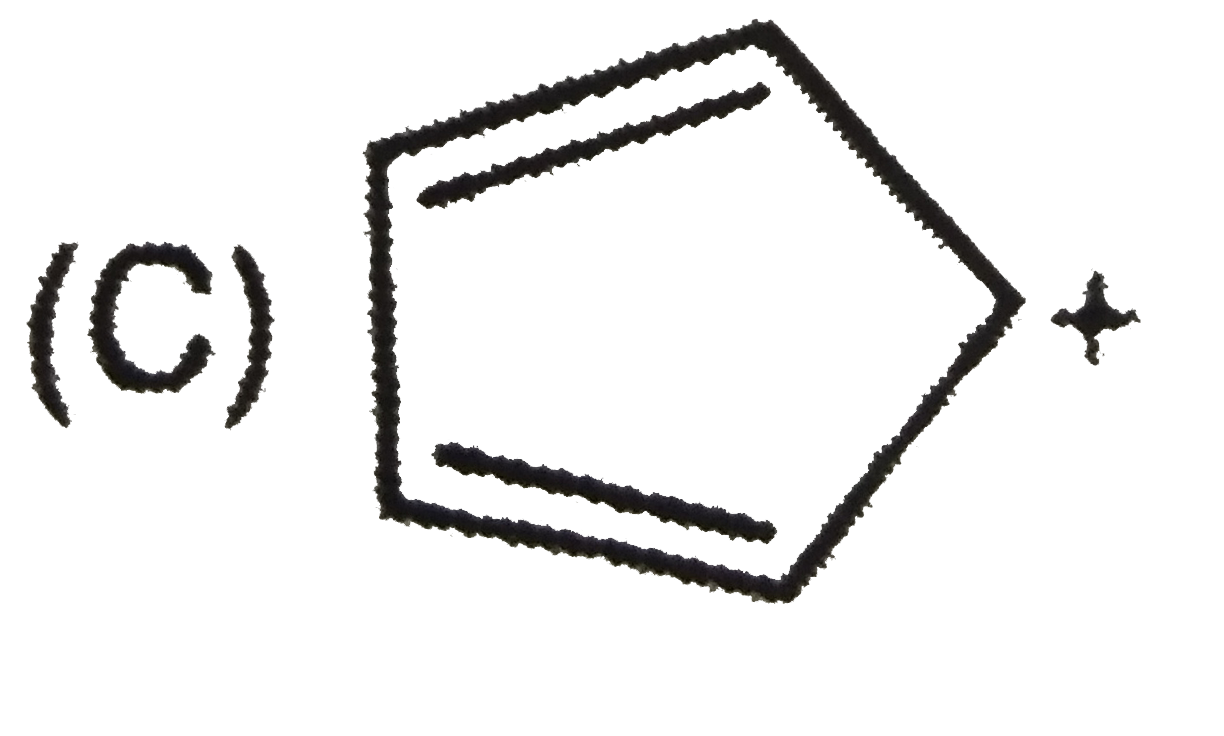
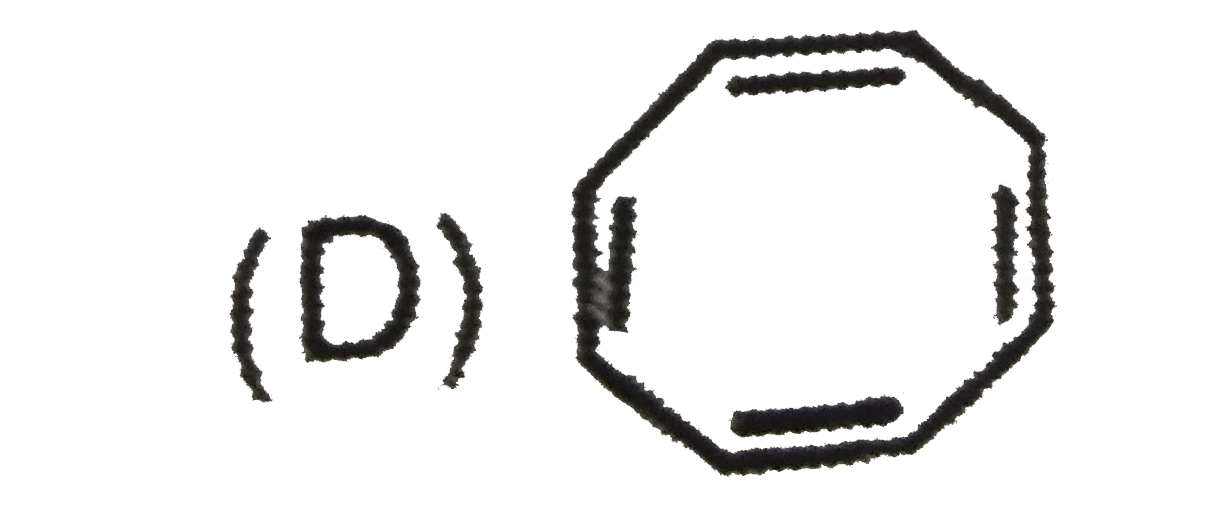
Identity the aromatic compound from the following.

A

B

C

D

Text Solution

AI Generated Solution

The correct Answer is:

To identify the aromatic compound from the given options, we will follow the criteria for aromaticity. The criteria are: 1. The compound must be cyclic. 2. The compound must be planar. 3. The compound must have a conjugated system (alternating single and double bonds). 4. The compound must follow Huckel's rule, which states that it should have \(4n + 2\) π electrons, where \(n\) is a non-negative integer. 5. All atoms in the ring must be sp² hybridized. Now, let's analyze the given compounds step by step: ### Step 1: Check each compound for cyclic structure - Identify if the compound is a ring structure. If it is not cyclic, it cannot be aromatic. ### Step 2: Check for planarity - Determine if the compound can lie flat in a plane. If the compound has bulky groups or is otherwise unable to be planar, it cannot be aromatic. ### Step 3: Check for conjugation - Look for alternating single and double bonds in the compound. A conjugated system is necessary for aromaticity. ### Step 4: Count the π electrons - Count the number of π electrons in the compound. For a compound to be aromatic, it must satisfy Huckel's rule, which means it should have \(4n + 2\) π electrons. ### Step 5: Check hybridization - Ensure that all the atoms in the ring are sp² hybridized. If any atom is sp³ hybridized or has a different hybridization, the compound cannot be aromatic. ### Analysis of Given Compounds: 1. **Compound A**: - Cyclic: Yes - Planar: Yes - Conjugated: Yes - π Electrons: 6 (satisfies \(4n + 2\) where \(n=1\)) - Hybridization: All sp² - **Conclusion**: This is an aromatic compound. 2. **Compound B**: - Cyclic: Yes - Planar: Yes - Conjugated: No (only has 4 π electrons) - π Electrons: 4 (does not satisfy \(4n + 2\)) - **Conclusion**: This is not aromatic. 3. **Compound C**: - Cyclic: Yes - Planar: Yes - Conjugated: Yes - π Electrons: 4 (does not satisfy \(4n + 2\)) - **Conclusion**: This is not aromatic. 4. **Compound D**: - Cyclic: Yes - Planar: Yes - Conjugated: Yes - π Electrons: 8 (does not satisfy \(4n + 2\)) - **Conclusion**: This is not aromatic. ### Final Conclusion: The only aromatic compound among the given options is **Compound A**.
Promotional Banner

Topper's Solved these Questions

  • GENERAL ORGANIC CHEMISTRY-I

    RESONANCE ENGLISH|Exercise PART-III : PRACTICE TEST-2|1 Videos
  • GENERAL ORGANIC CHEMISTRY-I

    RESONANCE ENGLISH|Exercise PART-III : PRACTICE TEST-3|1 Videos
  • GENERAL ORGANIC CHEMISTRY-I

    RESONANCE ENGLISH|Exercise PRACTICE TEST-1|30 Videos
  • GENERAL ORGANIC CHEMISTRY II

    RESONANCE ENGLISH|Exercise Part-III: Section-5: Matching List Type|1 Videos
  • HYDROGEN AND ITS COMPOUNDS

    RESONANCE ENGLISH|Exercise INORGANIC CHEMISTRY(Hydrogen & its compunds Y environment chemistry)|33 Videos

Similar Questions

Explore conceptually related problems

The aromatic compound would be

The aromatic compound would be :

The non-aromatic compound among the following is

Non-aromatic compound is

Identify the polynuclear aromatic compound which is aromatic.

Which forms aromatic compound on heating?

Which one is not aromatic compound ?

RESONANCE ENGLISH-GENERAL ORGANIC CHEMISTRY-I-PART-2(NSEC)
  1. Inductive effect is a polarisation of a

    Text Solution

    |

  2. Match the resonance energies 67, 88 and 121 kJ "mol"^(-1) for the foll...

    Text Solution

    |

  3. The pair of resonanating structures among the following is

    Text Solution

    |

  4. Identity the aromatic compound from the following.

    Text Solution

    |

  5. Which of the following species is aromatic?

    Text Solution

    |

  6. The number of pi electrons required for a planar cyclic conjugated sys...

    Text Solution

    |

  7. Following is an example of CH(2)=CH-overset(O)overset(||)CHharrover...

    Text Solution

    |

  8. The relative stabilites of the following carbocations is : H(2)"CO C...

    Text Solution

    |

  9. Identify the odd species out (which of the species among the following...

    Text Solution

    |

  10. Which of the following represents the true order of bond dissociation ...

    Text Solution

    |

  11. The correct order of dipole moment for the following molecules is

    Text Solution

    |

  12. The order of decreasing stability is :

    Text Solution

    |

  13. The most Carbocations, carbanions, free radicals and radical cation ar...

    Text Solution

    |

  14. The electronegativities of acetylene, ethylene and ethane are in the o...

    Text Solution

    |

  15. Which of the following structure is aromatic ?

    Text Solution

    |

  16. Which of the following is most stable?

    Text Solution

    |

  17. How many hperconjugative structures are possible in the following carb...

    Text Solution

    |

  18. Which of the following is not a resonating structure for the phenoxide...

    Text Solution

    |

  19. Among the following, the compound that is both paramagnetic and colour...

    Text Solution

    |

  20. The correct order of dipole moment for the following molecules is

    Text Solution

    |
