Home
Class 11
CHEMISTRY
Which of the following cannot be a base?...

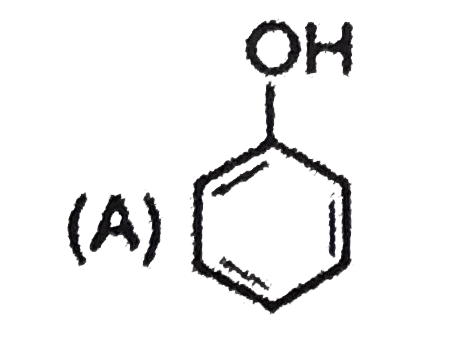
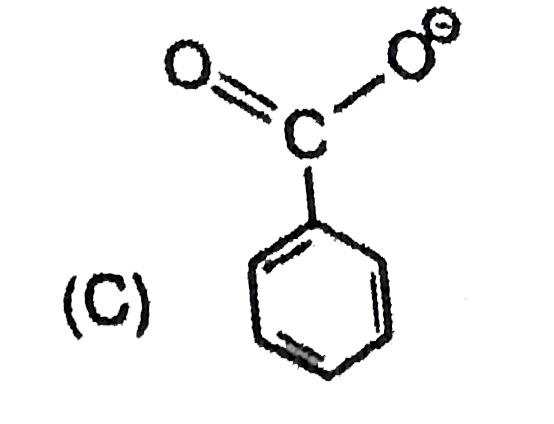
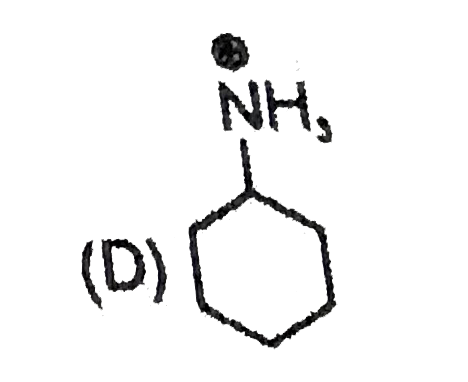
Which of the following cannot be a base?

A

B

`CH_(3)-underset(O)underset(||)C-NH_(2)`

C

D

Text Solution

AI Generated Solution

The correct Answer is:

To determine which of the given compounds cannot act as a base, we need to analyze each option based on their ability to donate a pair of electrons. Bases are typically defined as substances that can accept protons (H⁺) or donate electron pairs. ### Step-by-Step Solution: 1. **Identify the Options**: We need to analyze the compounds provided in the options (A, B, C, and D) to see which one cannot act as a base. 2. **Analyze Option A (Phenol)**: - Phenol has a hydroxyl group (-OH) attached to a benzene ring. The oxygen atom in the hydroxyl group has a lone pair of electrons. - Although the lone pair participates in resonance with the aromatic system, it can still donate an electron pair to a proton (H⁺). - **Conclusion**: Phenol can act as a base. 3. **Analyze Option B (Amine)**: - This compound contains a nitrogen atom with lone pairs of electrons. - The lone pairs on nitrogen can be used to bond with a proton (H⁺), allowing it to act as a base. - **Conclusion**: The amine can act as a base. 4. **Analyze Option C (Negative Ion)**: - This compound has a negative charge on an oxygen atom, indicating that it has extra electrons. - The negative charge can readily donate an electron pair to a proton (H⁺), making it a strong base. - **Conclusion**: This compound can act as a base. 5. **Analyze Option D (Quaternary Ammonium Ion)**: - This compound has a nitrogen atom bonded to four substituents, resulting in a positive charge on the nitrogen. - Since the nitrogen is already positively charged, it has no available lone pairs to donate; it cannot accept a proton as it has already reached its maximum bonding capacity. - **Conclusion**: This compound cannot act as a base. ### Final Answer: The compound that cannot be a base is **Option D**.
Promotional Banner

Topper's Solved these Questions

  • GENERAL ORGANIC CHEMISTRY II

    RESONANCE ENGLISH|Exercise Part-III: Match the Column|2 Videos
  • GENERAL ORGANIC CHEMISTRY II

    RESONANCE ENGLISH|Exercise Part-I : Only One Option Correct Type|22 Videos
  • GENERAL ORGANIC CHEMISTRY II

    RESONANCE ENGLISH|Exercise Exercise-1|20 Videos
  • GASEOUS STATE

    RESONANCE ENGLISH|Exercise ORGANIC CHEMISTRY(Hydrocarbon)|18 Videos
  • GENERAL ORGANIC CHEMISTRY-I

    RESONANCE ENGLISH|Exercise PART-III : PRACTICE TEST-19|1 Videos

Similar Questions

Explore conceptually related problems

Which of the following cannot be acylated ?

Which of the following cannot be measured by spirometry?

Which of the following cannot be obtained from an IC?

Which of the following cannot be obtained on basal medium?

Which of the following cannot be polarised?

Which of the following cannot be related to biotechnology ?

Which of the following cannot be resolved into enantiomers ?

Which of the following cannot be considered as parasitic adaptations of platyhelminthes?

Which of the following cannot be considered as characteristic feature of arthropods?

Which of the following cannot be accelerated by applying an electric field?

RESONANCE ENGLISH-GENERAL ORGANIC CHEMISTRY II-Part-II Only One Option Correct Type
  1. Which of the following shows the correct order of decreasing basicity ...

    Text Solution

    |

  2. Find the order of basic strength .(If R=Me) ? (I) R(4)N^(+)OH^(-) " ...

    Text Solution

    |

  3. Which of the following cannot be a base?

    Text Solution

    |

  4. Select the basic strength order of following molecules ?

    Text Solution

    |

  5. Among the following compounds the strongest acid is:

    Text Solution

    |

  6. Which of the following is not correct decreasing k(a) order .

    Text Solution

    |

  7. Which of the following acids has the smallest value of dissociation co...

    Text Solution

    |

  8. Find the strongest acid among the following compounds is:

    Text Solution

    |

  9. Which of the following options shows the correct order of decreasing a...

    Text Solution

    |

  10. Arrange increasing order of acidic strength of following dibasic acids...

    Text Solution

    |

  11. Arrange above phenol in increasing order of pK(a) value:

    Text Solution

    |

  12. Order of K(a) of following acids is:

    Text Solution

    |

  13. Arrange the following compounds in increasing order of their acidic st...

    Text Solution

    |

  14. , The products will be:

    Text Solution

    |

  15. Which reaction is not feasible ?

    Text Solution

    |

  16. Which of the following will accept H^(+) from NH(4) ion.

    Text Solution

    |

  17. Complete the following reaction

    Text Solution

    |

  18. Keto enol tautomerism is not observed in:

    Text Solution

    |

  19. The enolic form of acetone contains:

    Text Solution

    |

  20. The above molecule can be enolised by which hydrogen ?

    Text Solution

    |
