


Home
Class 11
CHEMISTRY
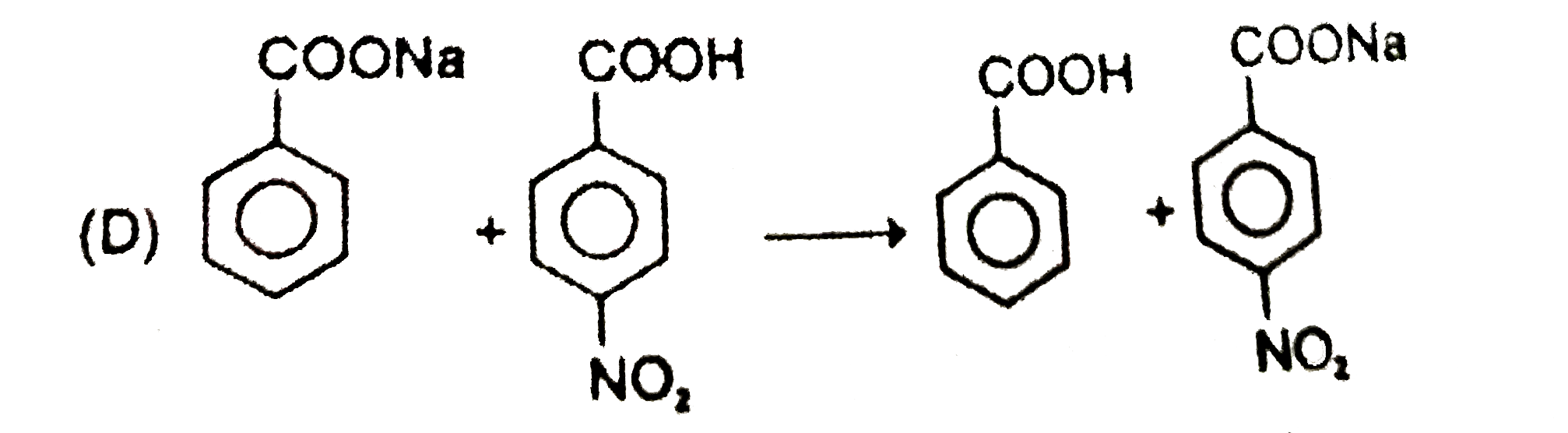
Which reaction is not feasible ?...

Which reaction is not feasible ?

A

B

C

D

Text Solution

Verified by Experts

The correct Answer is:

C
Promotional Banner

Topper's Solved these Questions

  • GENERAL ORGANIC CHEMISTRY II

    RESONANCE ENGLISH|Exercise Part-III: Match the Column|2 Videos
  • GENERAL ORGANIC CHEMISTRY II

    RESONANCE ENGLISH|Exercise Part-I : Only One Option Correct Type|22 Videos
  • GENERAL ORGANIC CHEMISTRY II

    RESONANCE ENGLISH|Exercise Exercise-1|20 Videos
  • GASEOUS STATE

    RESONANCE ENGLISH|Exercise ORGANIC CHEMISTRY(Hydrocarbon)|18 Videos
  • GENERAL ORGANIC CHEMISTRY-I

    RESONANCE ENGLISH|Exercise PART-III : PRACTICE TEST-19|1 Videos

Similar Questions

Explore conceptually related problems

Which reaction is least feasible

Which of the following reaction is not feasible?

The enthalpy and entropy of a reaction are -5.0 kJ//mol and -20 JK^(-1) mol^(-1) respectively and are independent of temperature . What is the highest temperature unto which the reaction is feasible ?

Using the standard electrode potential, find out the pair between which redox reaction is not feasible. E^(@) values : Fe^(3+)//Fe^(2+)=+0.77, I_(2)//I^(-)=+0.54 V Cu^(2+)//Cu= + 0.34 V, Ag^(+)//Ag= +0.80 V

Using the standard electrode potential, find out the pair between which redox reaction is not feasible. E^(θ) values: Fe^(3+)//Fe^(2+)=0.77, I_(2)//I^(-)=+0.54 , Cu^(2+)//Cu=+0.34, Ag^(+)//Ag=+0.80V

Following reactions occur at cathode during the electrolysis of aqueous copper (II) chloride solution: CU_((aq))^(2+)+ 2e^(-)rightarrow Cu_(s), E^(@) = + 0.34V H_((aq))^(+) +e^(-) rightarrow (1)/(2)H_(2(s)), E^(@) = 0.00V On the basis of their standard reduction electrode potential (E^(@)) values, which reaction is feasible at the cathode and why?

Following reactions can occur at cathode during the electrolysis of aqueous silver nitrate solution using Pt electrodes : Ag^(+)""_((aq)) ""^(+e^(-))to Ag""_((s)),E^(@)=0.80V H^(+)""_((aq)) ""^(+e^(-))to 1/2H_(2(g)),E^(@)=0.00V On the basis of theri standars electrode protential values, which reaction is feasible at cathode and why ?

Which of the following reaction is feasible ?

(i) Cu+ 2HCl_(2) +H_(2)(g) [E_(Cu_(2+)//Cu^(@) = ).34V] (ii) Zn + 2HClrightarrow ZNCl+ (2)+ H_(2) ((g)) [E(ZN^(2+)//ZN^(@) = -0.76V] (iii) Ag+ 2HCl rightarrow AgCl+(1)//(2) H_(2) (g) [E(Ag^(+)//Ag)^(@) =+0.80V] Which of the following reaction is feasible ?

RESONANCE ENGLISH-GENERAL ORGANIC CHEMISTRY II-Part-II Only One Option Correct Type
  1. Which of the following cannot be a base?

    Text Solution

    |

  2. Select the basic strength order of following molecules ?

    Text Solution

    |

  3. Among the following compounds the strongest acid is:

    Text Solution

    |

  4. Which of the following is not correct decreasing k(a) order .

    Text Solution

    |

  5. Which of the following acids has the smallest value of dissociation co...

    Text Solution

    |

  6. Find the strongest acid among the following compounds is:

    Text Solution

    |

  7. Which of the following options shows the correct order of decreasing a...

    Text Solution

    |

  8. Arrange increasing order of acidic strength of following dibasic acids...

    Text Solution

    |

  9. Arrange above phenol in increasing order of pK(a) value:

    Text Solution

    |

  10. Order of K(a) of following acids is:

    Text Solution

    |

  11. Arrange the following compounds in increasing order of their acidic st...

    Text Solution

    |

  12. , The products will be:

    Text Solution

    |

  13. Which reaction is not feasible ?

    Text Solution

    |

  14. Which of the following will accept H^(+) from NH(4) ion.

    Text Solution

    |

  15. Complete the following reaction

    Text Solution

    |

  16. Keto enol tautomerism is not observed in:

    Text Solution

    |

  17. The enolic form of acetone contains:

    Text Solution

    |

  18. The above molecule can be enolised by which hydrogen ?

    Text Solution

    |

  19. Which among the following compound will give maximum enol content in s...

    Text Solution

    |

  20. Arrange the following in decreasing order of percentage enol content.

    Text Solution

    |
