


Home
Class 11
CHEMISTRY
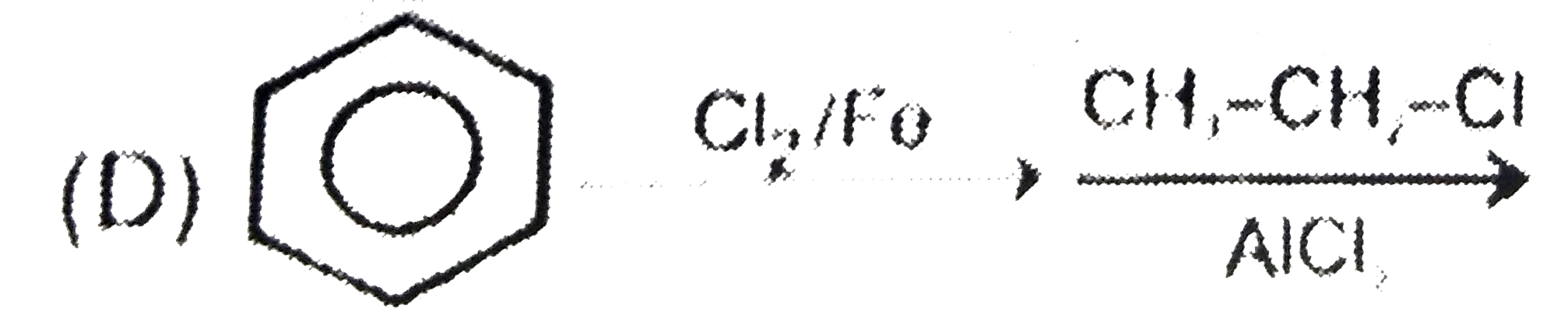
Which step is used to produce 1-Chloro-3...

Which step is used to produce 1-Chloro-3-ethylbenzene

A

B

C

D

Text Solution

AI Generated Solution

The correct Answer is:

To produce 1-Chloro-3-ethylbenzene, we can follow these steps: ### Step 1: Starting Material Begin with benzene as the starting material. Benzene is a six-carbon aromatic compound with alternating double bonds. ### Step 2: Friedel-Crafts Acylation React benzene with acetic anhydride (or acetyl chloride, CH3COCl) in the presence of a Lewis acid catalyst, such as aluminum chloride (AlCl3). This reaction will introduce an acetyl group (COCH3) onto the benzene ring, forming acetophenone. **Reaction:** \[ \text{C}_6\text{H}_6 + \text{CH}_3\text{COCl} \xrightarrow{\text{AlCl}_3} \text{C}_6\text{H}_5\text{COCH}_3 \] ### Step 3: Directing Effects The acetyl group (keto group) is a meta-directing group due to its electron-withdrawing nature. Therefore, any further electrophilic substitution will occur at the meta position relative to the acetyl group. ### Step 4: Electrophilic Substitution Next, perform an electrophilic substitution reaction with chlorine (Cl2) in the presence of a catalyst (like FeCl3). The chlorine will substitute at the meta position of the acetophenone, resulting in the formation of 1-Chloro-3-ethylbenzene. **Reaction:** \[ \text{C}_6\text{H}_5\text{COCH}_3 + \text{Cl}_2 \xrightarrow{\text{FeCl}_3} \text{C}_6\text{H}_4\text{Cl}\text{COCH}_3 \] ### Step 5: Reduction (if necessary) If the ethyl group is required, you can reduce the ketone (acetophenone) to an ethyl group using zinc and hydrochloric acid (Zn/HCl). This will yield the final product, 1-Chloro-3-ethylbenzene. **Final Reaction:** \[ \text{C}_6\text{H}_4\text{Cl}\text{COCH}_3 \xrightarrow{\text{Zn/HCl}} \text{C}_6\text{H}_4\text{Cl}\text{C}_2\text{H}_5 \] ### Conclusion Thus, the correct step to produce 1-Chloro-3-ethylbenzene involves starting with benzene, performing Friedel-Crafts acylation to introduce the acetyl group, and then conducting electrophilic substitution with chlorine. ---
Promotional Banner

Topper's Solved these Questions

  • ORGANIC REACTION MECHANISMS - II

    RESONANCE ENGLISH|Exercise Exercise-2 Part-2|8 Videos
  • ORGANIC REACTION MECHANISMS - II

    RESONANCE ENGLISH|Exercise Exercise-2 Part-3|10 Videos
  • ORGANIC REACTION MECHANISMS - II

    RESONANCE ENGLISH|Exercise Exercise-1 Part-3|2 Videos
  • MOLE CONCEPT

    RESONANCE ENGLISH|Exercise ORGANIC CHEMISTRY(BASIC CONCEPTS)|27 Videos
  • ORGANIC REACTION MECHANISMS-IV

    RESONANCE ENGLISH|Exercise APSP PART-3|22 Videos

Similar Questions

Explore conceptually related problems

Which raw materials are used to produce hydrogen by Bosch's process?

Which reaction produce 1-methylcyclohexene

Which of the following is used to produce radio waves of constant amplitude?

Which technique is commonly used to produce virus-resistant plants?

Using anhydrous AlCl_(3) as catalyst, which one of the following reactions produces ethylbenzene (PhEt) ?

Draw the Structure for 1-Chloro-2,4-dinitrobenzene

Write the structure of the compound 1-chloro-4-ethyl cyclohexane.

The compound which is used to produce dioxygen and to remove carbon dioxide in submarines is

In the reaction with HCl, an alkene reacts in accordance with Markownikoff's rule to give a product 1-chloro-1-methylcyclohexane. The possible alkene is:

At which step oxygen is used in peroxisome ?
