Home
Class 11
CHEMISTRY
Which of the following compounds will gi...

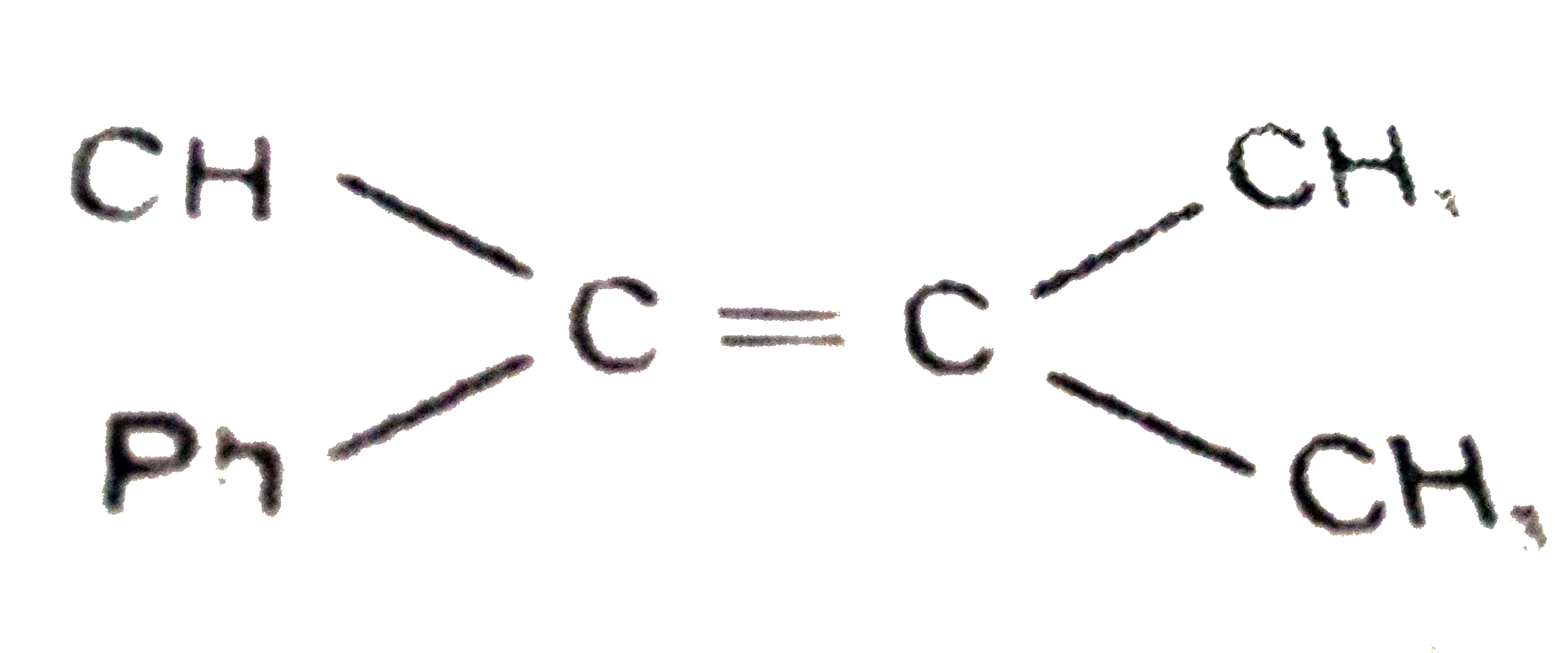
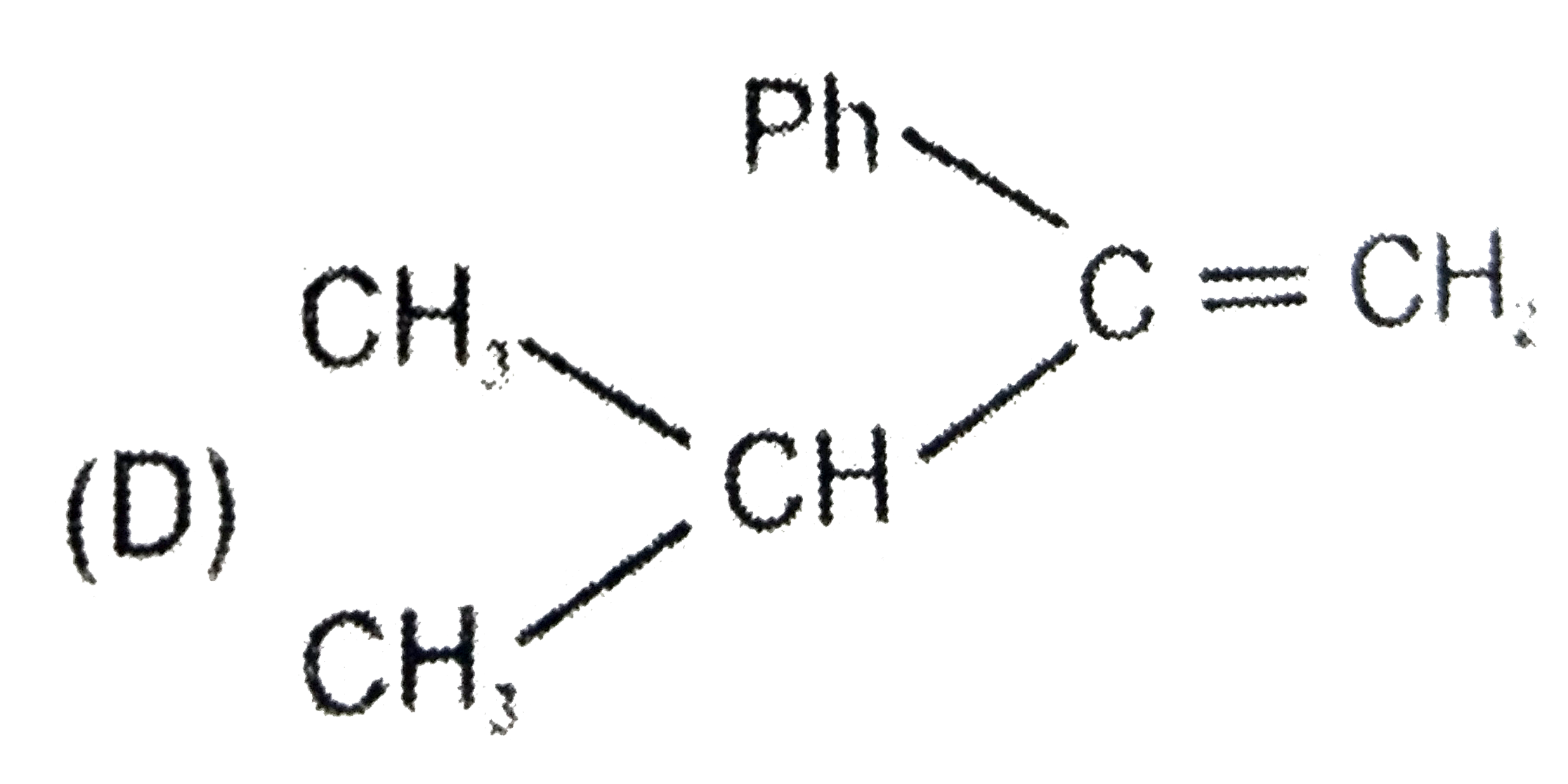
Which of the following compounds will give same major product on acid catalysed hydration ?

A

`Ph-undersetunderset(CH_3)(|)oversetoverset(CH_3)(|)C-CH=CH_2`

B

`Ph-oversetoverset(CH_3)(|)CH-undersetunderset(CH_3)(|)C=CH_2`

C

D

Text Solution

AI Generated Solution

The correct Answer is:

To determine which of the given compounds will yield the same major product upon acid-catalyzed hydration, we will analyze each compound step by step. ### Step 1: Identify the Compounds Let’s denote the compounds as follows: - Compound A: \( \text{pH} - C(CH_3)_2 - CH = CH_2 \) - Compound B: \( \text{pH} - CH - C(CH_3)_2 - CH_2 \) - Compound C: \( CH_3 - \text{pH} - CH = CH_2 \) - Compound D: \( CH_3 - CH = C(CH_3) - \text{pH} \) ### Step 2: Analyze Compound A 1. **Formation of Carbocation**: - Upon protonation, the double bond in Compound A will form a carbocation at the more substituted carbon due to Markovnikov's rule. - The carbocation formed is \( \text{pH} - C(CH_3)_2 - CH^+ \). 2. **Rearrangement**: - A methyl shift occurs, leading to a more stable carbocation. - The final product after hydration will be \( \text{pH} - C(CH_3)_2 - CH_2OH \). ### Step 3: Analyze Compound B 1. **Formation of Carbocation**: - Similar to Compound A, the double bond in Compound B will also form a carbocation at the more substituted carbon. - The carbocation formed is \( \text{pH} - C(CH_3)_2 - CH^+ \). 2. **Rearrangement**: - A hydride shift occurs, leading to a more stable carbocation. - The final product after hydration will also be \( \text{pH} - C(CH_3)_2 - CH_2OH \). ### Step 4: Analyze Compound C 1. **Formation of Carbocation**: - The double bond in Compound C will form a carbocation at the more substituted carbon. - The carbocation formed is \( CH_3 - \text{pH} - CH^+ \). 2. **Rearrangement**: - A shift occurs, leading to a more stable carbocation. - The final product after hydration will be \( \text{pH} - C(CH_3)_2 - CH_2OH \). ### Step 5: Analyze Compound D 1. **Formation of Carbocation**: - The double bond in Compound D will form a carbocation at the less substituted carbon. - The carbocation formed is \( CH_3 - CH^+ - C(CH_3) - \text{pH} \). 2. **Rearrangement**: - A different rearrangement occurs, leading to a different product. - The final product after hydration will be different from those of A, B, and C. ### Conclusion - **Same Major Products**: Compounds A, B, and C yield the same major product, which is \( \text{pH} - C(CH_3)_2 - CH_2OH \). - **Different Product**: Compound D yields a different product. ### Final Answer Compounds A, B, and C will give the same major product upon acid-catalyzed hydration.
Promotional Banner

Topper's Solved these Questions

  • ORGANIC REACTION MECHANISMS - II

    RESONANCE ENGLISH|Exercise Exercise-2 Part-4|5 Videos
  • ORGANIC REACTION MECHANISMS - II

    RESONANCE ENGLISH|Exercise Exercise-3 Part-1|20 Videos
  • ORGANIC REACTION MECHANISMS - II

    RESONANCE ENGLISH|Exercise Exercise-2 Part-2|8 Videos
  • MOLE CONCEPT

    RESONANCE ENGLISH|Exercise ORGANIC CHEMISTRY(BASIC CONCEPTS)|27 Videos
  • ORGANIC REACTION MECHANISMS-IV

    RESONANCE ENGLISH|Exercise APSP PART-3|22 Videos

Similar Questions

Explore conceptually related problems

Which of te following reaction gives correct major product-

Which of the following reaction/s give same product?

The major product formed by the acid catalysed hydration of

Which of the following compounds will give tertiary butanol as the major product when treated with excess of MeMgBr?

Which of the following will give same product on ozonolysis

Which of the following hydrocarbons give same product on hydrogenation :

Which of the following alkenes will give same product by any method out of hydration, hydroboration-oxidation and oxymercuration-demercuration?
