
Home
Class 11
CHEMISTRY
Consider experimental data shown in the ...

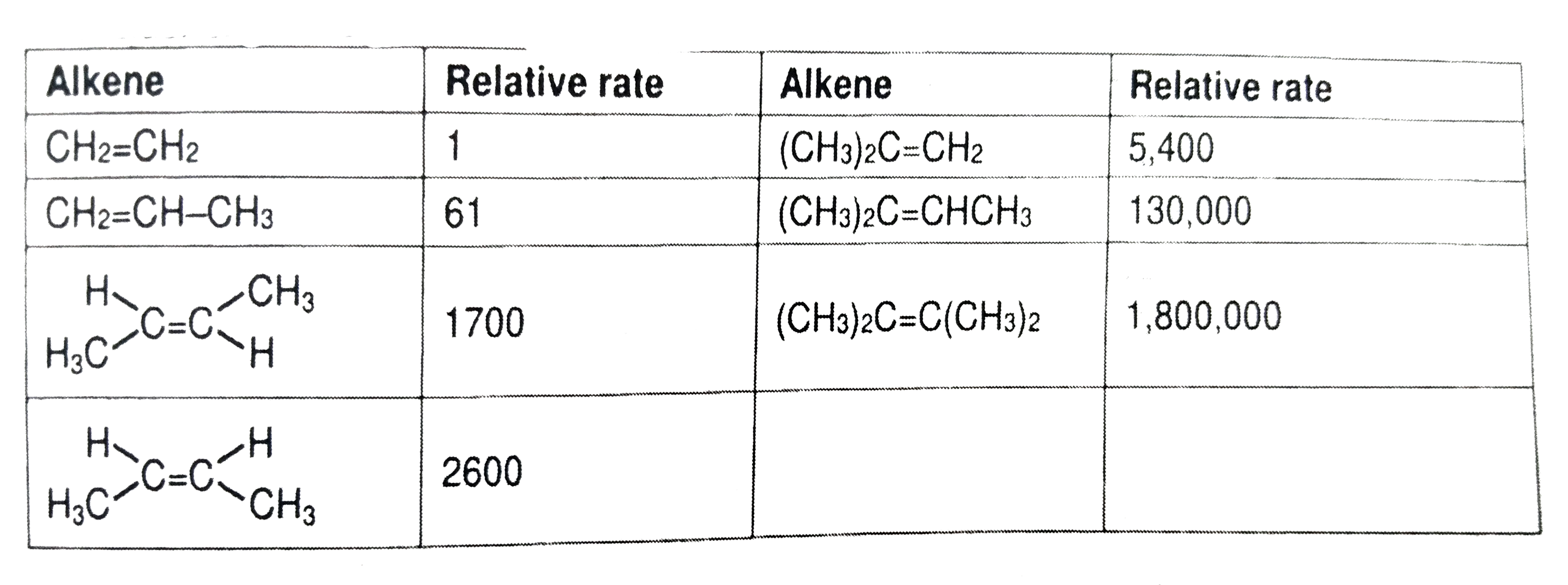
Consider experimental data shown in the table :

Rate of electrophilic addition on isobutylene is significantly higher than cis or trans-2-Butene chiefly due to -

A

B

C

Better stabilization of positive charge acquired during formation of bromonium ion intermediate by Me-groups.

D

High angle strain in the molecule.

Text Solution

Verified by Experts

The correct Answer is:

C
Promotional Banner

Topper's Solved these Questions

  • ORGANIC REACTION MECHANISMS - II

    RESONANCE ENGLISH|Exercise APSP Part - 2|42 Videos
  • MOLE CONCEPT

    RESONANCE ENGLISH|Exercise ORGANIC CHEMISTRY(BASIC CONCEPTS)|27 Videos
  • ORGANIC REACTION MECHANISMS-IV

    RESONANCE ENGLISH|Exercise APSP PART-3|22 Videos

Similar Questions

Explore conceptually related problems

Consider experimental data shown in the table : Which of the following would be expected to have highest rate of electrophilic addition of Br_2 ?

Assertion:- Boiling point of cis-2-butene is more than trans-2-butene. Reason:- Dipole moment of cis-2-butene is more than trans-2-butene.

The formation of oxide ion O^(2-)(g) from oxygen atom requires first an exothermic and then an endothermic step as shown below O(g)+e^(-) rarr O^(-)(g), DeltaH^(-) = - 141 kj mol^(-1) O^(-)(g) +e^(-) rarr O^(2-) (g), DeltaH^(-) =+ 780 kj mol^(-1) Thus, process of formation of O^(2-) in gas phase is unfavourable even through O^(2-) is isoelectronic with neon. It is due to the fact that A) oxygen is more electronegative B) addition of electron in oxygen results in larget size of the ion C) electron repulsion outweights the stability gained by achieving noble gas configuration D) O^(-) ion has comparatively smaller size than oxygen atom

a. Cis- 2 -butene rarr trans- 2 -butane, DeltaH_(1) b. Cis- 2 -butane rarr1 -butene, DeltaH_(2) c. Trans- 2 -butene is more stable than C is- 2 -butene d. Ethalpy of combustion of 1 -butene, DeltaH =- 649.8 kcal//mol e. 9DeltaH_(1) +5DeltaH_(2) = 0 f. Enthalpy of combustion of trans -2 -butene, DeltaH =- 647.1 kcal mol^(-1) . Calculate DeltaH_(1) and DeltaH_(2) ?

Explain the following observation : a. When pent -1 en -4- yneistrested with HBr in molar proportion, the addition takes place on the double bond and not on the triple bond, thereby, yielding the porduct , b. The (C=-C) bond length in propene is shorter than expected. c. Whey benzyl carbocation is more stable than ethyl carbocation ? d. Why does but -2- ene exhibit cis - trans isomerism but but -2- yne does not ? e. CI_(2)C=C C I_(2) does not add CI_(2) under usual conditions but adds in the presence of AICI_(3) .

Stabilities of alkanes can be compared by converting these compounds to a common product and comparing the amount of the heat given off. One possiblitiy would be to measure the heat of combustion from converting alkenes to xo_(2) and H_(2)O . The heats of combustion are of large values and measuring small difference in these large numbers is difficult. Alkene of the lowest heat of combustion among isomeric alkenes is of the lowest energy and is most stable. Th stability of alkenes is often compared by meansuring the ehat of hydrogenation 9 heat given off, Delta H_(h)^(@) during catalytic hydrogenation. The heat of hydrogenation is in smal number, which provides more accurate energy difference. For a compound containing more than one double bond, Delta_(h)^(@) is the sum of heat of hydrogenation of individual double bonds. For non - conjugated diens, this additive relatioship is found to hold. For conjugated dienes, however, the measured value is slightly lower than expected. Cumulated dienes, which are even less stable than non - conjugated dienes. The more stable is the alkene, lower is the heat of combustion and heat of hydrogenation. More highly substituted double bonds are usually more stable. In case of cyclokanes, compounds having higher angle strin are less stable. Arrange the following compounds according to their increasing heat of combustion. I. 1- Butene II. cis -2- Butene III. trans -2- Butene IV. 2- Methyl propene

This interference film is used to measure the thickness of slides, paper, etc. The arrangement is as shown in fig. For the sake of clarity, the two strips are shown thick. Consider the wedge formed in between strips 1 and 2. If the interference pattern because of the two waves reflected from wedge surface is observed, then from the observed data we can compute thickness of paper, refractive index of the medium filled in wedge, number of bonds formed, etc. Considre the strips to be thick as compared to wavelength of ligth and light is incident normally. Neglect the effect due to reflection from top surface of strip 1 and bottom surface of strip 2. Take L = 5 cm and lambda_(air) = 40 nm . For data in question53 determine the distance of point B from the 20th dark band. Counting of dark point has to start from the contact point.

This interference film is used to measure the thickness of slides, paper, etc. The arrangement is as shown in fig. For the sake of clarity, the two strips are shown thick. Consider the wedge formed in between strips 1 and 2. If the interference pattern because of the two waves reflected from wedge surface is observed, then from the observed data we can compute thickness of paper, refractive index of the medium filled in wedge, number of bonds formed, etc. Considre the strips to be thick as compared to wavelength of ligth and light is incident normally. Neglect the effect due to reflection from top surface of strip 1 and bottom surface of strip 2. Take L = 5 cm and lambda_("air") = 400 nm ,h=20mm. In question 53, if air wedge has been filled with a medium having refractive index 1.3 then find the number of bright bands.

Light guidance in an optical fibre can be understood by considering a structure comprising of thin solid glass cylinder of refractive index n_1 surrounded by a medium of lower refractive index n_2 . The light guidance in the structure takes place due to successive total internal reflectrions at the interface of the media n_1 and n_2 as shown in the fugure. All rays with the angle of incidence i less than a particular value i_m are confined in the medium of refractive index n_1 . The numerical aprture (NA) of the structure is defined as sini_m For two structure namely S_1 with n_1=(sqrt45)/(4) and n_2=(3)/(2) , and S_2 with n_1=(8)/(5) and n_2=(7)/(5) and taking the refractive index of water to be (4)/(3) and that of air to be 1, the correct option (s) is (are) ?

Light guidance in an optical fibre can be understood by considering a structure comprising of thin solid glass cylinder of refractive index n_1 surrounded by a medium of lower refractive index n_2 . The light guidance in the structure takes place due to successive total internal reflectrions at the interface of the media n_1 and n_2 as shown in the fugure. All rays with the angle of incidence i less than a particular value i_m are confined in the medium of refractive index n_1 . The numerical aprture (NA) of the structure is defined as sini_m If two structure of same cross-sectional area, but different numerical apertures NA_1 and NA_2(NA_2ltNA_1) are joined longitudinally, the numerical aperture of the combined structure is

RESONANCE ENGLISH-ORGANIC REACTION MECHANISMS - II-APSP Part - 3
  1. Complete the following reaction

    Text Solution

    |

  2. The reaction of toluene with CI(2) in presence of FeCI(3) gives X and ...

    Text Solution

    |

  3. The correct order of heat of combustion for following alkadienes is

    Text Solution

    |

  4. X,Y and Z reaction are :

    Text Solution

    |

  5. The major product of the given reaction is :

    Text Solution

    |

  6. In which reaction incorrect products have been reported.

    Text Solution

    |

  7. In the chlorination of Methane which of the following reaction involve...

    Text Solution

    |

  8. Which of the following reactions are completed through free radical in...

    Text Solution

    |

  9. Which of the following statement are correct for give reaction. CH3-...

    Text Solution

    |

  10. In which of the following reactions and products are correctly matched...

    Text Solution

    |

  11. Which statement is/are correct.

    Text Solution

    |

  12. Which of the following statements is/are incorrect ?

    Text Solution

    |

  13. How many of the following substituents can cause aromatic electrophili...

    Text Solution

    |

  14. How many alkene/s react faster than propane with dil. H(2)SO(4)?

    Text Solution

    |

  15. When addition of Br2 was carried out in presence of aq. NaCl on ethene...

    Text Solution

    |

  16. How many reactions will proceed through free radical addition mechanis...

    Text Solution

    |

  17. In the given reactions M is the number of major products obtained in I...

    Text Solution

    |

  18. Consider experimental data shown in the table : Rate of electroph...

    Text Solution

    |

  19. Consider experimental data shown in the table : Which of the foll...

    Text Solution

    |

  20. Match List-I (Compounds) with List-II (% meta electrophilic substituti...

    Text Solution

    |
