Home
Class 11
CHEMISTRY
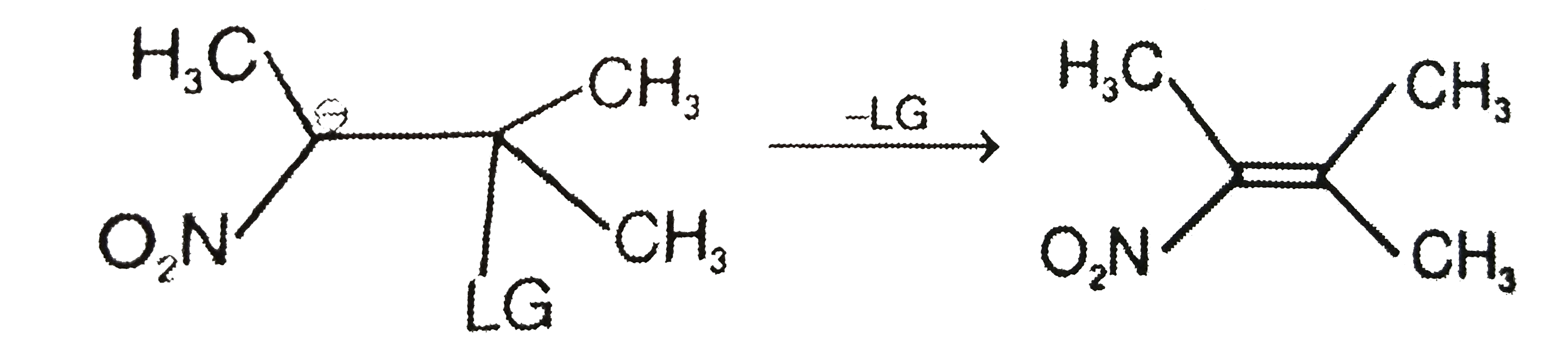
The carbanion expels a leaving group LG ...


The carbanion expels a leaving group LG to yield an alkene as shown above by

A

E1cB mechanism

B

E1 mechanism

C

E2 mechanism

D

Such a reaction does not take place

Text Solution

Verified by Experts

The correct Answer is:

A
Promotional Banner

Topper's Solved these Questions

  • ORGANIC REACTION MECHANISMS-IV

    RESONANCE ENGLISH|Exercise APSP PART-3|22 Videos
  • ORGANIC REACTION MECHANISMS-IV

    RESONANCE ENGLISH|Exercise APSP PART-1|30 Videos
  • ORGANIC REACTION MECHANISMS - II

    RESONANCE ENGLISH|Exercise APSP Part - 3|22 Videos
  • PERIODIC TABLE & PERIODICITY

    RESONANCE ENGLISH|Exercise ORGANIC CHEMISTRY(BASIC CONCEPTS)|27 Videos

Similar Questions

Explore conceptually related problems

The order of leaving group ability is :

Nucleophilic substitution reactions generally expressed as Nu^(-) +R-L rarr R-Nu +L^(-) Where Nu^(-) rarr Nucleophile , R-L rarr substrate, L rarr leaving group The best leaving groups are those that become the most stable ions after they depart. since most leaving group leave as a negatibe ion, the best leaving groups are those ions that stabilize a negative charge most effectively. A good leaving group should be (a) electron-withdrawing to polarize the carbon (b) stable once it has left (not a strong base) (c) polaristable to maintain partial bonding with the carbon in the transition state (both S_(N)1 and S_(N)2) . This bonding helps to stabilise the transition state and reduces the activation energy. (I) CI^(-) (II) CH_(3)O^(-) (III) CH_(3)S^(-) (IV) I^(-) The correct order of increasing leaving group capability of above anions

Nucleophilic substitution reactions generally expressed as Nu^(-) +R-L rarr R-Nu +L^(-) Where Nu^(-) rarr Nucleophile , R-L rarr substrate, L rarr leaving group The best leaving groups are those that become the most stable ions after they depart. since most leaving group leave as a negatibe ion, the best leaving groups are those ions that stabilize a negative charge most effectively. A good leaving group should be (a) electron-withdrawing to polarize the carbon (b) stable once it has left (not a strong base) (c) polaristable to maintain partial bonding with the carbon in the transition state (both S_(N)1 and S_(N)2) . This bonding helps to stabilise the transition state and reduces the activation energy. Among the following which is false statement?

Nucleophilic substitution reactions generally expressed as Nu^(-) +R-L rarr R-Nu +L^(-) Where Nu^(-) rarr Nucleophile , R-L rarr substrate, L rarr leaving group The best leaving groups are those that become the most stable ions after they depart. since most leaving group leave as a negatibe ion, the best leaving groups are those ions that stabilize a negative charge most effectively. A good leaving group should be (a) electron-withdrawing to polarize the carbon (b) stable once it has left (not a strong base) (c) polaristable to maintain partial bonding with the carbon in the transition state (both S_(N)1 and S_(N)2) . This bonding helps to stabilise the transition state and reduces the activation energy. Among the following which is feasible?

ElcB reaction is favoured by stabilisation of carbanion and poor leaving group. The reaction is kinetically of the second order and unimolecular.

Find the value of i in the circuit shown above.

The leaving group is that functional group which is ejected with overline e^, s of the sigma -bond in a reaction. Better the leaving group, faster is the reaction. The relative leaving ability of the leaving group X in (R - X) is increased by : (i) The polarisability of (R - X) bond. (ii) The stability of X^(Ө) . (iii) The degree of stabilisation through solvation of X . (iv) The strength of (R - X) bond. The leaving group tendency is also called fugacity. Which of the following undergoes SN reaction easily ?

The leaving group is that functional group which is ejected with overline e^, s of the sigma -bond in a reaction. Better the leaving group, faster is the reaction. The relative leaving ability of the leaving group X in (R - X) is increased by : (i) The polarisability of (R - X) bond. (ii) The stability of X^(Ө) . (iii) The degree of stabilisation through solvation of X . (iv) The strength of (R - X) bond. The leaving group tendency is also called fugacity. Which one of the followingd has the highest fugacity ?
