Home
Class 12
PHYSICS
Choose Graph between potential and time...

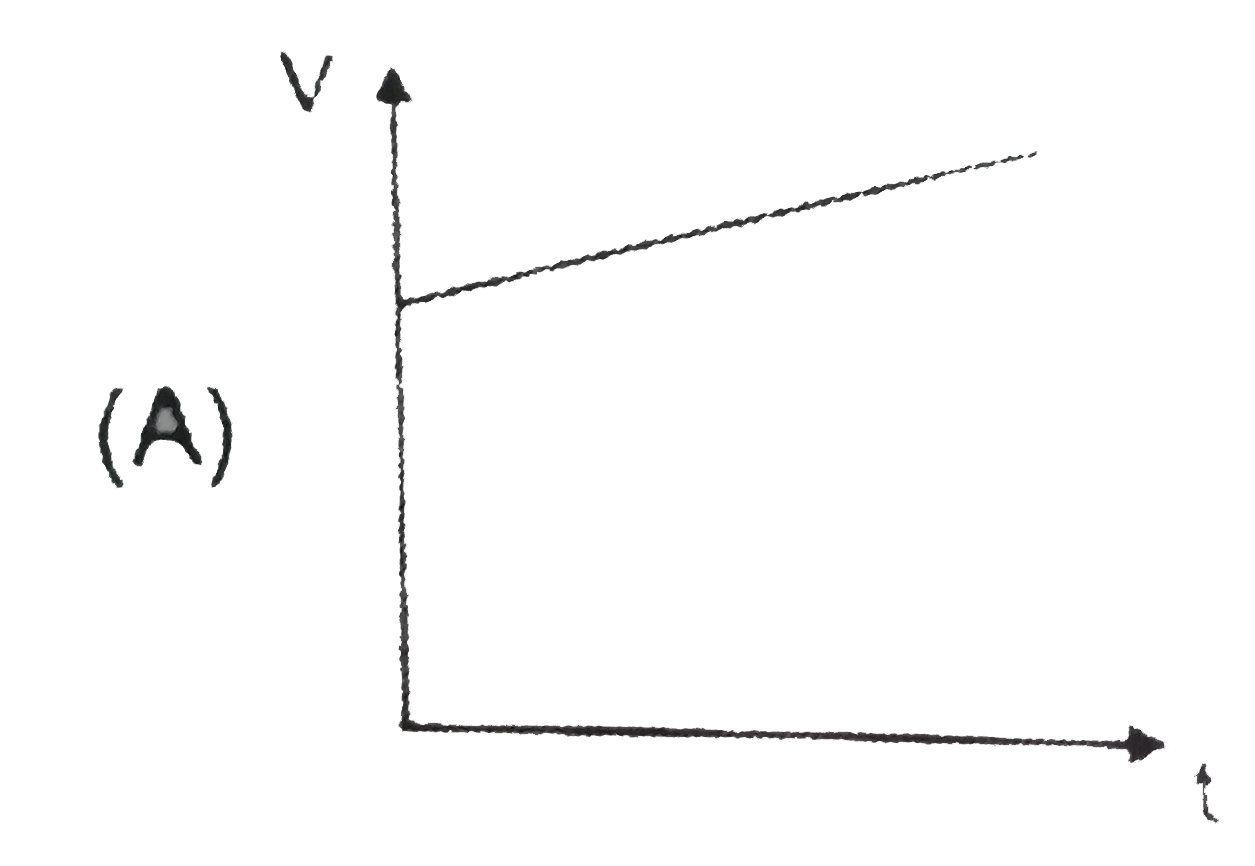
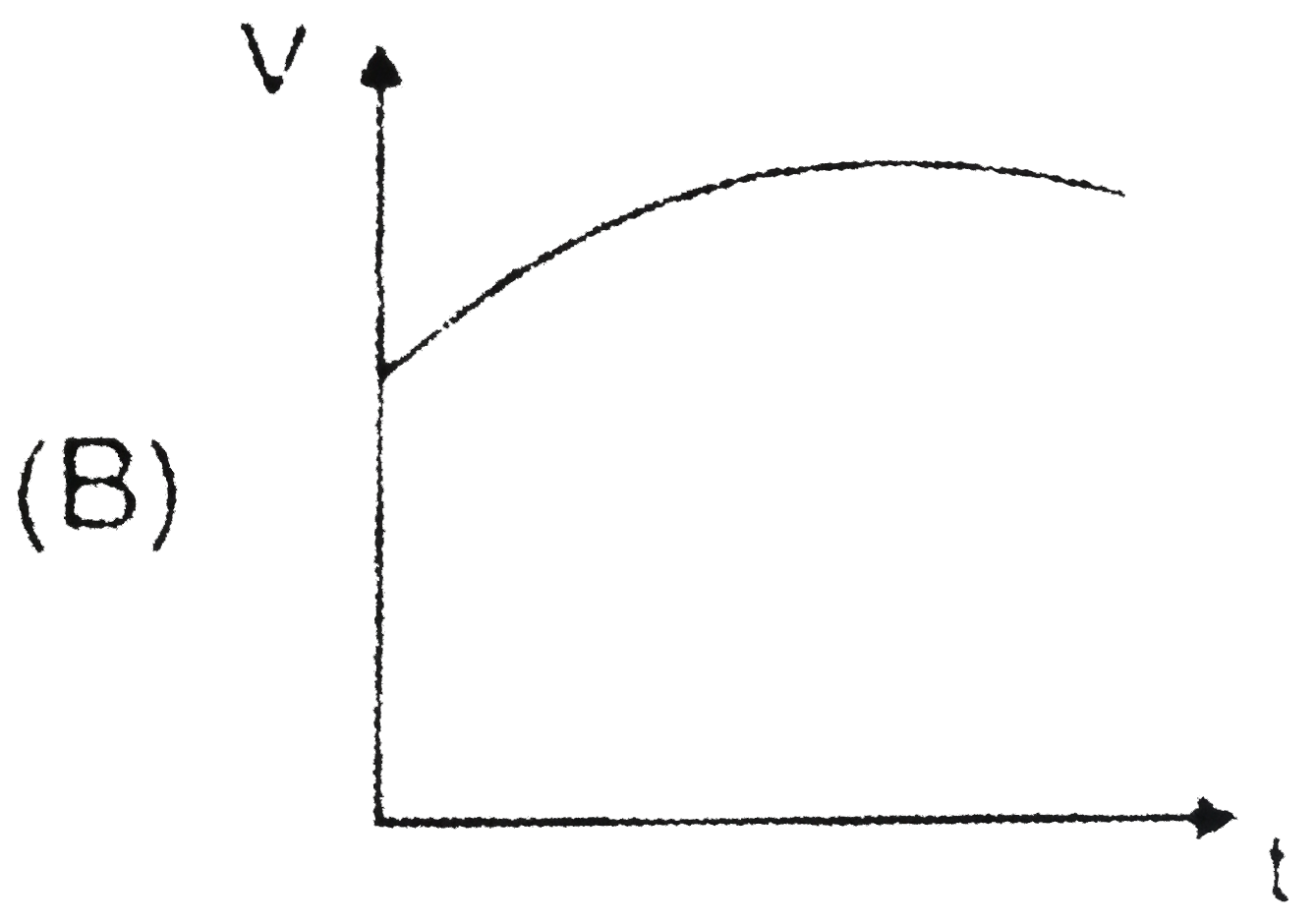
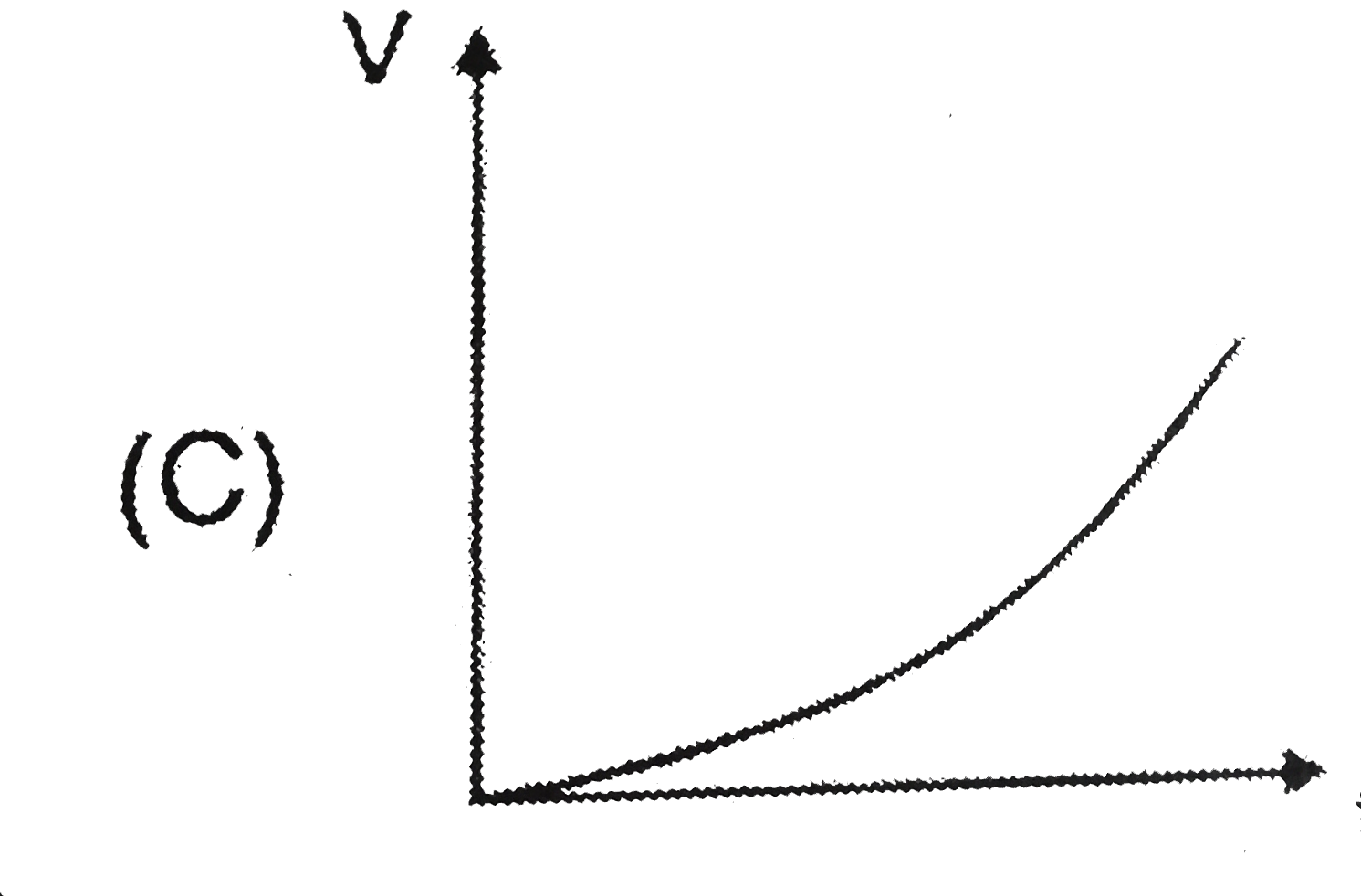
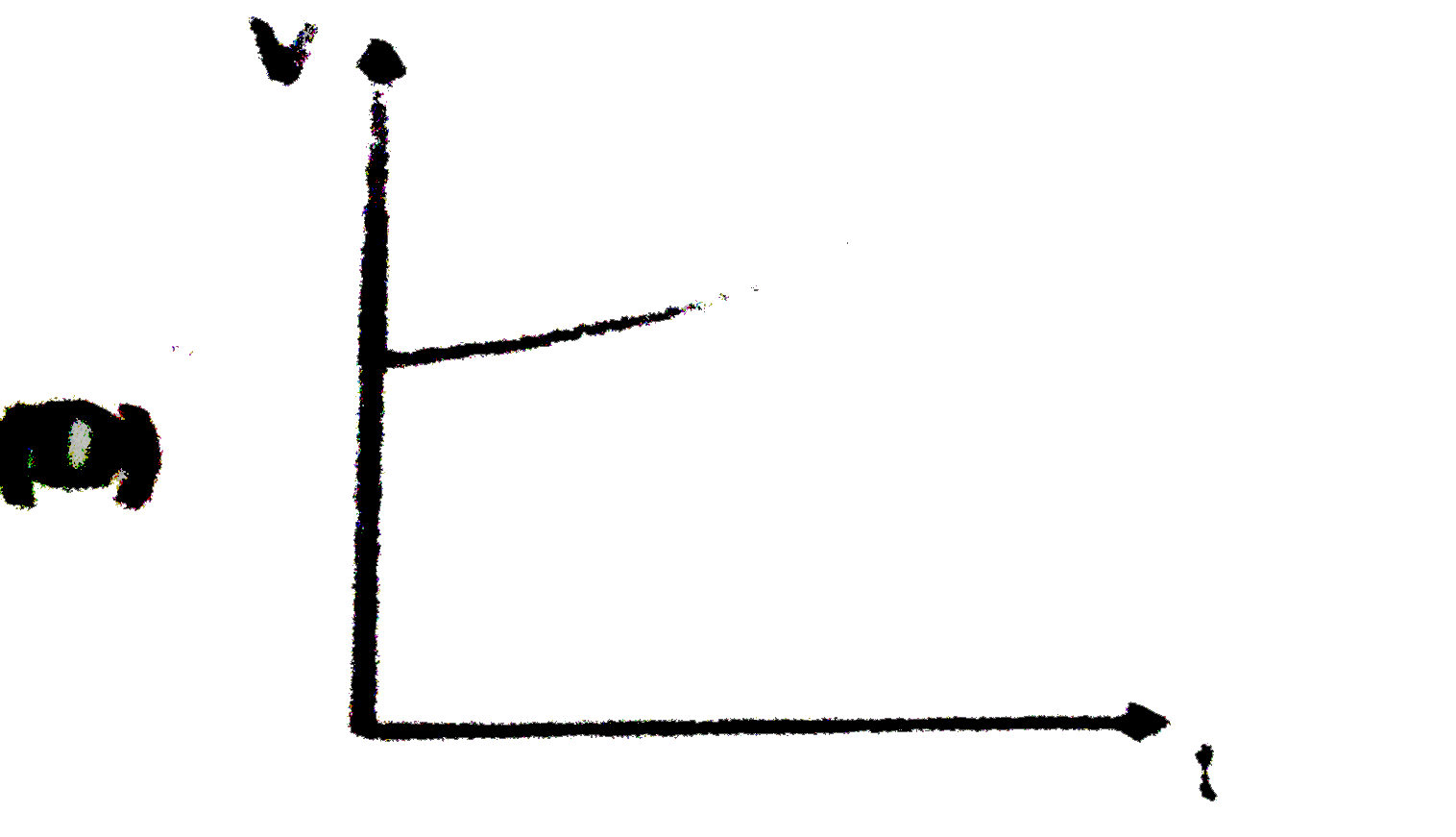
Choose Graph between potential and time for an isolated conductor of finite capacitance C, if its charge varies according to the formula `Q=(alpha t +Q_(0))` coulomb, where `Q_(0)` and `alpha` are positive constant.

A

B

C

D

Text Solution

AI Generated Solution

The correct Answer is:

To solve the problem, we need to analyze the relationship between the charge \( Q \) on an isolated conductor and the potential \( V \) across it, given the formula for charge as \( Q = \alpha t + Q_0 \), where \( Q_0 \) and \( \alpha \) are positive constants. ### Step-by-step Solution: 1. **Understand the relationship between charge and potential:** The potential \( V \) across a capacitor is given by the formula: \[ V = \frac{Q}{C} \] where \( C \) is the capacitance of the conductor. 2. **Substitute the expression for charge into the potential formula:** Given \( Q = \alpha t + Q_0 \), we can substitute this into the potential formula: \[ V = \frac{\alpha t + Q_0}{C} \] 3. **Simplify the expression for potential:** We can rewrite the potential as: \[ V = \frac{\alpha}{C} t + \frac{Q_0}{C} \] This is a linear equation in the form \( V = mt + b \), where: - \( m = \frac{\alpha}{C} \) (the slope) - \( b = \frac{Q_0}{C} \) (the y-intercept) 4. **Identify the characteristics of the graph:** - The graph of \( V \) versus \( t \) will be a straight line. - The slope of the line is positive since both \( \alpha \) and \( C \) are positive constants. - The y-intercept is also positive since \( Q_0 \) is a positive constant. 5. **Conclusion about the graph:** Since the slope is constant and positive, and the y-intercept is also a constant positive value, the graph will be a straight line that starts above the origin and rises as time increases. ### Final Answer: The graph between potential \( V \) and time \( t \) is a straight line with a positive slope, starting from \( \frac{Q_0}{C} \) on the y-axis. ---
Promotional Banner

Topper's Solved these Questions

  • CAPACITANCE

    RESONANCE ENGLISH|Exercise Exercise - 3|26 Videos
  • CAPACITANCE

    RESONANCE ENGLISH|Exercise High Level Problems|16 Videos
  • CAPACITANCE

    RESONANCE ENGLISH|Exercise Exercise - 1|79 Videos
  • ATOMIC PHYSICS

    RESONANCE ENGLISH|Exercise Advanved level problems|17 Videos
  • COMMUNICATION SYSTEMS

    RESONANCE ENGLISH|Exercise Exercise 3|13 Videos

Similar Questions

Explore conceptually related problems

A particle having a velocity v = v_0 at t= 0 is decelerated at the rate |a| = alpha sqrtv , where alpha is a positive constant.

A charge Q is given to the plates of an isolated capacitor of capacitance C. Now, the terminals of this capacitor are connected to the terminals of an inductor L at t = 0. After how much time will the energy stored in the capacitor and the Inductor become equal?

Potential difference that is applied across a conductor of resistance .R. varies with time .t. according to the equation V(t)=V_(0)e^(-t//z) where z is a constant that has dimonsions of time. Obviously, the applied potential difference decreases exponentially with time. Charge that passes through any fixed observation point within the conductor between t=0 and t=z will be

The displacement x of a particle varies with time t as x = ae^(-alpha t) + be^(beta t) . Where a,b, alpha and beta positive constant. The velocity of the particle will.

The displacement x of a particle varies with time t as x = ae^(-alpha t) + be^(beta t) . Where a,b, alpha and beta positive constant. The velocity of the particle will.

The plates of a capacitor of capacitance C are given the charges Q_1 and Q_2 as shown in figure. Now the switch is closed at t =0. Find the charges on plates after time t.

The charge flowing throug a conductor beginning with time to=0 is given by the formula q=2t^(2)+3t+1 (coulombs). Find the current i=(dq)/(dt) at the end of the 5th seconds.

The time dependence of a physical quantity P is given by P=P_(0) exp (-alpha t^(2)) , where alpha is a constant and t is time. The constant alpha

The time dependence of a physical quantity P is given by P=P_(0) exp (-alpha t^(2)) , where alpha is a constant and t is time. The constant alpha

A capacitor of capacitance C = 2.0 +- 0.1 mu F is charged to a voltage V = 20+- 0.2 V . What will be the charge Q on the capacitor ? Use Q = CV .

RESONANCE ENGLISH-CAPACITANCE-Exercise - 2
  1. The plates of a parallel plate capacitor are pulled apart with a veloc...

    Text Solution

    |

  2. Choose Graph between potential and time for an isolated conductor of...

    Text Solution

    |

  3. A thin metal plate M is inserted between the plates of a parallel of a...

    Text Solution

    |

  4. Two spherical conductors A(1) and A(2) of radii r(1) and r(2) are plac...

    Text Solution

    |

  5. There are two conducting spheres of radius a and b (b gt a) carrying ...

    Text Solution

    |

  6. A capacitor of capacitance C(0) is charged to a patential V(0) and the...

    Text Solution

    |

  7. A network of uncharged capacitors and resistances is as shown C...

    Text Solution

    |

  8. A 3 mu F capacitor is charged to a potential of 300 V and 2 mu F capa...

    Text Solution

    |

  9. A block of a mass of 10 kg rests on a horizontal table. The coefficien...

    Text Solution

    |

  10. In the circuit shown in figure, the capacitors are initially uncharged...

    Text Solution

    |

  11. Six capacitors each of capacitance 'C' is connected as shown in the ...

    Text Solution

    |

  12. The equivalent capacitance between point A and B is

    Text Solution

    |

  13. In the arrangement of the capacitor shown in the figure, each C(1) cap...

    Text Solution

    |

  14. In the arrangement of the capacitor shown in the figure, each C(1) cap...

    Text Solution

    |

  15. In the arrangement of the capacitor shown in the figure, each C(1) cap...

    Text Solution

    |

  16. A combination arrangement of the capacitors is shown in the figure ...

    Text Solution

    |

  17. A combination arrangement of the capacitors is shown in the figure ...

    Text Solution

    |

  18. The V versus x plot for six identical metal plates of cross-sectiona...

    Text Solution

    |

  19. Each edge of the cube contains a capacitance C. The equivalent capacit...

    Text Solution

    |

  20. The potential difference between the points P and Q in the adjoining c...

    Text Solution

    |
