Home
Class 12
PHYSICS
A body of mass 10 kg and velocity 10 m/s...

A body of mass 10 kg and velocity 10 m/s collides with a stationary body of mass 5 kg . After collision both bodies stick to each other , velocity of the bodies after collision will be

A

a) 3 /10 m/s

B

b) 18 /3 m/s

C

c) 9 /2 0 m/s

D

d) 20 /3 m/s

Text Solution

Verified by Experts

(a) In the circuit shown if we assume that potential at A is zero then potential at A is zero then potential at B is `epsi-ir`. Now since the connecting wires are of zero resistance
`thereforeV_(D)=V_(A)=0rArrV_(C)=B_(B)=epsi-ri`
Now current through CD is also i (because it's in series with the cell).
`therefore i=(V_(C)-V_(D))/R=((epsi-ir)-0)/R" Current i"=epsi/(r+R)`
Note : After learning the concept of series combination we will be able to calculate the current directly
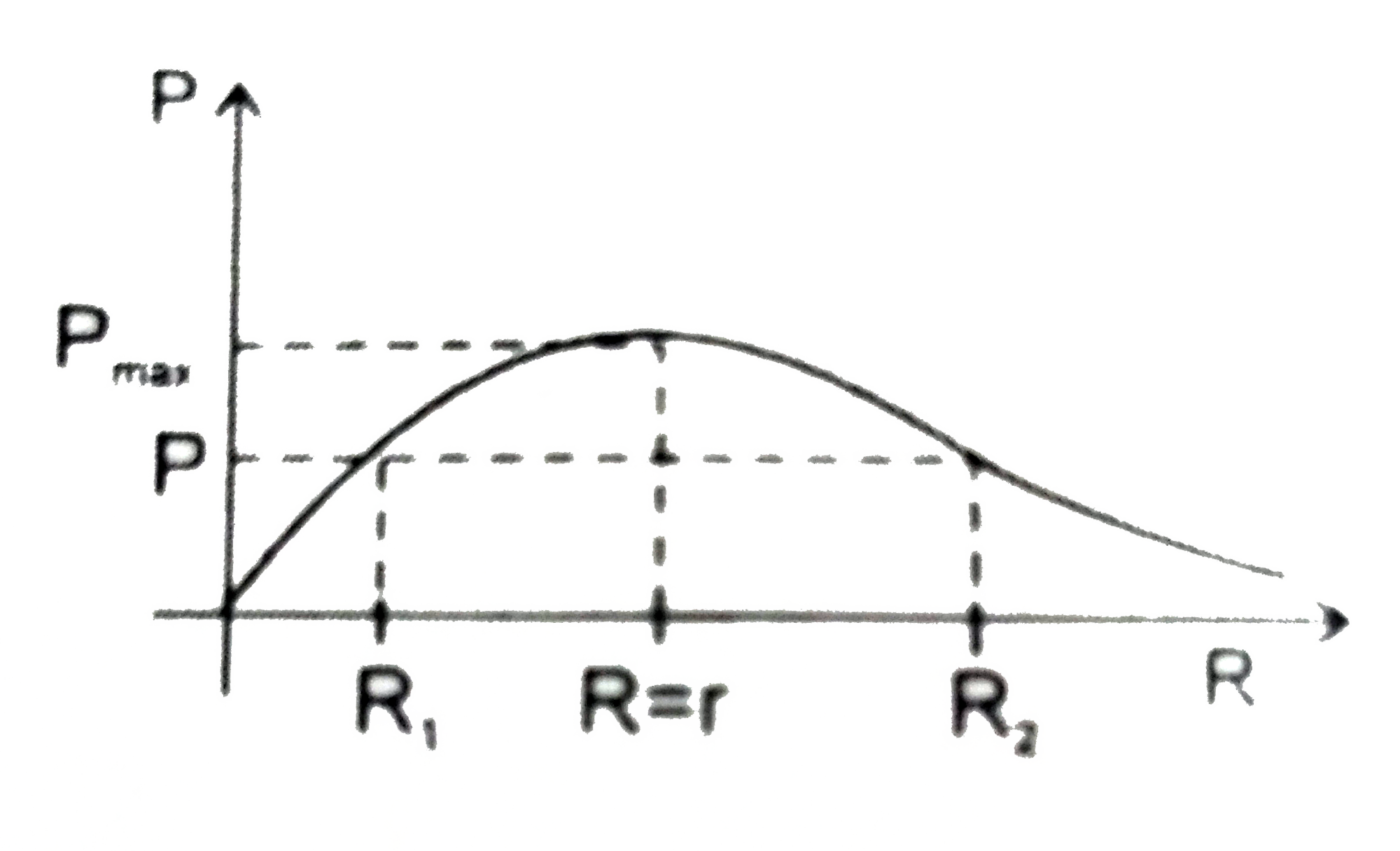
(b) Power output `P=i^(2)R=epsi^(2)/((r+R)^(2))R`
( c) `(dp)/(dR)=epsi^(2)/((r+R)^(2))-(2epsi^(2)R)/((r+R)^(3))[R+r-2R]`

for maximum power supply `(dp)/(dR)=0`
`rArr r+R-2R=0rArrr=R`
Here for maximum power output outer resistance should be equal to internal resistance
(d) `P_("max")=epsi^(2)/(4r)`
( e) Graph between 'P' and R maximum power output at R=r
`P_("max")=epsi^(2)/(4r)rArri=epsi/(r+R)`
(f) Power output `P=(epsi^(3)R)/((r+R)^(2))`
`P(r^(2)+2rR+R^(2))=epsi^(2)R`
`R^(2)+(2r-epsi^(2)/P)R+r^(2)=0`
Above quadratic equation in R has two roots `R_(1)" and "R_(2)` for given values of `epsi,` P and r such that
`thereforeR_(1)R_(2)=r_(2)("product of roots")`
`r^(2)=R_(1)R_(2)`
(g) Power of battery spent `=epsi^(2)/((r+)^(2)),2r=epsi^(3)/(2r)`
Power (output)`=(epsi/(r+r))^(2)xxr=epsi^(2)/(4r)`
`"Efficiency ="("Power output")/("total power by cell")=(epsi^(2)/(4r)xx100)/(epsi^(2)/(2r))=1/2xx100=50%`
Promotional Banner

Topper's Solved these Questions

  • CURRENT ELECTRICITY

    RESONANCE ENGLISH|Exercise Solued miscellaneous Prolblems|8 Videos
  • CURRENT ELECTRICITY

    RESONANCE ENGLISH|Exercise Exercise-1 (Part-1)|41 Videos
  • COMMUNICATION SYSTEMS

    RESONANCE ENGLISH|Exercise Exercise 3|13 Videos
  • DAILY PRACTICE PROBLEM

    RESONANCE ENGLISH|Exercise DPP.No.71|1 Videos

Similar Questions

Explore conceptually related problems

A body of mass 2 kg moving with a velocity of 3 m/sec collides head on with a body of mass 1 kg moving in opposite direction with a velocity of 4 m/sec. After collision, two bodies stick together and move with a common velocity which in m/sec is equal to

A body of mass 10 kg moving with speed of 3 ms ^(-1) collides with another stationary body of mass 5 kg As a result, the two bodies stick togethre. The KE of composite mass will be

A body of mass 4 kg moving with velocity 12 m//s collides with another body of mass 6 kg at rest. If two bodies stick together after collision , then the loss of kinetic energy of system is

A body of mass 4 kg moving with velocity 12 m//s collides with another body of mass 6 kg at rest. If two bodies stick together after collision , then the loss of kinetic energy of system is

A body of mass 3 kg moving with a velocity of 4 m//s towards left collides head on with a body of mass 4 kg moving in opposite direction with a velocity of 3 m//s . After collision the two bodies stick together and move with a common velocity which is

A ball weighing 4 kg and moving with velocity of 8 m/sec. Collides with a stationary ball of mass 12 kg. After the collision, the two balls move together. The final velocity is

A body of mass m_(1) moving with a velocity 3 m//s collides with another body at rest of m_(2) . After collision the velocities of the two bodies are 2 m//s and 5 m//s , respectively , along the direction of motion of m_(1) . The ratio m_(1)//m_(2) is

A body of mass m moving with velocity 3km//h collides with a body of mass 2m at rest. Now, the combined mass starts to move with a velocity

A ball of mass 1 kg moving with a velocity of "0.4 ms"^(-1) collides with another stationary ball. After the collision, the first ball moves with a velocity of 0.3ms^(1) in a direction making an angle of 90^(@) with its initial direction. The momentum of the second ball after the collision will be (in kg ms^(-1) )

A body of mass m moving with a constant velocity collides head on with another stationary body of same mass if the coefficient of restitution between the bodies is (1)/(2) then ratio of velocities of two bodies after collision with be

RESONANCE ENGLISH-CURRENT ELECTRICITY-High Level Problems (HIP)
  1. A body of mass 10 kg and velocity 10 m/s collides with a stationary bo...

    Text Solution

    |

  2. A galvanometer having 30 divisions has a current sensitivity of 20 mu ...

    Text Solution

    |

  3. A 100 V voltmeter of internal resistance 20 kOmega in series with a hi...

    Text Solution

    |

  4. A perosn decides to use his bath tub water to generate electric power ...

    Text Solution

    |

  5. A cell of emf 3.4 V and internal resistance 3 Omega is connected to an...

    Text Solution

    |

  6. When a cell is conneted in a circuit, a current 1(1) flows in the circ...

    Text Solution

    |

  7. A battery is made by joining m rows of identical cells in parallel. Ea...

    Text Solution

    |

  8. In the circuit shown in figure, all wires have equal resistance r. Fin...

    Text Solution

    |

  9. A galvanometer having a coil resistance of 100 Omega gives a full scal...

    Text Solution

    |

  10. A 6V battery of negligible internasl resistance is connected across a ...

    Text Solution

    |

  11. The emf (epsilon)and the internal resistance r of the battery shown in...

    Text Solution

    |

  12. Consider an infinite ladder of network shown In fig 5.223. A voltage i...

    Text Solution

    |

  13. Find the resistance R(AB) of the frame made of a thin wire. Assume tha...

    Text Solution

    |

  14. A nichrome wire uniform cross-sectional area is bent to form a rectang...

    Text Solution

    |

  15. A thin uniform wire AB of length 1 m, an unknown resistance X, and a r...

    Text Solution

    |

  16. A thin wire of length L and cross-sectional area A oriented in the x-d...

    Text Solution

    |

  17. A galvanometer vaving 50 divisions provided with a variable shunt S is...

    Text Solution

    |

  18. Standard rating of each bulb is P, V. If total power consumption by co...

    Text Solution

    |

  19. If the reading of ammeter A(1)in figure is 2.4 A, what will the ammete...

    Text Solution

    |

  20. An ideal cell having a steady emf of 2 volt is connected across the po...

    Text Solution

    |