Home
Class 12
PHYSICS
A rod of mass m and resistance r is plac...

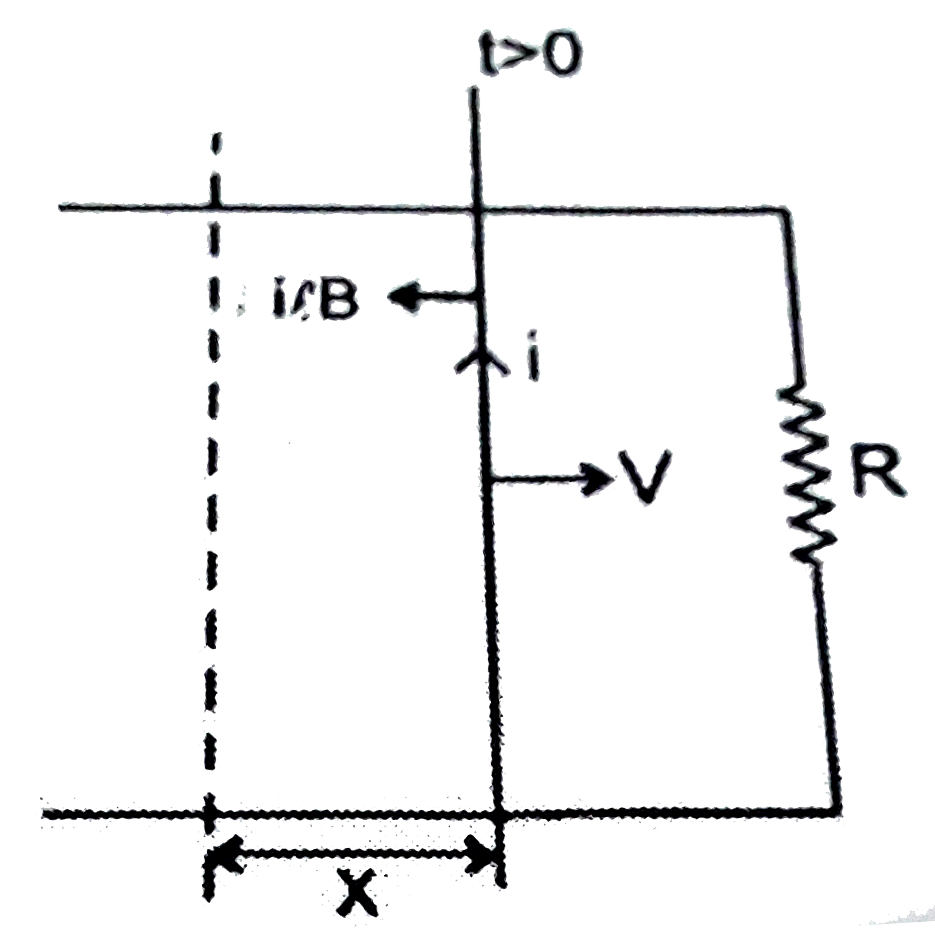
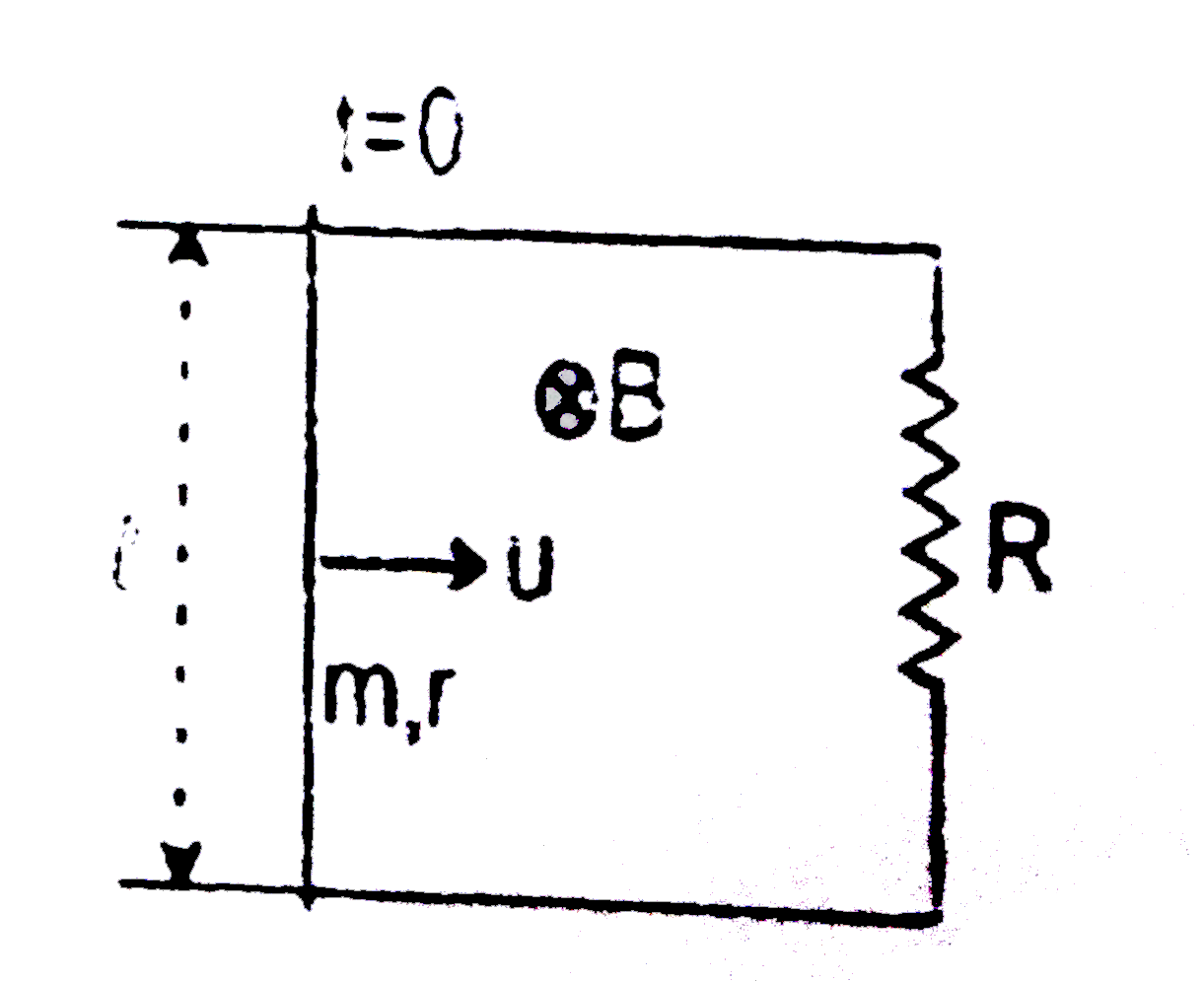
A rod of mass `m` and resistance `r` is placed on fixed, resistanceless, smooth conducting rails (closed by a resistance `R`) and it is projected with an initial velocity `u`.Find its velocity as a function of time.

Text Solution

Verified by Experts
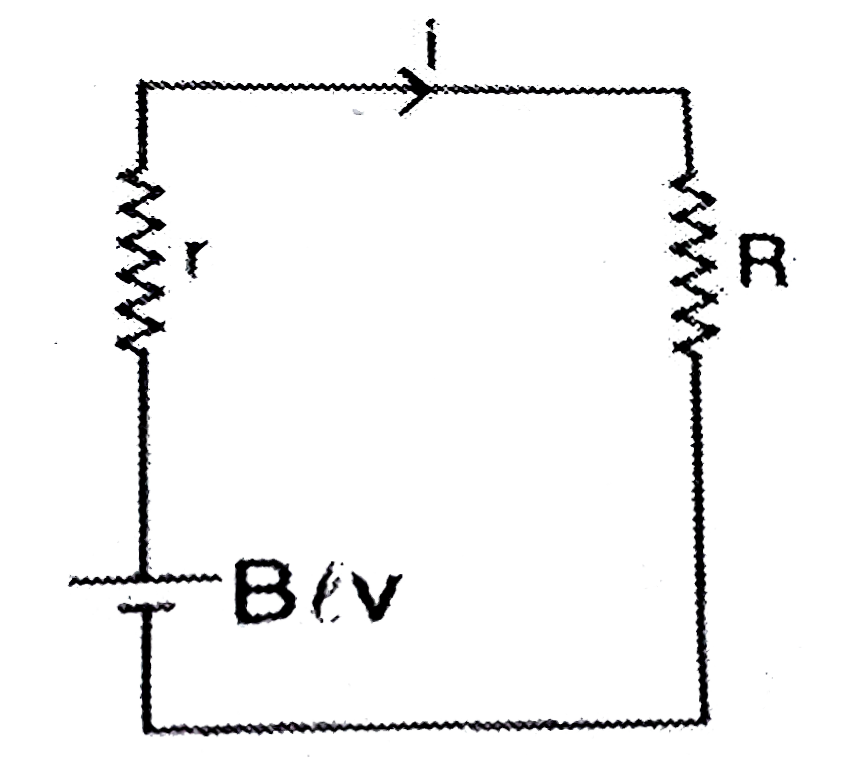
Let at an instant the velocity of the rod be v. The emf induced in the rod will be vBl. The electrically equivalent circuit is shown in the following diagram.

`:.` Current in the circuit `i=(Blv)/(R+r)`
At time t
Magnetic force acting on the rod is F=ilB, opposite to the motion of the rod.

`ilB=-m(dV)/(dt)`.....(1)
`i=(Blv)/(R+r)`....(2)
Now solving these two equation
`(B^(2)l^(2)V)/(R+r)=-m*(dV)/(dt)`
`-(B^(2)l^(2))/((R+r)m)*dt=(dV)/(V)`
let `(B^(2)l^(2))/((R+r)m)=k`
`-K.dt=(dV)/(V)`
`int_(u)^(v)(dV)/(V)=int_(0)^(t)-K.dt`

In `((v)/(u))=-Kt`
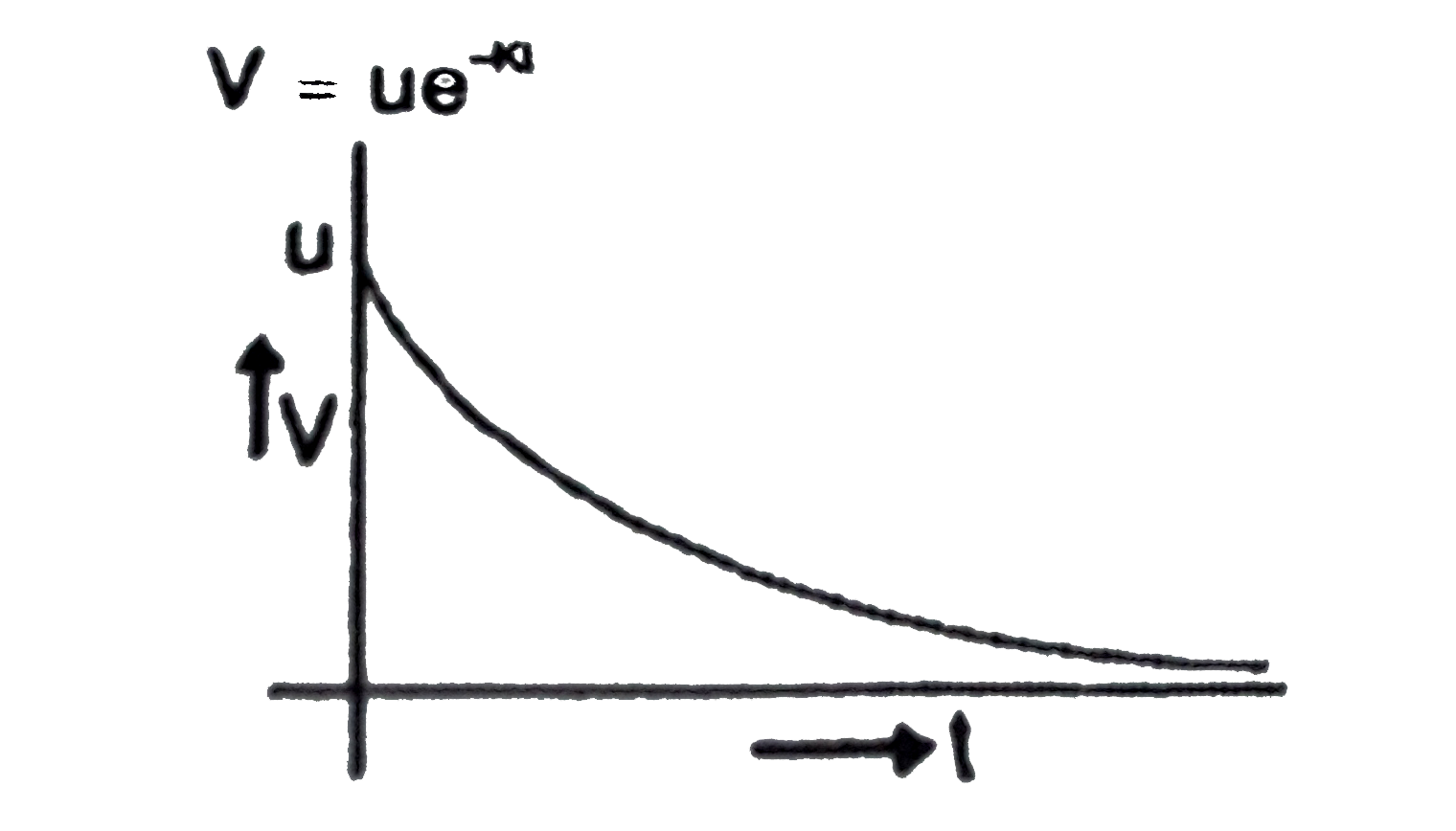
`V=ue^(-Kt)`
Promotional Banner

Similar Questions

Explore conceptually related problems

Shows rod PQ of mass m and resistance r moving on two fixed, resistanceless, smooth conducting rails (closed on both sides by resistances R_(1) and R_(2) ). Find the current in the rod (at the instant its velocity is v ).

Shows rod PQ of mass m and resistance r moving on two fixed, resistanceless, smooth conducting rails (closed on both sides by resistances R_(1) and R_(2) ). Find the current in the rod (at the instant its velocity is v ).

A body is projected with an initial Velocity 20 m/s at 60° to the horizontal. Its velocity after 1 sec is

In the figure shown PQRS is a fixed resistanceless conducting frame in a uniform and constant magnetic field of strength B . A rod EF of mass m length l and resistance R can smoothly move on this frame.A capacitor charged to a potential difference V_(0) initially is connected as shown in the figure.Find the velocity of the rod as function of time t if it is released at t=0 from rest.

A rod of mass m and resistance R slides on frictionless and resistance less rails at distance l apart, that include a source of emf E_0 (see figure). The rod is initially at rest. Find the expression for the a. Velocity of the rod v(t). b. current in the loop i(t).

A block of mass m is attached to a pulley disc of equal mass, radius r by means of a slack string as shown. The pulley is hinged about its centre on a horizontal table and the block is projected with an initial velocity of 5 m//s . Find the velocity when the string becomes taut. .

A conducting rod MN of mass m and length 'l' is placed on parallel smooth conducting rails connected to an uncharged capacitor of capacitance C and a battery of emf epsilon as shown. A uniform magnetic field B is existing perpendicular to the plane of the rails. The steady state velocity acquired by the conducting rod MN after closing switch S is (neglect the resistance of the parallel rails and the conducting rod)

In the figure shown a conducting rod of length l , resistnace R and mass m is moved with a constant velocity v .The magnetic field B varies with time t as B=5 t , where t is time in second.At t=0 the area of the loop containing capacitor and the rod is zero and the capacitor is uncharged.The rod started moving at t=0 on the fixed smooth conducting rails which have negligible resistance.Find (i)The current in the circuit as a function of time t . (ii)If the above system is kept in vertical plane such that the rod can move vertically downward due of gravity and other parts are kept fixed and B =constant = B_(0) .then find the maximum current in the circuit.

A conducting light string is wound on the rim of a metal ring of radius r and mass m . The free end of the string is fixed to the ceiling. A vertical infinite smooth conducting plane is always tangent to the ring as shown in the figure. A uniform magnetic field Bis applied perpendicular to the plane of the ring. The ring is always inside the magnetic field. The plane and the strip are connected by a resistance R . When the ring is released, find a. the curent in the resistance R as as function of time. b. the terminal velocity of the ring.

A wire of length l , mass m and resistance R slides without any friction down the parallel conducting rails of negligible resistance . The rails are connected to each other at the bottom by a resistanceless rail parallel to the wire so that the wire and the rails form a closed rectangualr conducting loop. The plane of the rails makes an angle theta with the horizontal and a uniform vertical magnetic field of the inducetion B exists throughout the rregion. Find the steady state velocity of the wire.