Home
Class 12
PHYSICS
In the following circuit the switch is c...

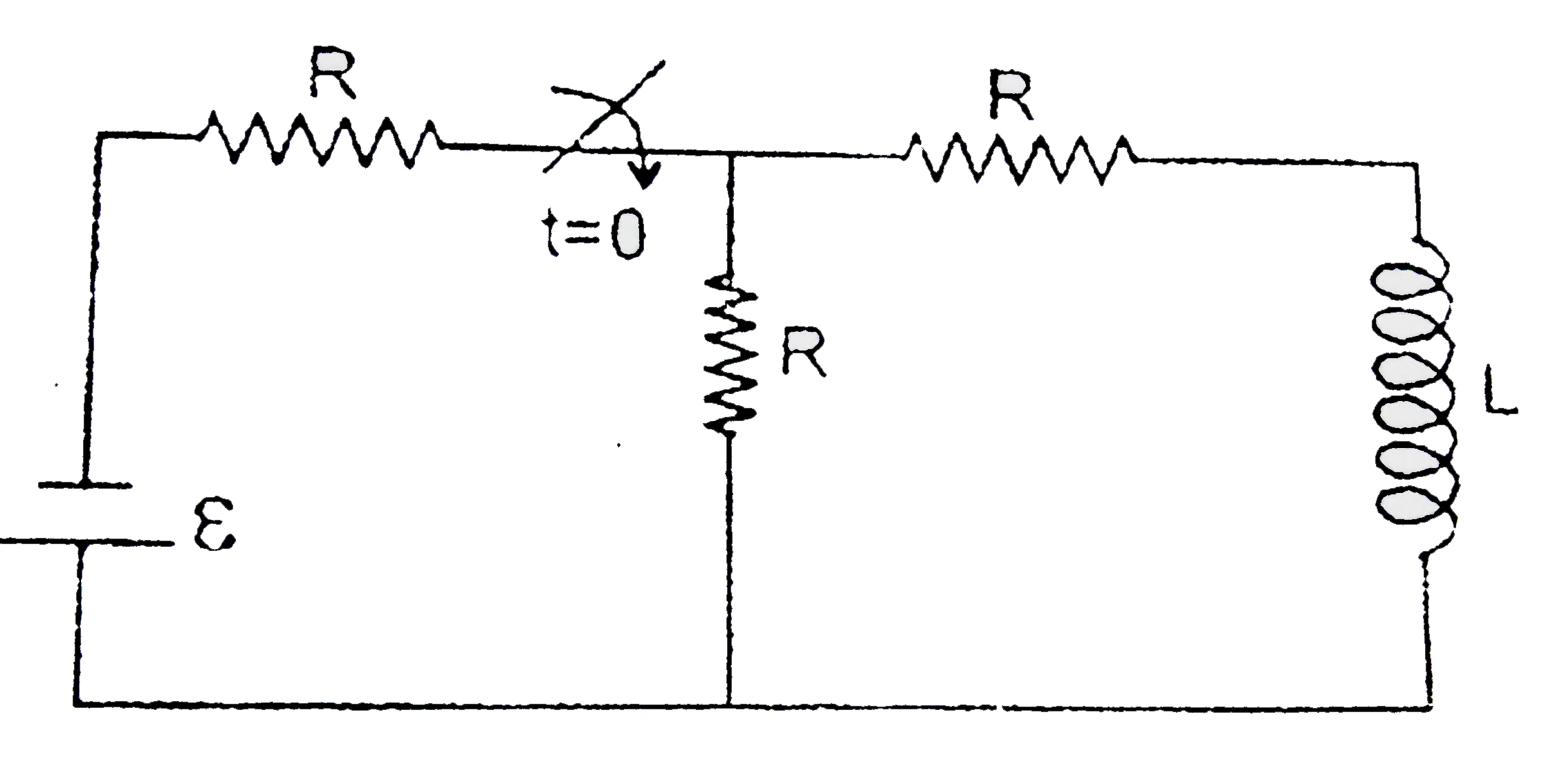
In the following circuit the switch is closed at `t=0`.Intially there is no current in inductor.Find out current the inductor coil as a function of time.

Text Solution

Verified by Experts
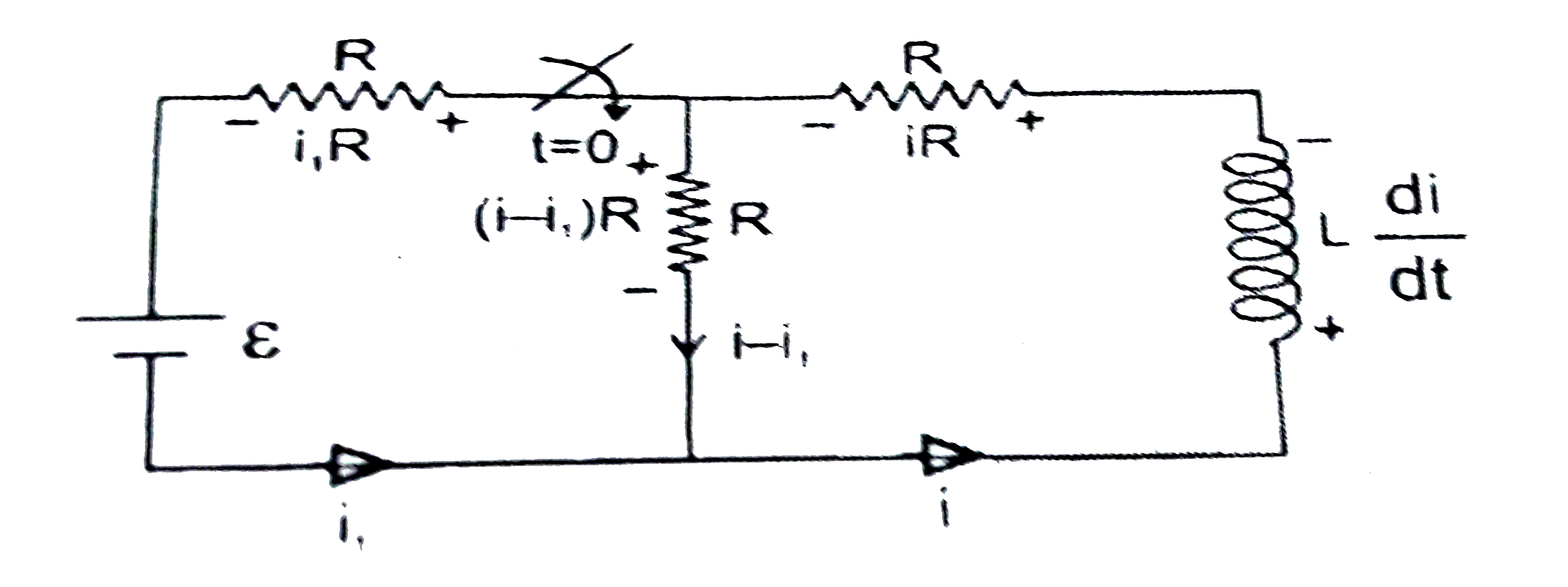

At any time t
`-epsi+i_(1)R-(i-i_(1))R=0`
`-epsi+2i_(1)R-iR=0`
`i_(1)=(iR+epsi)/(2R) " Now," -epsi+i_(1)R+iR+L.(di)/(dt)=0`
`=epsi+((iR+epsi)/(2))+iR+L.(di)/(dt)=0 " " implies =(epsi)/(2)+(3iR)/(2)= -L.(di)/(dt)`
`((-epsi+3iR)/(2))dt=-L.di" "implies-(-dt)/(2L)=(di)/(-epsi+3iR)`
`-int_(0)^(t)(dt)/(2L)=int_(0)^(i)(di)/(-epsi+3iR) " " implies -(t)/(2L)=(1)/(3R)In ((-epsi+3iR)/(-epsi))`
`-In((-epsi+3iR)/(-epsi))=(3Rt)/(2L)" "implies i=+(epsi)/(3R)(1-e^(-(3Rt)/(2L)))`
Promotional Banner

Similar Questions

Explore conceptually related problems

In the following circuit (Fig.)the switch is closed at t = 0 . Intially, there is no current in inductor. Find out the equation of current in the inductor coil as s function of time.

The switch in figure is closed at time t = 0 . Find the current in the inductor and the current through the switch as functions of time thereafter.

In the circuit shown, the switch is closed at t=0 , the currents I_1, I_2 and I_3 are

In the circuit shown, switch S is closed at time t = 0 . Find the current through the inductor as a function of time t .

Consider a L-R circuit shown in figure. There is no current in circuit switch S is closed at t = 0, time instant when current in inductor is equal to current in resistor 2R will be :

The frequency of oscillation of current in the inductor is -

In the circuit arrangement shown in figure, the switch S is closed at t = 0 . Find the current in the inductance as a function of time? Does the current through 10 Omega resistor vary with time or remains constant.

The frequency of oscillation of current in the inductor is:

Switch is closed at t = 0 then the current in the circuit at t = L/2R is

In the following circuit (Fig.) the switch is closed at t = 0 . Find the current i_(1),i_(2),i_(3) and di_(3)//dt at t = 0 and at t = oo . Intitially, all current are zero.

